Margin Required for Option Selling: Limits, Costs and the Hedge Benefit
Quick answer
The margin required for option selling is not a fixed amount. It is SPAN plus Extreme Loss Margin, recalculated by the clearing corporation every session, so the same strike needs a different amount on different days. The only reliable figure is the one your order window returns before you place the trade.
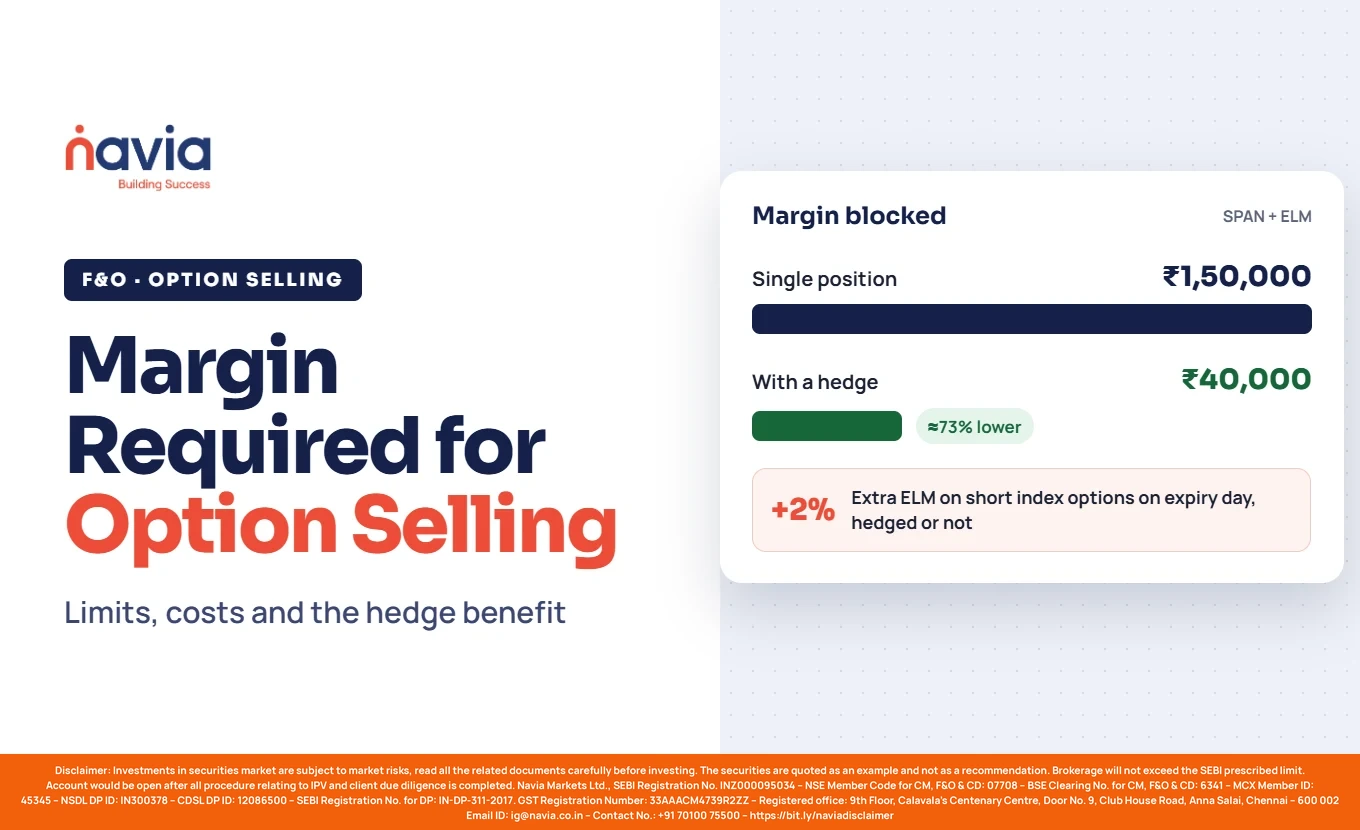
What you can plan around is the structure. A naked short blocks the most. An offsetting position reduces it sharply — in Navia’s own published example, a NIFTY April long blocking ₹1,50,000 falls to ₹40,000 once a May short is added against it.
Key takeaways
- The option seller margin is SPAN plus ELM and is recomputed each session. Treat any fixed rupee figure you read, anywhere, as out of date.
- A hedge is the main way to reduce margin in option selling. Navia’s published example shows a reduction of about 73%.
- Exiting one leg of a hedge removes the benefit immediately and can create a shortfall, a snapshot and a penalty on a position you thought you had reduced.
- Short index options carry an additional 2% Extreme Loss Margin on expiry day, charged on the value of the underlying index rather than on the strike you sold — so it is the same amount whichever strike it is.
- Premium received can fund a same-day option buy in the same segment, but not a fresh short.
How much is the margin required for option selling?
SPAN plus Extreme Loss Margin, as computed for that contract in that session.
That is an unsatisfying answer and it is the correct one. The clearing corporation recalculates through the day and takes a minimum of four random snapshots on the NSE, and seven or eight on the MCX depending on how late the commodity session runs, so the requirement is not fixed even within a single session. Navia collects a minimum of 20% of traded value for intraday equity trades and 100% for delivery, but F&O margin is set by the contract, not by a flat percentage of turnover. Navia pools margin across segments, which changes what is left free rather than what any one position needs (single margin across segments).
Any article quoting a rupee figure for one lot of Nifty was accurate on the day it was written and is not accurate now. Check the order window or a margin calculator before the order.
Why does selling need more margin than buying?
Because the loss on a short option is not capped.
When you buy an option your maximum loss is the premium paid, so that premium is the whole requirement. When you sell one, the position can move against you without a defined limit, so the margin blocked has to cover a severe adverse move rather than a known amount.
This is why option seller margin runs to tens of thousands of rupees per lot while the same contract costs a few hundred to buy. It is also why the amount changes as the underlying moves: the margin is sized against the risk in the position today, not against what you paid for it.
How do you reduce margin in option selling?
Hedge it. An offsetting position in the same underlying reduces net risk, and the margin benefit follows the risk down.
Navia publishes the arithmetic. A NIFTY long position in the April series blocks ₹1,50,000. Adding a NIFTY short in the May series against it brings the requirement to ₹40,000 — a margin offset of roughly 73% on the same capital. This cross margin benefit exists because the two positions cannot both lose at once.
Note what that example is: a position in one series offset against another, which is a calendar spread. It earns the benefit on ordinary trading days. It does not earn it on expiry day, which is covered below.
Navia’s F&O product page carries a second illustration: a two-leg NIFTY bull call spread shown at ₹21,480, described on the page as the real margin with spread benefits applied rather than the sum of the legs. Treat it as an illustration — the legs and pricing in that panel are from an earlier series.
What happens if you exit one leg of a hedge?
The margin benefit disappears the moment the hedge does, and the consequence is not just a higher requirement.
Navia’s example runs it through. Holding the NIFTY April long against the May short, ₹40,000 is blocked. Close the April long and the remaining position is no longer offset: the requirement jumps, the free balance goes negative, and a clearing corporation snapshot taken during that window records the shortfall. The penalty follows even if you close the second leg minutes later, because the snapshot has already captured it.
A recorded shortfall attracts a margin penalty, charged on a slab basis and escalating with repetition within a month.
Which hedges get no margin benefit?
Calendar spreads, on expiry day.
A calendar spread offsets a near-series contract against a far-series one. On an ordinary day it attracts the benefit — that is the ₹1,50,000 to ₹40,000 example above. On the expiry day of the near leg it does not. Navia states that full margins apply on both legs, plus the additional 2%.
The withdrawal of calendar spread benefit on expiry day took effect in February 2025, under SEBI circular SEBI/HO/MRD/TPD-1/P/CIR/2024/132 of 1 October 2024.
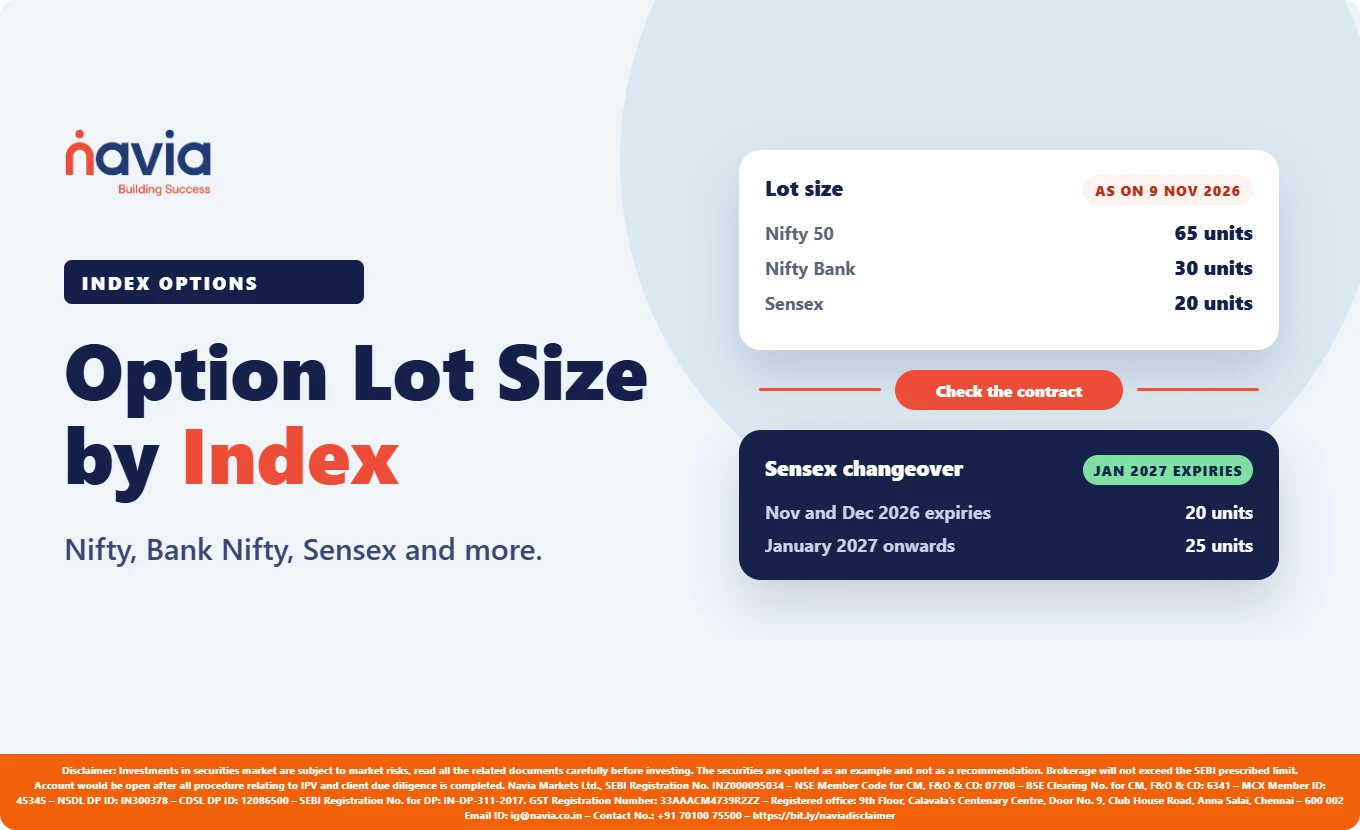
Short index options carry that separate expiry-day charge in any case: an additional Extreme Loss Margin of 2%, in force since 20 November 2024 under the same circular. It is charged on notional value, which NSE Clearing defines for a short option as the value of the underlying index, not the strike you sold. On an illustrative index level of 25,000 and the current Nifty lot of 65, that is ₹32,500 per lot blocked on top of the normal requirement — the same figure whichever strike you sold, because the charge follows the index. It applies to positions opened on expiry day as well as to those carried in, and the circular sets out no exemption for a short leg that sits inside a spread.
So a structure that is margin-efficient all month can become the most expensive position in your book on the one day you were relying on it.
Can you pay option seller margin with shares instead of cash?
Partly. Pledged shares provide collateral margin, but not the whole requirement.
Navia’s policy states that “a cash component requirement of 1:1 will apply.” Its own worked example makes the consequence plain: pledge ₹1,00,000 of stock with no cash in the ledger and, after a haircut, the collateral value is ₹70,000 — but the total usable benefit is nil, because the cash leg has nothing to match. With ₹50,000 of cash alongside the same ₹1,00,000 of stock, the benefit becomes usable.
Timing matters too. Pledge requests submitted before 5 PM are processed the same day and later ones the next; unpledge requests close at 1 PM; and margin against pledged stock starts from the next trading day. Collateral cannot be arranged on the day you want to trade.
How collateral value affects margin availability covers haircuts in detail.
Can you use the premium you received as margin?
Only for a same-day option buy in the same segment. Not for a fresh short.
Navia’s policy is specific. Proceeds from exiting a long option, or from writing a new one, can fund new long option trades in the same segment on the same trading day. They cannot fund a trade in a different segment that day, and they cannot fund a short position at all until the next trading day. The reason is settlement: derivatives settle on T+1, so the premium is not realised on day T, and using it would create a shortfall reported to the exchange.
The same applies to closing a carry-forward long. Navia’s example: an opening balance of ₹10,000, a carry-forward option buy position sold for ₹1,50,000, a balance now showing ₹1,60,000 — and an order for one lot of Bank Nifty options requiring ₹1,38,000 of margin is rejected. The sale value is only released by the exchange on T+1, and margin for a fresh short must be available upfront in clear balance. That ₹1,50,000 could have funded a fresh buy position. It cannot fund a short.
What else can block an option sell order?
Limits that have nothing to do with how much money you hold.
Navia’s risk management policy restricts how far from intrinsic value an option order can be placed:
| Segment | Buy ITM | Buy OTM | Sell ITM | Sell OTM |
|---|---|---|---|---|
| Equity options | up to 10% | up to 15% | up to 10% | up to 20% |
| Commodity options | up to 5% | up to 10% | up to 5% | up to 10% |
These are Navia’s own restrictions, not exchange-wide rules, and they are the reason a strike you can see on the option chain is not necessarily one you can trade. Deep out-of-the-money strikes with thin volume fall outside the band.
Alongside them: F&O profits settle on T+1 as per SEBI regulations and are not available as margin the same day, and the 2% expiry-day ELM applies to every short index option position.
So what can you actually change?
Not the margin. SPAN and Extreme Loss Margin are set by the clearing corporation, identical for the same position at every broker in India. No one can quote you a better number, and anyone who implies otherwise is describing a hedge, not a discount.
What you can change is what it costs to place the order.
An option seller placing 25 orders a day across 20 trading days is 500 orders a month. At ₹20 an order that is ₹10,000 in brokerage plus ₹1,800 of GST — ₹11,800 a month, roughly ₹1.42 lakh a year — before a single rupee of statutory charges. Spreads and hedges make it worse, not better, because every leg is its own order.
At Navia, brokerage on equity F&O is ₹0 for self-directed trades. The statutory charges still apply in full, and no broker can waive those.
And the shortfall described earlier happens because the legs were closed separately. Both legs can be placed and exited together with a basket order, which also carries the hedge benefit into the margin calculation at the point of entry.
A note on risk
Conclusion
There is no single answer to how much margin option selling needs, and anyone who gives you one is quoting a figure that has already moved. What is stable is the shape of it. A naked short blocks the most. An offsetting position cuts it substantially. Exiting one leg undoes that instantly, and the penalty can land before you have finished unwinding. Expiry day adds a charge that no hedge removes.
Check the requirement in the order window or a calculator before you place the order, not after the rejection. And check what each of those orders costs you, because that is the part of the equation you control.
What an expiry-day trade costs once the margin is in place is worked out in full in expiry day trading costs.
Educational content, not investment advice. Figures are illustrative; check the current margin schedule and charges before you trade.
Did you find this article helpful?
Your feedback helps us write better content.

Frequently Asked Questions
What is the option seller margin for one lot of Nifty?
There is no fixed figure. It is SPAN plus Extreme Loss Margin for that contract in that session, and the clearing corporation recomputes it through the day with a minimum of four random snapshots on the NSE. Check the order window or a margin calculator immediately before placing the order.
How do you reduce margin in option selling?
Hedge the position. In Navia’s published example a NIFTY April long blocking ₹1,50,000 falls to ₹40,000 once a May short is added, a reduction of about 73%. A spread cannot lose as much as a naked short, and the margin reflects that.
Does a hedge always give a margin benefit?
No. Calendar spread benefit is not available on expiry day — full margins apply on both legs plus the additional 2%. The 2% expiry-day Extreme Loss Margin on short index options is charged on the value of the underlying index, and the circular sets out no exemption for a short leg that sits inside a spread.
Why did a shortfall and a penalty appear after I closed one leg?
Because the remaining position is no longer offset. The requirement rises immediately, and if a clearing corporation snapshot falls in that window it records the shortfall. Closing the second leg afterwards does not remove the snapshot. Close both legs together, or fund the difference first.
Can I use pledged shares for option selling margin?
Yes, as collateral margin, but a cash component applies at 1:1. In Navia’s example, ₹1,00,000 of pledged stock with no cash gives ₹70,000 of collateral value and no usable benefit. Pledge requests close at 5 PM and margin is available the next trading day.
Can I use the premium I received as margin for another position?
For a same-day option buy in the same segment, yes. For a fresh short, no — margin for a short must be in clear balance, and derivative proceeds are only released on T+1.