What Is a PIS Account and Do NRIs Still Need One?
If you’re an NRI who wants to invest in Indian shares, you’ve probably heard that you “need a PIS account.” For years that was true for nearly every NRI who traded on the stock exchange. The rules have since changed. Many NRIs now invest in India without any PIS account at all, while others still need one to keep their investments fully repatriable.
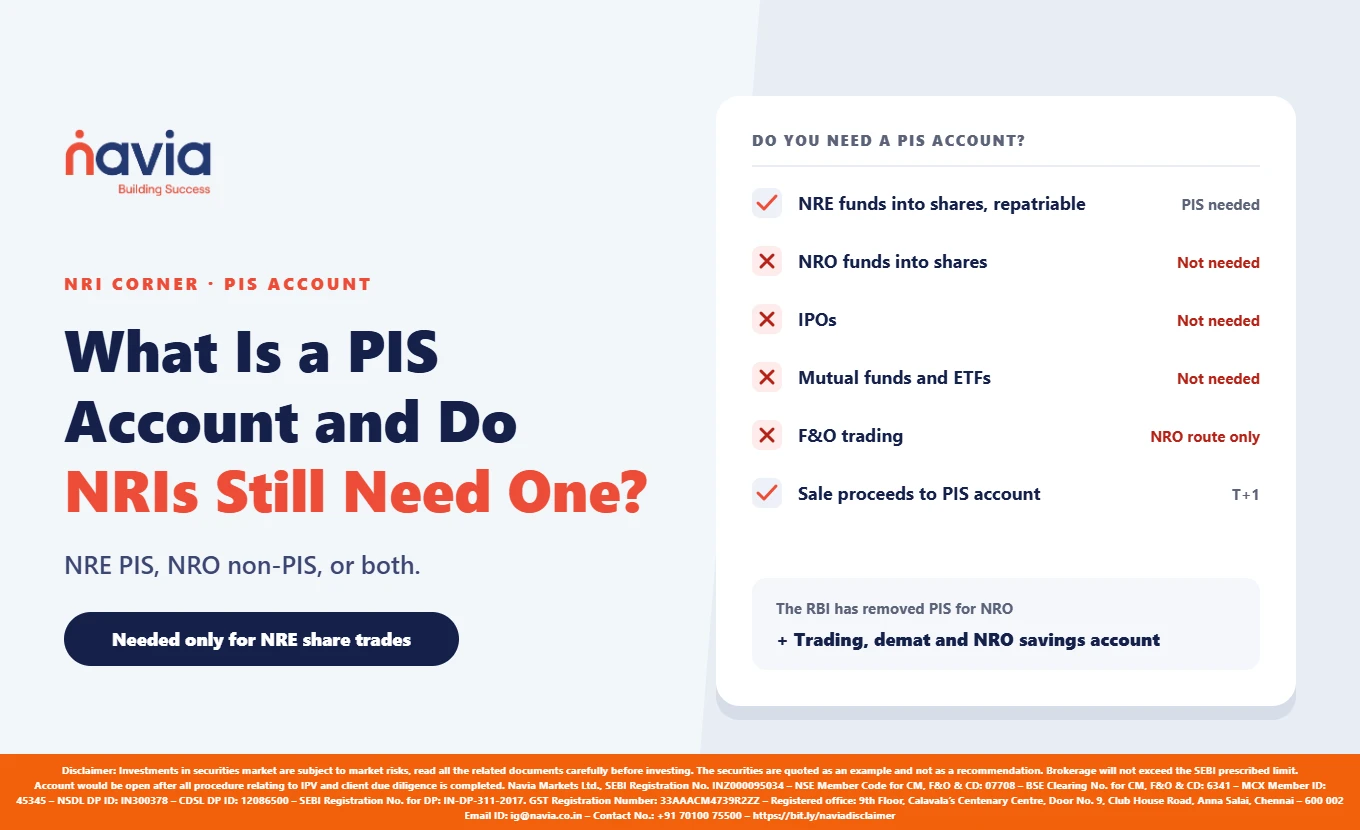
So what is a PIS account, and do you still need one? The short answer: you need a PIS account only if you want to buy and sell shares on the stock exchange using your NRE (repatriable) funds. For NRO investing, IPOs, mutual funds and F&O, you don’t. This article explains how PIS works, who it suits, who can skip it, and how Navia makes PIS trading easier.
Key takeaways
- A PIS (Portfolio Investment Scheme) account is a special NRE bank account used to trade Indian shares on a repatriable basis.
- Your bank reports every PIS trade to the RBI, which tracks NRI shareholding limits in Indian companies.
- The RBI has removed the PIS requirement for NRO accounts, so NRO investing needs only a trading account, a demat account and an NRO savings account.
- You still need PIS if you want to invest your NRE funds in shares and take the full amount, gains included, back abroad.
- IPOs, mutual funds, ETFs, bonds and F&O don’t go through PIS.
What Is a PIS Account?
PIS stands for Portfolio Investment Scheme, a scheme set up by the Reserve Bank of India (RBI) that lets NRIs buy and sell shares and convertible debentures of Indian companies on recognised stock exchanges.
A PIS account is a special bank account, usually an NRE account, opened with an RBI-authorised bank (Authorised Dealer). The bank gives you a PIS permission letter on behalf of the RBI, which you need to buy and sell shares on a repatriable basis. For each NRI, the bank lets you hold only one PIS account at a time.
At Navia, the PIS account is set up at the same time as your NRE trading and demat account, so all three work together from day one.
How a PIS Account Works
A PIS account is your settlement account for NRE equity trades. Here’s what happens behind the scenes:
Why do sale proceeds sometimes get delayed?
Your bank needs the purchase records of the shares you sell. If it doesn’t have them, for example because the shares weren’t bought through PIS, it can’t credit the proceeds. Navia’s NRI desk sorts out these cases with the bank, including a separate process for crediting non-PIS sale proceeds to an NRE savings account.
What Changed: PIS Is No Longer Needed for NRO
Earlier, NRIs needed a PIS bank account for both NRE and NRO stock market investing. The RBI has since removed the PIS requirement for NRO accounts.
Today, to invest in NRO (non-repatriable) mode, all you need is:
- A trading account with Navia
- A demat account with Navia
- A regular NRO savings bank account with any bank in India. If you don’t have one, Navia can help you open it.
This is the main reason many NRIs now say they “don’t need PIS”: they invest from NRO funds, which are often income earned in India, such as rent, dividends or pension.
So, Do NRIs Still Need a PIS Account?
It depends on where your money comes from and where you want it to end up.
| Your situation | Need PIS? | Why |
|---|---|---|
| You want to invest foreign earnings (NRE funds) in Indian shares and take everything back abroad | Yes | Repatriable secondary-market equity trades must go through PIS. |
| You want to invest Indian income (NRO funds) in shares | No | The RBI has removed PIS for NRO investing. |
| You want to trade Futures & Options | No | F&O is open to NRIs only through the NRO route. |
| You want to apply for IPOs | No | IPO applications don’t go through PIS. |
| You want to invest in mutual funds or bonds | No | These aren’t covered by PIS. |
| You already hold shares bought as a resident | No | Convert the account to NRI status. Selling these shares is treated as a non-PIS transaction. |
Why Would an NRI Open a PIS Account?
1. Full repatriation of capital and gains
This is the biggest reason. Investments made through NRE PIS are fully repatriable. You can send both your original investment and your profits back to your country of residence, with no USD 1 million yearly cap like the one on NRO repatriation.
2. Investing foreign earnings in India
If your salary or savings are abroad and you send them to India through your NRE account, PIS is how you put that money into Indian shares while keeping it repatriable.
3. Tax-free NRE balance
Interest on NRE savings balances is tax-free in India. Unspent funds in your NRE account between trades keep that benefit, while gains on shares are taxed as capital gains.
4. Clear RBI-reported records
Every PIS trade is reported to the RBI through your bank. This gives you a clean, regulated record of each investment, which helps when you repatriate funds or file taxes.
5. Long-term equity investing in India
For NRIs who want to build a long-term portfolio of Indian shares and may eventually move the money abroad, NRE PIS is the most flexible route for equity delivery investing.
Transactions That Can’t Be Funded From a PIS Account
A PIS account is only for buying and selling equity shares on the stock exchange. These transactions have to be funded from your non-PIS NRE or NRO savings bank account:
- IPO applications
- Mutual fund investments
- Eligible ETFs
- Bonds
- Payments for exercising ESOPs
- Payments for promoter shareholding
- Non-brokerage charges such as demat charges
Navia’s NRI desk helps NRE PIS clients keep the right balance in the right account, so IPO bids, mutual fund SIPs and ETF purchases aren’t rejected for lack of funds.
PIS vs Non-PIS at a Glance
| Basis | NRE PIS | NRO Non-PIS |
|---|---|---|
| Source of funds | Foreign earnings (NRE) | Indian income (NRO) |
| Repatriation | Fully repatriable | Up to USD 1 million per financial year, subject to conditions |
| RBI reporting | Every trade reported through the bank | Not required |
| Bank charges | PIS transaction charges set by the bank | No PIS charges |
| F&O trading | Not allowed | Allowed |
| Who deducts tax | Your PIS bank | Navia, as your broker |
| Best for | Long-term equity investing with repatriation | Investing Indian income, F&O, lower costs |
For a detailed comparison, read our guide on the difference between PIS and Non-PIS accounts.
How to Open an NRE PIS Account with Navia
Want both routes? Many NRIs open both NRE PIS and NRO non-PIS accounts with Navia: NRE for repatriable long-term investing, and NRO for F&O and investing Indian income.
Navia’s PIS Services
PIS trading involves three parties working together: your broker, your bank and the RBI. When one link breaks, your sale proceeds get stuck. Navia’s NRI support covers the whole PIS process:
- A dedicated NRI desk with one-to-one support across time zones, from choosing between NRE and NRO to account activation.
- Help opening your PIS bank account with Axis Bank, HDFC Bank or IDFC First Bank, alongside your Navia trading and demat account.
- Reporting of every PIS trade by Navia to your bank, so the RBI’s records stay accurate.
- Sale-proceeds tracking: if proceeds aren’t credited on T+1, our team works with your bank to fix missing purchase records.
- Crediting non-PIS sale proceeds to an NRE account, with a separate process guide for shares that weren’t bought through PIS.
- Fund planning for PIS clients, so IPOs, mutual funds and ETFs are funded from the right savings account.
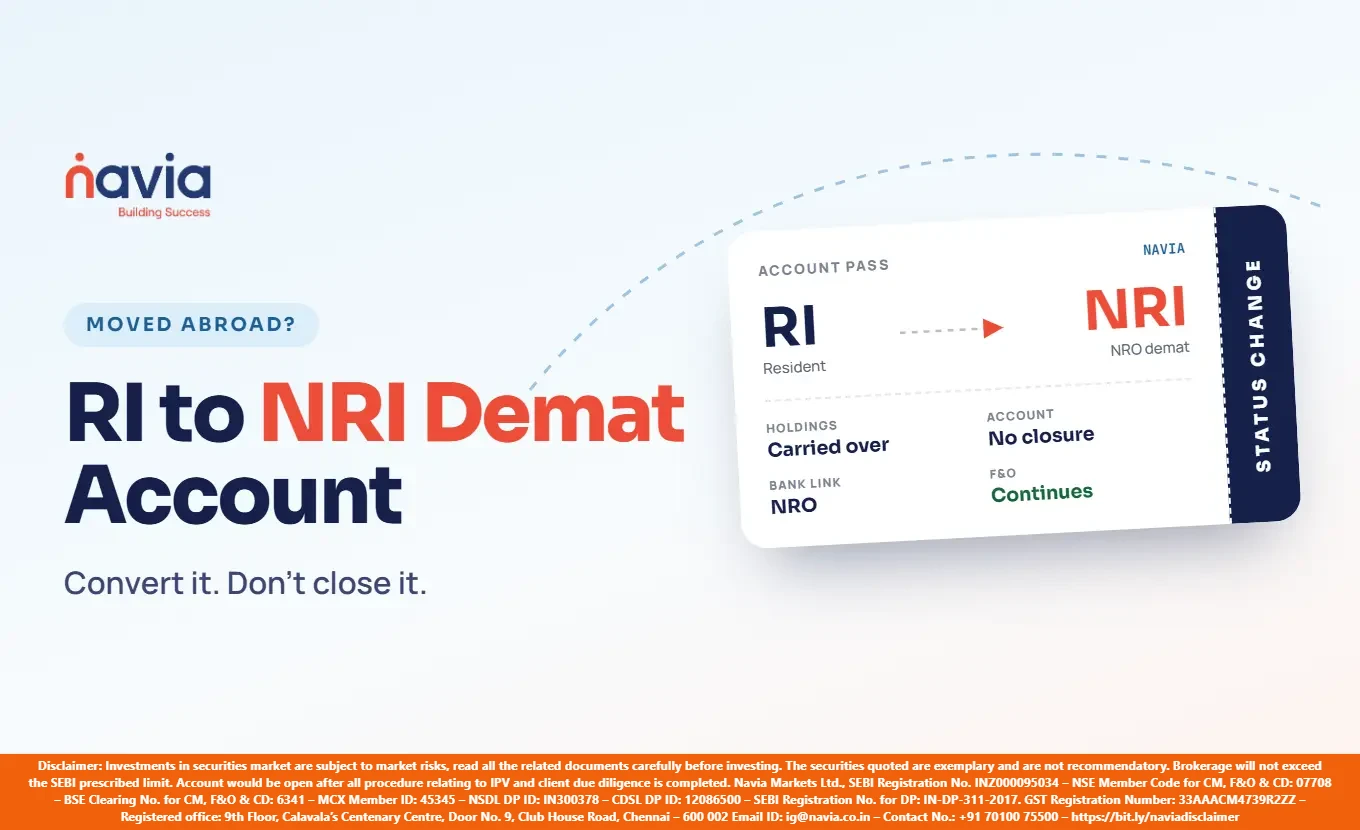
- Converting resident accounts to NRI status without closing your existing account or moving your holdings.
- Clear guidance on tax and charges: who deducts TDS (the PIS bank for NRE, Navia for NRO) and what PIS transaction charges your bank applies.
- F&O through the NRO route, activated within one working day of receiving your request and documents.
- A detailed help centre on the Navia Support Portal, with step-by-step NRI guides.
Conclusion
A PIS account is still the right choice for NRIs who want to invest foreign earnings in Indian shares and take everything back abroad. It’s no longer the only way to invest in India. With the RBI removing PIS for NRO accounts, NRIs can trade shares and F&O and invest Indian income through a simpler, lower-cost non-PIS route. The best setup for many NRIs is to use both. Whichever route you choose, Navia’s NRI desk handles the bank coordination, RBI reporting and sale-proceeds follow-up for you.
Did you find this article helpful?
Your feedback helps us write better content.

Frequently Asked Questions
What is a PIS account?
A PIS (Portfolio Investment Scheme) account is a special NRE bank account, opened with an RBI-authorised bank, that NRIs use to buy and sell Indian shares on the stock exchange on a repatriable basis. The bank reports every trade to the RBI.
Is a PIS account mandatory for NRIs?
Only if you want to trade equity shares on the stock exchange in NRE (repatriable) mode. It isn’t needed for NRO investing, IPOs, mutual funds or F&O.
Do I need a PIS account for NRO investments?
No. The RBI has removed the PIS requirement for NRO accounts. A trading account, a demat account and a regular NRO savings bank account are enough.
Can I trade F&O with a PIS account?
No. NRIs can trade Futures and Options only through the NRO (non-PIS) route.
Can I have more than one PIS account?
No. An NRI can hold only one PIS account at a time for buying and selling shares on the stock exchange.
When will I receive my sale proceeds?
Sale proceeds are credited to your PIS bank account on the T+1 working day, provided the bank has the purchase details of the shares you sold.
Who deducts tax on PIS transactions?
For NRE PIS trades, the bank that holds your PIS account deducts the applicable tax at source. For NRO non-PIS trades, Navia deducts it.
Are there extra charges for a PIS account?
Yes. Banks charge a PIS transaction fee, which varies by bank. Check the NRI section of your bank’s website for current rates, and see Navia’s NRI charges page for broker fees.
Disclaimer: This article is for general information only and isn’t legal, tax or investment advice. PIS, repatriation and tax rules are set by the RBI, SEBI and Indian tax authorities and can change. Bank charges and processes vary by bank. Please contact Navia or consult a qualified professional for advice specific to your situation. Investments in securities markets are subject to market risks. Read all related documents carefully before investing. Full disclaimer: https://bit.ly/naviadisclaimer