Most trading platforms give every user the same screen. Navia's web trading platform adapts instead — seven purpose-built workspaces, switchable in one click, each with its own tools and its own guardrails.
Analytics and guardrails built into the workspaces themselves. Tap any point to see it.
Each workspace has different default behavior, different information surfaced, different quick-actions — and where the risk is highest, different, genuinely enforced guardrails.
The complete platform — watchlists, order management, positions, holdings, option chain, Strategy Builder and basket orders, plus the IV Smile and the guided Easy Options wizard. Best for traders who want the full toolkit.
One-tap Quick Buy with a live position badge, one-click close/reverse, a dedicated mini chart beside the chain, and an always-visible session P&L — backed by an enforced session loss limit.
Set a session budget, an underlying and a direction — the chain auto-filters to genuinely out-of-the-money strikes, with max loss and time-decay shown on every buy button.
A live countdown to exact settlement, a mandatory risk acknowledgment, an enforced session loss limit, and a chain that defaults right at the money — where the swings this workspace exists for are sharpest.
Trade directly on the chart — tap a point to place an order, drag and drop to modify it instantly, and square off or reverse a position in one tap. Live P&L tracks right alongside price action.
Energy, Bullion and Metal watchlists auto-populated with live futures contracts, real contract specs, and delivery-window warnings for physically-settled contracts.
NIFTY and SENSEX on one screen — the option chain is the watchlist, grouped by strike, with the Future charted beside its ATM Call and Put and drag-and-drop order placement on any pane.
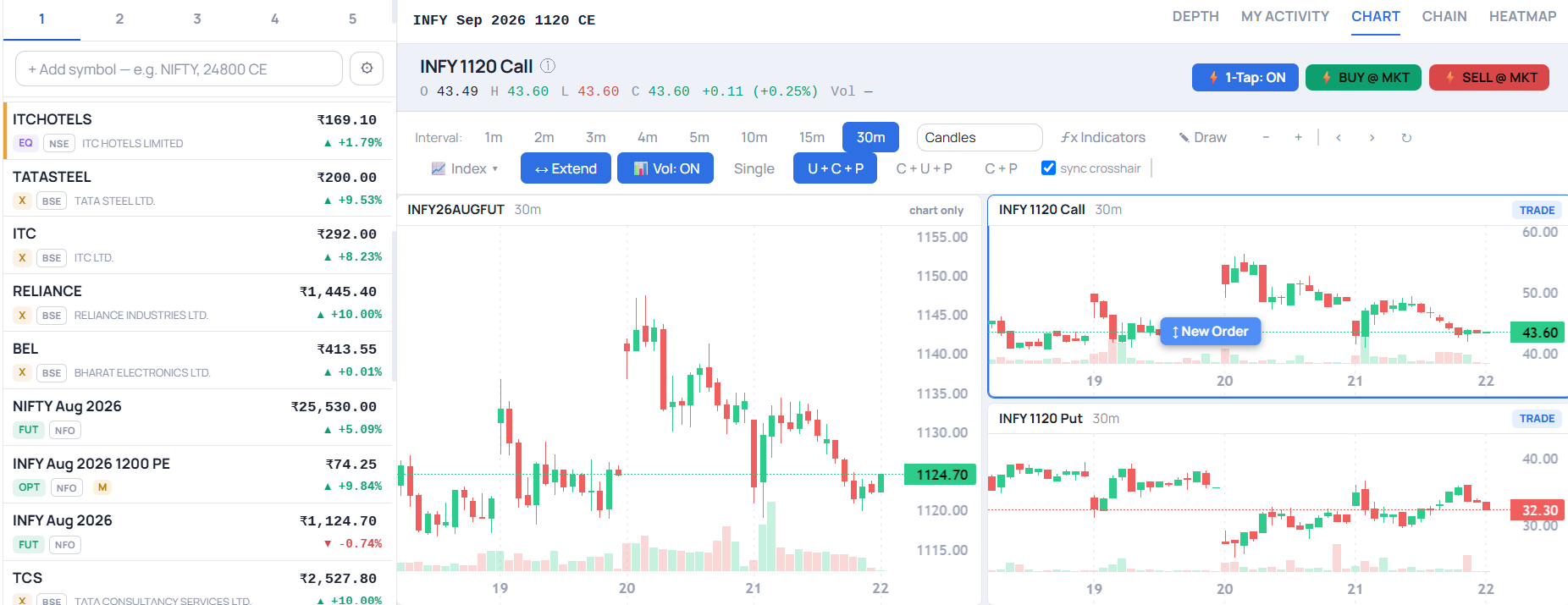
Five switchable watchlists on the left — equities, futures and options together, with colour-coded exchange and segment tags — and the charting surface on the right: the underlying future beside its Call and Put on a shared crosshair, a draggable New Order handle live on the chart, 1-Tap trading with BUY @ MKT and SELL @ MKT in the header, and DEPTH / CHAIN / HEATMAP a single tab away.
Analysis and execution built into the workspaces themselves — and the analytical tools all share one consistent calculation engine, not several different approximations scattered across the platform.
Implied volatility across the whole option chain, strike by strike — with a plain-English read on which side is pricing in more risk, framed as a snapshot, not a forecast.
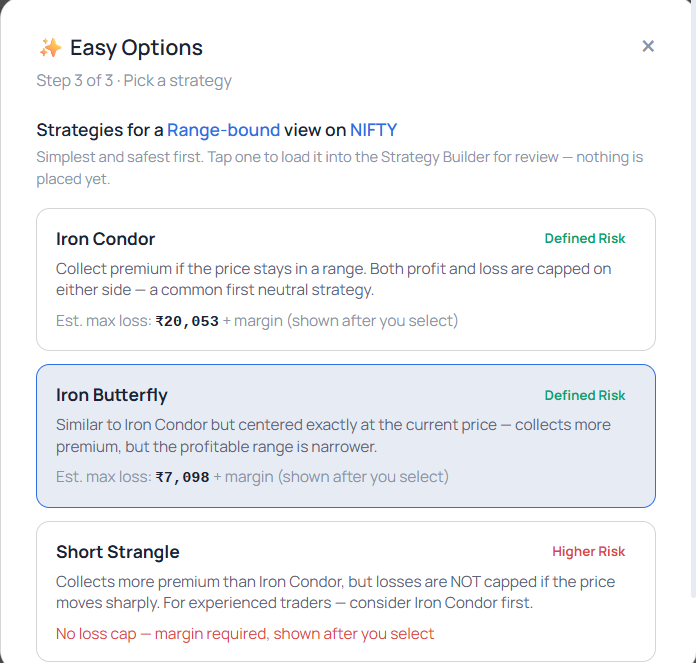
Build multi-leg positions leg by leg or from a template library. The "Easy Options" flow turns a market view into a matched shortlist, margin estimate included.
For any multi-leg strategy, chart the position's own total premium overlaid on the underlying — see how the whole structure has actually priced against the market, not a theoretical payoff line.
Live Delta, Gamma, Theta, Vega and IV for every contract, computed from real-time prices. One click swaps the chain between Open Interest and Greeks.
Enter what you're willing to risk and your stop level; it calculates the maximum quantity that stays in budget, rounded to a whole lot.
The same fast order flow in every workspace, with extra context — like the contract spec panel or the sizing calculator — layered in only where relevant.
In Chart Trader, drag a handle to any price to place an order, drag its line to re-price it, and close or reverse a position from the line itself — live P&L alongside price, no ticket needed.
1, 2 or 4 synced panes with independent intervals — or the underlying charted beside its ATM Call and Put with a shared crosshair, so one price move reads across all three at once.
Assemble several orders — or a whole multi-leg strategy — and fire them together in one go, with a combined margin estimate before you commit.
Call and Put OI side by side on the chain, with Max Pain and OI-resistance markers plus a PCR read — the positioning picture, without leaving the strike you're looking at.
Attach a stop loss, a trailing stop and a target to a single order — each shown in both percentage and rupee terms, so the risk is stated before you place it.
Square Off All and Cancel All sit in the top bar of every workspace — one tap to flatten every open position or pull every pending order at once.
Before you commit, see what the premium does: enter a move in the underlying and get projected premiums for a move down, flat and up — with the option to include the next hour's time decay. Especially useful for OTM buyers judging whether a strike can actually get there.
Ready-made lists you can load in a tap — NIFTY, BANKNIFTY, FINNIFTY, ETFs, sector baskets, and for commodities the Energy, Bullion and Metal segments, each auto-populated with the currently active contracts so nothing goes stale as they roll over.
Options group by strike so the Call and Put of the same strike sit together as one row, with exchange and segment tags colour-coded at a glance — up to five watchlists, each holding as many as thirty instruments.
More information and more friction before risk is taken — built directly into the workspaces where it matters most.
Set your own maximum acceptable loss once. When it's reached, new buy orders are genuinely blocked — continuing requires typing a full confirmation word, not a single tap. Closing or reducing positions is always still allowed.
Before your first session in Expiry Trader, a short, specific explanation of why last-hour options behave the way they do — with active confirmation required to continue.
OTM Trader runs entirely on a budget you set upfront. Contracts that don't fit are labeled, not hidden, and every buy button shows maximum possible loss before you place the order.
Physically-settled commodity contracts nearing delivery are flagged directly, and thin option strikes carry a warning that the last-traded price may not reflect your actual fill.
These features give traders more information and more control before a trade is placed. They describe what the platform does — not a promise about trading outcomes.
Live, real-time updates throughout — positions, watchlists, option chains and P&L, all from a live feed.
Instant workspace switching from a single rail — badges, filters and defaults reconfigure automatically.
Inline quick-actions on every watchlist row — chart, option chain or a quick buy/sell, without leaving the list.
Readable Indian numbering — lakh/crore notation with hover detail, not long-form figures.
Guest/demo mode with realistic sample data — explore the real interface before creating an account.
PIN lock & auto-lock for securing the platform on a shared or mobile device.
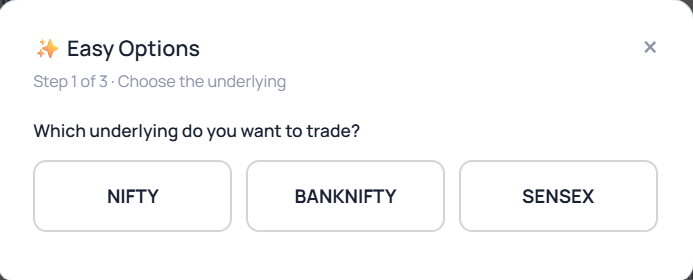
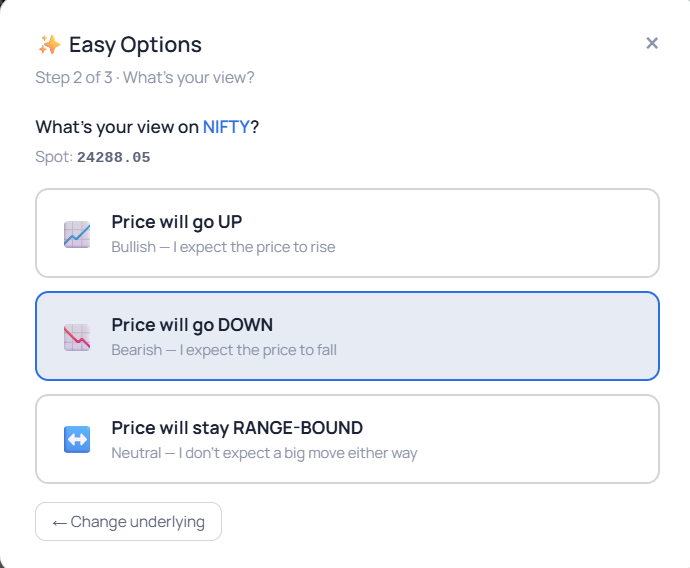
Not sure where to start with options? Pick your underlying, say what you expect the price to do, and get a curated shortlist of strategies matched to that view — with an upfront max-loss estimate before you commit to anything.
Each workspace has different default behavior, different information surfaced, different quick-actions, and — in the highest-risk workspaces — genuinely enforced guardrails. It's not a visual skin; the underlying logic changes.
Yes — workspace switching is instant and only changes what's shown and how it's organized. Your positions, orders and holdings are the same account, visible from every workspace.
In the Scalper and Expiry Trader workspaces, once your set limit is reached, new buy orders are genuinely blocked. Continuing requires typing a full confirmation word. You can always still close or reduce existing positions.
No — it's explicitly framed as a snapshot of implied volatility across the chain right now, not a forecast. The skew moves through the session, especially in the final hour before expiry.
Yes — guest/demo mode has realistic, fully-populated sample data (positions, holdings, a watchlist, order history) so you can explore the real interface with no real money and no commitment.
It's organized around MCX segments — Energy, Bullion and Metal — with live futures contracts, real contract specs, and delivery-window warnings specific to physically-settled commodity contracts.
Explore all seven workspaces on Navia Pro Web — or try the guest demo first, no account needed.