

DP Charges: What Changes When You Sell Over ₹1 Lakh
Quick answer
DP charges are demat debit transaction charges — a fee levied each time shares are debited from your demat account for a sale. At Navia the tariff is 0.03% of the sale value per scrip, subject to a minimum of ₹30 and a maximum of ₹300, plus GST (Navia pricing).
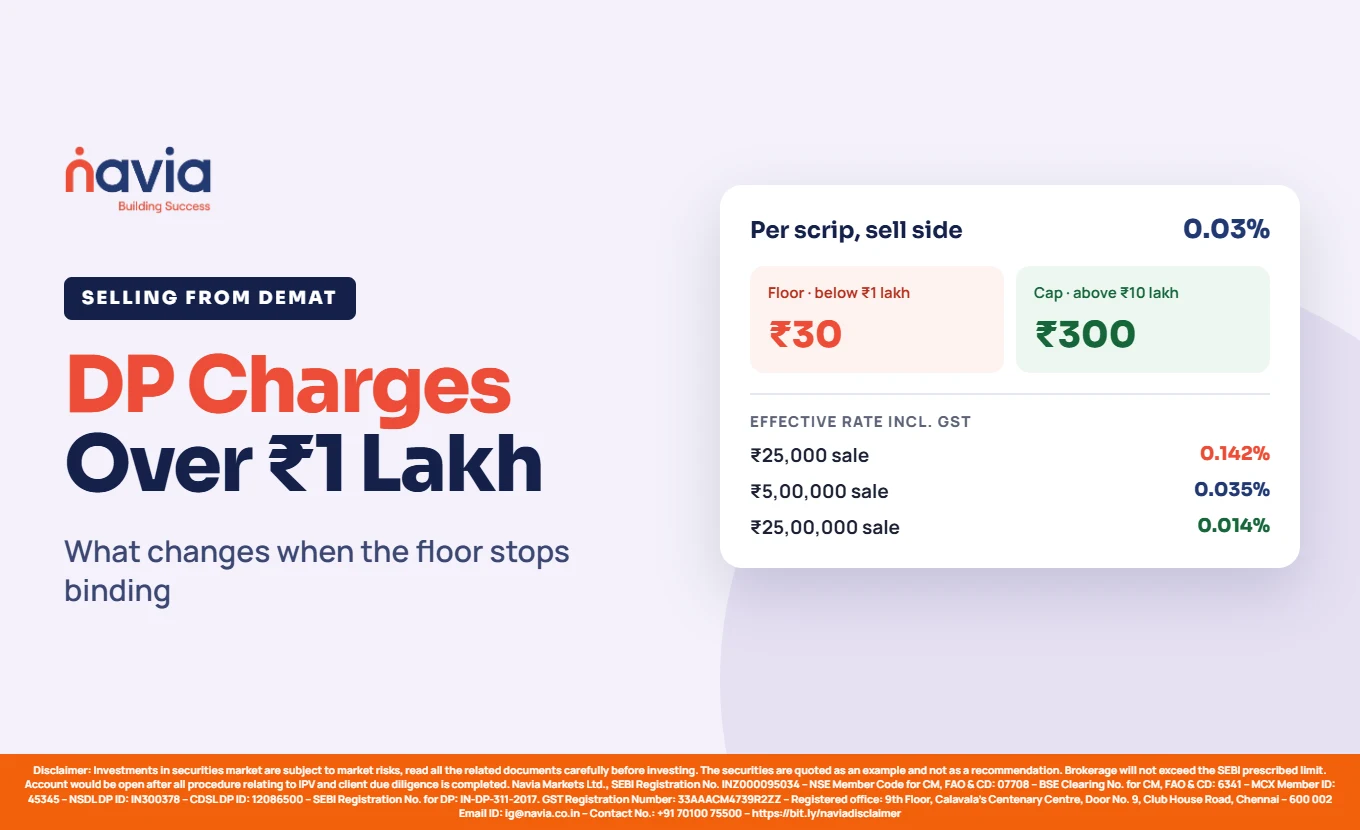
What the headline rate hides is that it only applies in the middle. Below a sale of ₹1,00,000 the ₹30 floor binds, so a ₹25,000 sale costs ₹35.40 with GST — an effective rate of 0.14%, nearly five times the 0.03% quoted. Above ₹10,00,000 the ₹300 cap binds and the effective rate falls the other way.
Key takeaways
- DP charges apply only when you sell from demat. Nothing is charged on a purchase, and DP charges on intraday trades do not arise at all, because an intraday position never debits your demat account.
- At Navia, below a ₹1,00,000 sale you pay the ₹30 floor, not 0.03%. The smaller the sale, the higher the effective rate.
- Between ₹1,00,000 and ₹10,00,000 you pay a flat 0.0354% including GST.
- The charge is per scrip, not per order. Selling three different stocks on one day costs three times as much as selling one.
- GST at 18% applies on top of the charge in every band.
What are DP charges, and who levies them?
A fee for taking shares out, not for trading them.
DP charges are what your depository participant bills you for moving securities out of your demat account. Navia is the depository participant; the depositories themselves are NSDL and CDSL, and they charge the DP their own per-debit fee, which the DP tariff then covers. Both publish their schedules openly — see the CDSL DP tariff structure and NSDL fees and charges to depository participants.
That two-layer structure is why DP charges differ between brokers while statutory charges do not. STT is set by law and identical everywhere; the DP charge is a commercial tariff each broker sets for itself. The full STT rate table by segment covers the statutory side.
What are the DP charges on selling shares at Navia?
0.03% per scrip, sell side only, floored at ₹30 and capped at ₹300.
Three numbers, but they produce three different regimes depending on how much you sell. The DP charge calculation example below runs a single scrip through all three.
| Sale value, one scrip | 0.03% works out to | You are charged | With 18% GST | Effective rate |
|---|---|---|---|---|
| ₹25,000 | ₹7.50 | ₹30 — floor binds | ₹35.40 | 0.142% |
| ₹50,000 | ₹15 | ₹30 — floor binds | ₹35.40 | 0.071% |
| ₹1,00,000 | ₹30 | ₹30 — exactly at the floor | ₹35.40 | 0.035% |
| ₹5,00,000 | ₹150 | ₹150 | ₹177 | 0.035% |
| ₹10,00,000 | ₹300 | ₹300 — exactly at the cap | ₹354 | 0.035% |
| ₹25,00,000 | ₹750 | ₹300 — cap binds | ₹354 | 0.014% |
What changes when you sell over ₹1 lakh?
The charge stops being ₹30 and starts being a percentage.
₹1,00,000 is the crossover, because 0.03% of ₹1,00,000 is exactly ₹30 — below it the floor is higher than the percentage, above it the percentage takes over.
The practical consequence runs the opposite way to what most people assume. Small sellers pay the highest effective rate, not the lowest. On a ₹25,000 sale the DP charge works out to 0.142% of what you sold, almost five times the 0.03% headline. Sell ₹5,00,000 of the same stock and you pay 0.035%. The second crossover is at ₹10,00,000, where the ₹300 cap takes over and the effective rate starts falling again — at ₹25,00,000 it is down to 0.014%.
Why does selling three stocks cost three times as much?
Because the charge counts scrips, not orders and not days.
DP charges for multiple scrips stack. Sell ₹20,000 each of three different stocks and you are charged three times: ₹35.40 × 3 = ₹106.20, even though the total sold is only ₹60,000. Sell ₹60,000 of a single stock and you pay ₹35.40 once.
Partial sells work the same way. Selling half a position today and half next week is two debits, so two charges, where selling the whole thing at once would have been one. That is the single most useful thing to know about DP charges, and it is the one the flat ₹30 framing obscures.
Can you avoid DP charges?
Not on a delivery sale — every debit from demat attracts one, at every broker.
Three things genuinely reduce what you pay:
- Intraday positions never touch demat, so no DP charge arises at all.
- Sell a position in one go rather than in parts across days. One debit instead of two or three.
- Consolidate where you can. The charge counts scrips, so a portfolio spread thinly across many small holdings costs more to exit than the same money in fewer names.
Anyone promising a broker with no DP charge is describing something else — usually a plan where the cost has moved to another line on the contract note.
Which charge should you actually be watching?
DP charges are visible, so they feel significant. They are also capped and infrequent. Brokerage is neither.
| Monthly cost | |
|---|---|
| DP charges — four scrips sold in a month | ₹141.60 |
| Brokerage at ₹20 an order — 500 orders | ₹11,800 incl. GST |
| Brokerage at Navia | ₹0 |
That is roughly an 83-fold difference, and it points at the real decision. You cannot change the DP charge by choosing a different broker in any way that matters — the structure is similar everywhere, and Navia’s ₹300 cap is favourable against uncapped percentage pricing at larger sale values, less favourable than low flat-fee pricing on small ones. What you can change is the charge sitting directly above it. Work out your own numbers in the brokerage calculator.
Conclusion
DP charges are one of the few costs in Indian broking that are neither statutory nor proportional, and at Navia they follow the 0.03% tariff with its floor and cap. The 0.03% headline is accurate only between ₹1,00,000 and ₹10,00,000; below that you pay a floor that can reach 0.14% in effective terms, and above it a cap that falls away to 0.014%.
Knowing where you sit on that curve changes two decisions: whether to exit a position in one trade or several, and whether a thinly spread portfolio is costing you more to unwind than it looks. What a zero balance demat account does and does not cover deals with the account side.
Educational content, not investment advice. Figures are illustrative; check the current margin schedule and charges before you trade.
Did you find this article helpful?
Your feedback helps us write better content.

Frequently Asked Questions
What are DP charges on selling shares?
DP charges are demat debit transaction charges levied when shares are debited from your demat account for a sale. At Navia the rate is 0.03% of sale value per scrip, minimum ₹30 and maximum ₹300, plus GST. They apply on the sell side only.
Are DP charges applicable on buying shares?
No. Nothing is debited from your demat account when you buy, so no DP charge arises. They also do not apply to intraday trades, because an intraday position is squared off before delivery.
What are the minimum and maximum DP charges?
At Navia the minimum is ₹30 and the maximum ₹300 per scrip, plus GST. The ₹30 floor applies to any sale below ₹1,00,000 and the ₹300 cap to any sale above ₹10,00,000.
Are DP charges per scrip or per order?
Per scrip, and per debit. Selling three different stocks in one day attracts three charges. Selling one holding across two days attracts two.
How do you avoid DP charges?
You cannot avoid them on a delivery sale at any broker. You can reduce them by trading intraday, where no demat debit occurs, by exiting a position in a single sell rather than in parts, and by holding fewer, larger positions.
Is GST charged on DP charges?
Yes, at 18% on top of the charge. A ₹30 DP charge is ₹35.40 in total, and a ₹300 charge is ₹354.