Why Your Option Lost Value Though the Index Moved Your Way
Quick answer
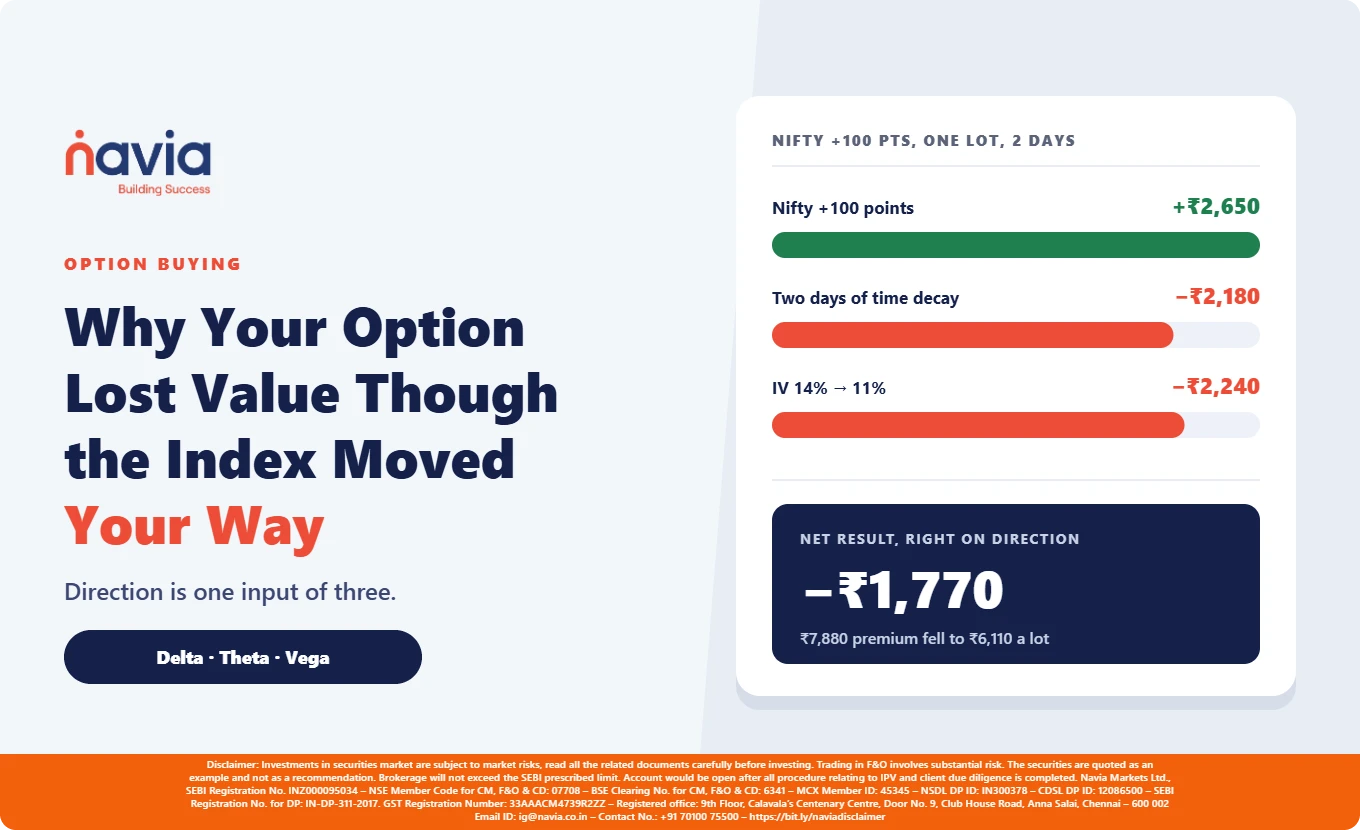
You were right about direction and still lost money, because direction is only one of three things pricing your option. The other two — time decay in options and a fall in implied volatility — both work against a buyer, and together they routinely outrun the gain from the index. In the worked example below, Nifty rises 100 points in your favour over two days and a 25200 call still falls from about ₹7,880 to ₹6,110 a lot, a loss of roughly ₹1,770. The index gained you ₹2,650. Time took ₹2,180 and the volatility drop took ₹2,240. Nothing went wrong with your view. The position needed the index to reach 25,161, not 25,100.
Key takeaways
- An option premium moves on three forces: the index, time passing, and implied volatility. A buyer only profits when the first beats the other two combined.
- Time decay is relentless and accelerates near expiry. In the example, theta alone cost about ₹950 a lot a day — roughly 12% of the premium, every day, whether the index moved or not.
- A fall in implied volatility can cost more than time. Here a drop from 14% to 11% took ₹2,240, slightly more than two days of decay.
- Being right on direction is not the same as being right by enough. The breakeven needed +161 points, not the +100 the index delivered.
- This is structural, not bad luck. SEBI’s August 2026 study found 87.7% of individual traders in equity derivatives made net losses in FY26.
The short answer: direction is one input of three
An option premium is not a bet on direction alone. It prices three things at once:
- Delta — how much the premium moves per one-point move in the index. An out-of-the-money call might have a delta of 0.37, capturing 37 paise of every rupee the index gains.
- Theta — how much it loses each day that passes, because there is less time left for the move to happen.
- Vega — how much it moves when implied volatility changes.
You bought direction. You also, without choosing to, sold time and bought volatility. When the index moves your way but the premium falls, the delta gain was simply smaller than what theta and vega took. Our post on option Greeks defines each individually; this one shows what happens when they pull against each other.
What actually happened to the premium?
Take the trade most retail buyers place — a slightly out-of-the-money weekly index call.
Entry. Nifty at 25,000. You buy one lot of the 25200 call with seven days to expiry, when implied volatility is elevated at 14% ahead of an event. The premium is ₹121.26, so one lot of 65 costs about ₹7,880.
At that moment the position carries a delta of 0.37, a theta of about ₹15 per unit per day, and a vega of about ₹13 per volatility point.
Exit, two days later. The event passes without drama. Nifty is at 25,100 — up 100 points, exactly the direction you wanted. But implied volatility has fallen back to 11%, and two days are gone. The premium is now ₹94.02, about ₹6,110 a lot.
You were right, and you are down about ₹1,770. If you have been wondering why option premium is not increasing while the index climbs, this is the whole of it.
| What moved | Effect on the premium | Per lot |
|---|---|---|
| Nifty +100 points | +₹40.77 | +₹2,650 |
| Two days of time passing | −₹33.57 | −₹2,180 |
| Implied volatility 14% → 11% | −₹34.43 | −₹2,240 |
| Net | −₹27.23 | −₹1,770 |
The index did its job. It contributed ₹2,650. The problem is that the other two columns together took ₹4,420.

How much does time decay in options cost per day?
The time decay options carry is charged for every calendar day you hold them, and theta is its name. In the example it was about ₹15 per unit per day — roughly ₹950 a lot, every single day, or about 12% of the premium you paid.
Note that two days of decay cost ₹2,180 in the table, more than twice the ₹950 daily figure. That is not an inconsistency — it is the acceleration. Theta is the rate on the day you measure it, and it rises as expiry gets closer, so the second day costs more than the first.
Two features make it dangerous for buyers. It never pauses — theta is charged on weekends and holidays too, so a Thursday-to-Monday hold is four days of decay, not one. And it accelerates: time value drains slowly when expiry is far away and steeply in the final days, which is why the same call, held the same two days with the index moving the same 100 points, is a different trade depending on when you bought it. On expiry day itself all remaining time value goes to zero, which our post on expiry day trading costs covers.
What is implied volatility in options, and why did it cost more than time?
Of the three columns, this is the one most buyers meet only after it has cost them money.
Implied volatility in options is not a forecast of direction — it is how much movement the market is currently pricing in. When something uncertain is coming — a policy decision, results season, an election — it rises, and every option gets more expensive, calls and puts alike. Once the uncertainty resolves it falls back, and every option gets cheaper regardless of which way the index went.
That fall is called an IV crush, and it is why buying just before a scheduled event is so often a losing trade even when you call the event correctly. You paid an inflated premium for uncertainty; the moment it is gone, so is that part of the price.
In the example, the 3-point drop in implied volatility cost ₹2,240 a lot — more than two full days of time decay. You can watch this building in advance: India VIX, published by NSE, tracks Nifty implied volatility for the next 30 days, and a high reading means you are paying up for uncertainty.
Here is the cleanest way to see how much this one factor mattered: had implied volatility simply stayed at 14%, the same trade would have been worth about ₹8,350 a lot — a gain of ₹470 rather than a loss of ₹1,770. Same index move. Same two days. The entire difference is volatility.

Why being right by 100 points was not enough
Any long option needs the index to travel far enough, fast enough, to cover what time and volatility take.
In the example, for the premium merely to return to what you paid, Nifty had to reach about 25,161 by the exit date — a 161-point move, not 100. Anything less and you lose money while being directionally correct. That gap is the real cost of the position, and it is invisible on the order screen. It is worth working out before you buy: if the move you need is larger than the move you expect, the trade does not work even if your view is right.

What should you check before the next trade?
None of this makes buying options a bad idea. It makes buying them without checking three things an expensive one.
Our post on when you should not buy options sets out the situations where the odds are worst before you commit.
Conclusion
An option that falls while the index rises is not a broken quote or a broker error. It is the ordinary result of three forces pricing the contract at once, two of which work against a buyer every day the position is open. Time decay in options is charged daily and accelerates into expiry; implied volatility falls hardest exactly when the event you were waiting for is over.
Being right about direction is necessary; on its own it is not sufficient. The traders who last check what the move has to be before they pay for it.
Did you find this article helpful?
Your feedback helps us write better content.

Frequently Asked Questions
What is time decay in options?
Time decay in options, measured by theta, is the option premium decay that happens each day purely because there is less time left before expiry. It applies to calendar days, including weekends and holidays, and it accelerates as expiry approaches. In the example above, theta cost about ₹950 a lot a day, roughly 12% of the premium paid.
Why is my option premium not increasing even though the index is going up?
Because the gain from the index is smaller than what time decay and a fall in implied volatility are taking away. All three act on the premium at once. If the index gives you ₹2,650 while time takes ₹2,180 and a volatility drop takes ₹2,240, the premium falls despite a correct directional call.
What is an IV crush?
A sharp fall in implied volatility, usually right after a scheduled event. Before the event, uncertainty inflates every premium; once it resolves, that part of the price disappears for calls and puts alike, regardless of direction. Buying just before a known event and holding through it is the most common way traders meet it.
How does India VIX affect option premiums?
India VIX is NSE’s measure of the volatility expected in Nifty over the next 30 days. When it rises, option premiums rise with it; when it falls, premiums fall. A high reading means you are paying more for the same strike, so a buyer needs a larger index move to break even.
Does time decay affect call and put options equally?
Both lose time value as expiry approaches, and for a buyer both work against you. The amount differs by how close the strike is to the index and how much time remains — options near the money carry the most time value and so have the most to lose.
Does this mean option buying never works?
No. It means a buyer needs the index to move far enough and fast enough to cover time decay and any fall in implied volatility — a higher bar than simply being right about direction, which is why working out the breakeven move before placing the order matters more than the view itself.