Gold vs Silver Futures: Lot Size and Contract Specs
Quick answer
MCX lists five gold contracts and four silver contracts, and the lot size decides whether a trade fits your capital. Gold runs 1 kg, Gold Mini 100 g, Gold Ten 10 g, Gold Guinea 8 g and Gold Petal 1 g. Silver runs 30 kg, Silver Mini 5 kg, Silver Micro 1 kg and Silver 100 at 100 grams.
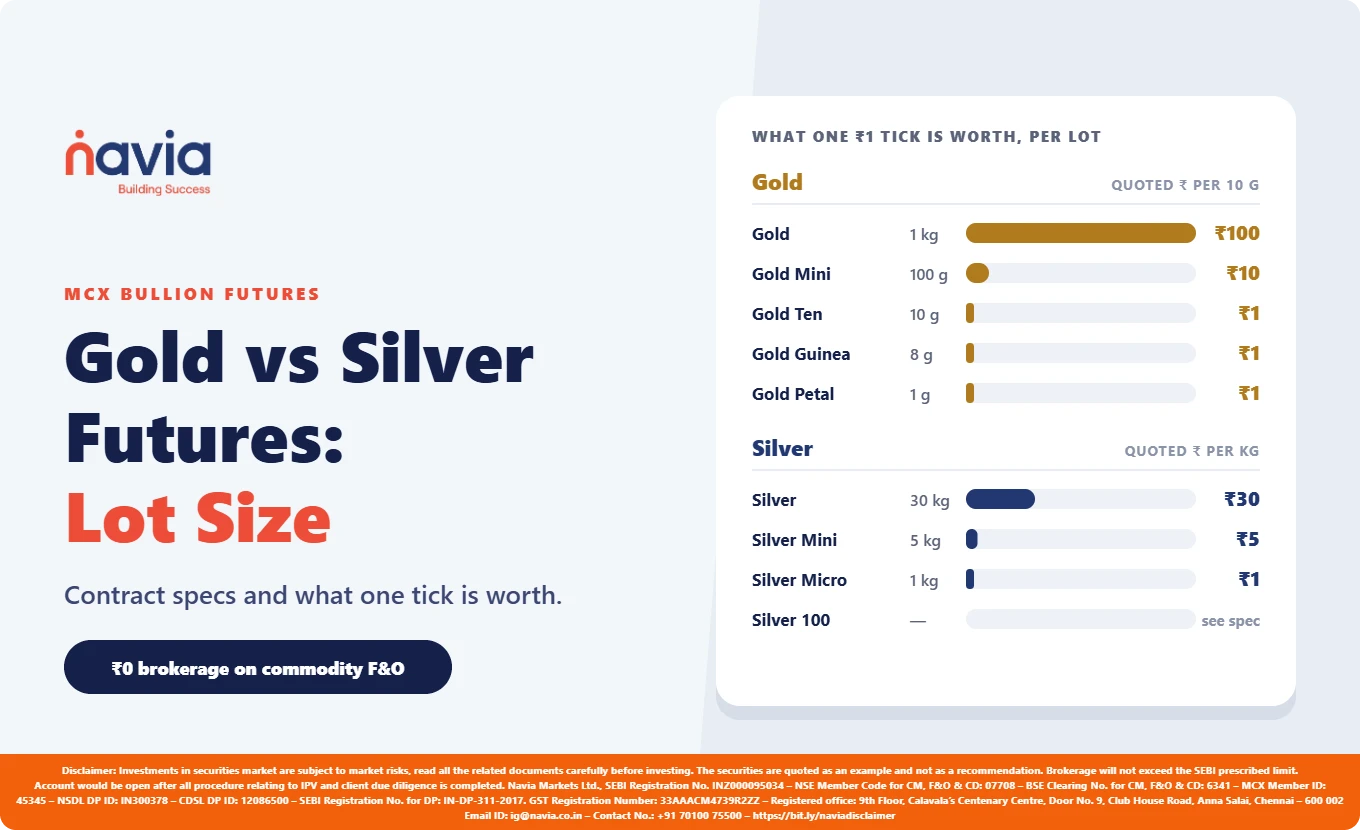
What matters more than the lot is the tick. Both metals move in ₹1 ticks, but a tick is ₹100 on Gold and ₹30 on Silver, against ₹10 on Gold Mini and ₹1 on Gold Petal and Silver Micro — a hundredfold spread across the gold ladder.
Key takeaways
- Gold: 1 kg, Gold Mini 100 g, Gold Ten 10 g, Gold Guinea 8 g, Gold Petal 1 g. Silver: 30 kg, Silver Mini 5 kg, Silver Micro 1 kg, plus Silver 100 at 100 g.
- Gold is quoted in rupees per 10 grams; silver in rupees per kilogram. The quotation basis, not the metal, is why their tick values differ.
- A ₹1 tick is worth ₹100 on Gold, ₹30 on Silver, ₹10 on Gold Mini, ₹5 on Silver Mini, and ₹1 on Gold Ten, Gold Guinea, Gold Petal and Silver Micro.
- The standard gold contracts deliver 995 purity; Gold Ten, Guinea and Petal deliver 999. Every silver contract is 999.
- Contract value is the quoted price multiplied by a fixed number — 100 for Gold, 30 for Silver, 10 for Gold Mini, 5 for Silver Mini. Margin is a percentage of that, set by the exchange and revised daily.
- Navia charges ₹0 brokerage on commodity futures and options. The costs that remain are CTT, exchange transaction charges, SEBI turnover fee, stamp duty and GST.
What is the lot size for gold and silver on MCX?
MCX lists five gold contracts and four silver contracts, and they differ only in size — the underlying metal and the exchange are the same.
The MCX gold lot size runs from 1 kg down to a single gram, and the silver lot size in MCX from 30 kg down to 1 kg.
| Metal | Contract | Symbol | Lot size | Purity | Quoted in |
|---|---|---|---|---|---|
| Gold | Gold | GOLD | 1 kg | 995 | ₹ per 10 g |
| Gold | Gold Mini | GOLDM | 100 g | 995 | ₹ per 10 g |
| Gold | Gold Ten | GOLDTEN | 10 g | 999 | ₹ per 10 g |
| Gold | Gold Guinea | GOLDGUINEA | 8 g | 999 | ₹ per 8 g |
| Gold | Gold Petal | GOLDPETAL | 1 g | 999 | ₹ per 1 g |
| Silver | Silver | SILVER | 30 kg | 999 | ₹ per kg |
| Silver | Silver Mini | SILVERM | 5 kg | 999 | ₹ per kg |
| Silver | Silver Micro | SILVERMIC | 1 kg | 999 | ₹ per kg |
| Silver | Silver 100 | SILVER100 | 100 g | 999 | ₹ per 10 g |
The thing to notice is the quotation basis, because it is doing more work than the lot size. Gold is quoted per 10 grams while the standard lot holds 1,000 grams. Silver is quoted per kilogram while the standard lot holds 30. That mismatch between what is quoted and what is held is what turns a ₹1 price move into very different rupee amounts.

What is one tick worth on each contract?
Every bullion contract moves in ₹1 ticks, so the rupee value of a tick is simply how many quoted units sit inside one lot.
| Contract | Quoted units per lot | One ₹1 tick is worth |
|---|---|---|
| Gold | 100 × 10 g | ₹100 |
| Gold Mini | 10 × 10 g | ₹10 |
| Gold Ten | 1 × 10 g | ₹1 |
| Gold Guinea | 1 × 8 g | ₹1 |
| Gold Petal | 1 × 1 g | ₹1 |
| Silver | 30 × 1 kg | ₹30 |
| Silver Mini | 5 × 1 kg | ₹5 |
| Silver Micro | 1 × 1 kg | ₹1 |
| Silver 100 | 10 × 10 g | ₹10 |
A ₹100 move in the quoted gold price is ₹10,000 on one Gold lot and ₹1,000 on one Gold Mini. The same ₹100 move in silver is ₹3,000 on one Silver lot and ₹100 on one Silver Micro.
This is the figure to size a position on, because it converts a price view into a rupee outcome without needing the contract value at all.

How do you work out what one lot commits you to?
Contract value is the quoted price multiplied by the units in the lot — and because bullion prices move daily, the multiplier is the durable number, not the rupee total.
- Gold = quoted price per 10 g × 100
- Gold Mini = quoted price per 10 g × 10
- Gold Ten = quoted price per 10 g × 1
- Silver = quoted price per kg × 30
- Silver Mini = quoted price per kg × 5
- Silver Micro = quoted price per kg × 1
Look up today’s price, multiply, and you have the exposure one lot carries. Gold Ten, Gold Guinea and Gold Petal are quoted on the same basis as their lot, so for those three the contract value is simply the quoted price.

You do not pay the contract value. You post margin: the MCX gold margin, and the silver margin, are set by the exchange as a percentage of contract value through SPAN plus Extreme Loss Margin. That percentage is revised daily and rises when volatility rises, so a position that was comfortable last week can need more margin this week without the price having moved against you.
Which contract fits your capital?
Work backwards from the tick value rather than from the margin, because margin changes and the tick value does not.
Decide the rupee loss you are willing to take and the move you expect to be wrong by, and the tick value tells you which contract you can carry. If a ₹500 adverse move would cost ₹50,000 on one Gold lot and ₹5,000 on one Gold Mini, the question answers itself.
The smaller contracts exist for exactly this, and MCX describes the smallest gold ones as giving retail investors and small jewellers SIP-style flexibility. The silver micro lot size of 1 kg and the gold petal lot size of 1 g are the smallest exposures in each metal. The gold mini lot size of 100 g, the gold ten lot size of 10 g and the silver mini lot size of 5 kg sit between the extremes. All of them track the same underlying metal, so a view on gold does not require the full gold lot size of 1 kg to express.
Two cautions. Liquidity is not equal across the ladder, and a thin order book costs you on entry and exit regardless of how small the lot is — check the volume and bid-ask spread on the specific contract before committing, rather than assuming the smallest one trades as readily as the benchmark. And a smaller lot reduces the size of your exposure, not the risk of the position: leverage, volatility and the possibility of losing more than you expect are unchanged.
Do all the gold contracts deliver the same gold?
No — and this is the difference the lot-size tables never show.
The two standard gold contracts, Gold and Gold Mini, are deliverable against 995 purity. Gold Ten, Gold Guinea and Gold Petal are deliverable against 999. Every silver contract — Silver, Silver Mini, Silver Micro and Silver 100 — is 999.
That matters if you ever intend to take delivery rather than square off. The smaller gold contracts are built around tamperproof retail-sized delivery, which is why MCX pitches them at small jewellers and retail investors, while the 1 kg and 100 g contracts are the trade-grade benchmarks. If you are only trading the price and closing before expiry, purity does not affect your P&L. If you might stand for delivery, it decides what actually arrives.
How do gold and silver differ beyond size?
Silver is the more volatile of the two, which matters more than the lot size when you are choosing between them.
The practical consequence for sizing is this: a Silver Mini and a Gold Mini are not equivalent risks just because both are the mid-size contract in their metal. Compare them on the rupee value of a realistic daily move, not on the lot label. Navia covers the reasons behind the gap — industrial demand, market depth and the economic cycle — in why silver is more volatile than gold.
Both metals are delivery-based contracts on MCX. A position held to expiry goes to delivery under the exchange’s rules rather than being cash-settled, so positions are normally closed or rolled before expiry unless delivery is genuinely intended. The same structure applies across MCX energy contracts — Navia sets out the equivalent figures for crude oil on MCX.
What does it cost to trade gold and silver at Navia?
Navia charges ₹0 brokerage on commodity futures and options. Brokerage will not exceed the SEBI prescribed limit.
What remains are the statutory and exchange charges, which apply at every broker:
| Charge | Futures | Options |
|---|---|---|
| CTT (sell side only) | 0.01% | 0.05% |
| Exchange transaction charges | 0.0021% | 0.0418% |
| SEBI turnover fee | 0.0001% (buy and sell) | 0.0001% (buy and sell) |
| Stamp duty (buy side only) | 0.002% | 0.002% |
| Clearing charges | 0.0014% | 0.05% on premium turnover |
| GST | 18% on brokerage, exchange, SEBI and clearing charges | 18% on brokerage, exchange, SEBI and clearing charges |
Because these are percentages of turnover, they scale with contract size — another reason the smaller contracts suit smaller capital. To work out the figure for a specific trade before you place it, use the Navia brokerage calculator.
Conclusion
Choose the contract by what a tick costs you, not by which metal you have a view on.
Gold and silver each offer a ladder of sizes — five rungs in gold, four in silver — and the gap between top and bottom is large: ₹100 a tick on Gold against ₹1 on Gold Petal, ₹30 on Silver against ₹1 on Silver Micro. That is a hundredfold spread in gold and thirtyfold in silver. The view that made you want the trade works the same way on every rung. Only the rupee consequence changes.
Educational content, not investment advice. Contract specifications and charges are those published at the time of writing; MCX revises specifications by circular, and margins change daily. Confirm the live specification and margin in your order window before trading.
Did you find this article helpful?
Your feedback helps us write better content.

Frequently Asked Questions
What is the MCX lot size for gold?
MCX lists five gold contracts: Gold at 1 kg, Gold Mini at 100 grams, Gold Ten at 10 grams, Gold Guinea at 8 grams and Gold Petal at 1 gram. All are quoted with a ₹1 tick, but because Gold and Gold Mini are quoted per 10 grams, one tick is worth ₹100 on Gold and ₹10 on Gold Mini, against ₹1 on the three smallest.
What is the silver lot size in MCX?
Silver is 30 kg, Silver Mini is 5 kg and Silver Micro is 1 kg, and MCX also lists Silver 100 at 100 grams, quoted per 10 grams. The first three are quoted in rupees per kilogram with a ₹1 tick, so one tick is worth ₹30 on Silver, ₹5 on Silver Mini and ₹1 on Silver Micro. All silver contracts deliver 999 purity.
Which is better for a small account, gold mini or silver micro?
Silver Micro carries the smaller rupee consequence per tick at ₹1, against ₹10 for Gold Mini. But silver is typically the more volatile metal, so the two are not equivalent on risk. Compare them on the rupee value of a realistic daily move rather than on lot size alone.
How much margin do gold and silver futures need?
Margin is set by the exchange as SPAN plus Extreme Loss Margin, calculated as a percentage of contract value, and it is revised daily. It rises with volatility, so the requirement can change without the price moving against you. Check the live margin for the specific contract before placing the order.
Are MCX gold and silver contracts cash settled?
No. Both are delivery-based contracts on MCX, so a position held to expiry goes to delivery under the exchange’s rules. Positions are normally closed or rolled before expiry unless delivery is genuinely intended.
Does Navia charge brokerage on commodity trading?
Navia charges ₹0 brokerage on commodity futures and options. Brokerage will not exceed the SEBI prescribed limit. The costs that remain are CTT, exchange transaction charges, the SEBI turnover fee, stamp duty and GST, which apply at every broker.