Pledging Shares for Margin: Process and Charges
Quick answer
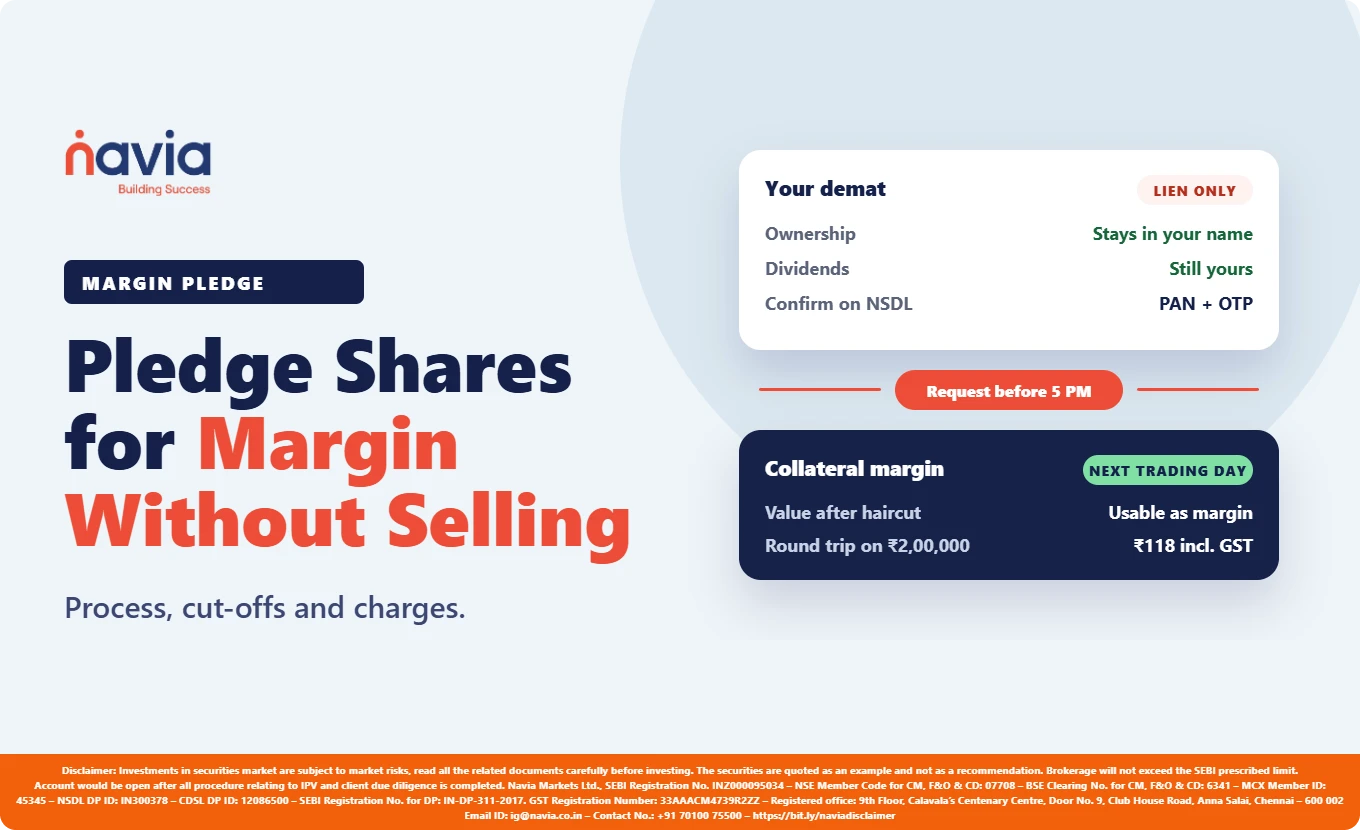
A margin pledge locks shares you already own as collateral so their value can be used as trading margin, without selling them. The shares stay in your demat account and in your name — only a lien is recorded. You raise the request with Navia, confirm it on the NSDL link sent by SMS and email, enter your PAN, and approve with an OTP.
The timing catches people out. Navia processes requests placed before 5 PM on a working day that evening, and the margin is usable only from the next trading day. Unpledge requests go in before 1 PM.
Key takeaways
- Pledged shares stay in your demat account under your name. Ownership does not move; only a lien is recorded.
- Navia accepts pledge requests until 5 PM on working days; margin is available from the next trading day, not the same day.
- Unpledge requests go in before 1 PM, and only clear if no margin is currently using that stock.
- Pledge creation costs 0.02% of value, minimum ₹50, plus GST — and closing the pledge costs the same again, so budget for a round trip.
- On ₹2,00,000 the percentage does not bite: the ₹50 floor applies, making the round trip ₹118 including GST.
What is a margin pledge?
A margin pledge is an instruction recorded with the depository that marks shares in your demat account as collateral for trading margin, while leaving them in your name.
The margin pledge meaning that matters in practice is narrow, and the pledge shares meaning is the same one: to pledge shares means to record a lien, not to hand them over. Nothing is sold and nothing is transferred out. You keep the dividends and the corporate actions. What you gain is collateral margin — the value of those shares, after a haircut, becomes available to meet margin obligations in the F&O segment or to fund positions under Margin Trading Facility.
Since the SEBI framework effective 1 August 2020, this is the only route by which a broker may take securities as margin. The pledge is created in the depository system and confirmed by you with an OTP, which is why no broker can move your shares into its own account to use as collateral.
How do you pledge shares for margin at Navia?
The route depends on which segment the margin is for, but both end on the depository’s own confirmation page.
- Raise the pledge request with your broker. For F&O margin, log in to the Navia web trading platform, open Back Office and select Add New Margin Pledge Request, choosing the F&O segment — or raise a support ticket listing the stocks and quantities. For Margin Trading Facility, go to Accounts → Funds → Pledge under Seg:MTF in the Navia app and select the stocks from your holdings; app requests go in before 4 PM for same-day processing.
- Open the confirmation link from the depository. NSDL sends it by SMS and email once the request is raised. The link is generated per request and cannot be reached by logging in separately.
- Enter your PAN. This identifies the account on the depository’s page.
- Review and select the stocks. Check the stocks and quantities listed on screen and tick the ones you want pledged.
- Approve with the OTP. An OTP arrives on your registered mobile. Enter it on the depository page and the pledge is created. The OTP expires the same day; if the approval is not completed the request lapses and must be raised again.
The OTP step is yours alone. Navia raises the request; only you can complete it.
Where do you approve a CDSL or NSDL margin pledge request?
On the depository’s own portal, not on the broker’s platform.
This is the step people search for when a request is already pending. Navia operates through NSDL, so the confirmation arrives as an NSDL margin pledge link by SMS and email once the request is raised. Open that link, enter your PAN, review the stocks and quantities listed, tick what you want pledged, and approve with the OTP sent to your registered mobile.
If the SMS has not arrived, ask Navia to re-trigger the request rather than hunting for the margin pledge request portal yourself — the confirmation link is generated per request and cannot be reached by logging in separately. NSDL’s margin pledge page explains the framework and the alternative routes, which are the SPEED-e platform and the paper Form 43 submitted through your depository participant. A CDSL margin pledge works the same way on CDSL’s own system, which is why the link you receive depends on which depository holds the account rather than on who your broker is.
The OTP expires. If you do not complete the approval the same day, the request lapses and has to be raised again.
What are the margin pledge charges?
The charge is a depository charge rather than a brokerage charge, and two things about how it is counted decide what you actually pay.
| Event | Charge | GST |
|---|---|---|
| Pledge creation | 0.02% of the value pledged, minimum ₹50 | 18% |
| Pledge closure or invocation | 0.02% of the value pledged, minimum ₹50 | 18% |
Source: Navia support, Depository account charges, retrieved 13 November 2026. Navia’s pricing page lists pledge and unpledge as “as applicable” without a rate, so the figures above come from the depository charges schedule.
First, the ₹50 floor does most of the charging. 0.02% only exceeds ₹50 once the value pledged passes ₹2,50,000. Below that, the pledge pays the floor regardless of value.
Second, closing the pledge is charged like creating it, so every figure doubles on a round trip.
Worked example — ₹2,00,000 pledged and later released:
| Step | Calculation | Charge |
|---|---|---|
| Pledge creation | 0.02% of ₹2,00,000 = ₹40, below the ₹50 floor | ₹50 |
| GST at 18% | ₹50 × 1.18 | ₹59 |
| Pledge closure | charged the same as creation | ₹59 |
| Round trip | ₹118 |
At ₹2,00,000 that round trip is 0.059% of the value pledged, against a headline rate of 0.02% — the floor, charged twice, is what you actually pay. A position you expect to release within days rarely justifies either leg.
One thing to confirm with your broker before you pledge several stocks at once. Navia’s pricing page describes the depository charge as applying “per scrip per request”, while its Margin Trading Facility page describes the same charge as a minimum “per transaction”. The two readings give very different totals on a multi-stock pledge: on ₹2,00,000 split across three holdings, a per-scrip floor charges three times, a per-transaction floor charges once. Ask before you split a pledge across holdings.
A separate DP charge applies when you sell, so a stock you pledge, release and then sell carries charges on all three events.
Brokerage will not exceed the SEBI prescribed limit. To work out what the trades themselves cost, use the Navia brokerage calculator.
When does the margin actually arrive?
Not on the day you pledge — margin against pledged stock is usable from the next trading day.
Navia accepts pledge requests until 5 PM on working days and processes them at end of day. A request placed after 5 PM waits for the following working day, and weekend requests are not processed at all.
The practical consequence: if you need margin for Monday, the pledge has to be confirmed by 5 PM on Friday. Pledging on Monday morning for a Monday position does not work, however urgent the shortfall.
How do you unpledge shares?
Raise a support ticket with the stock name, quantity and demat details before 1 PM on a working day.
Approved requests are processed within one business day and Navia confirms by email.
Two conditions have to hold. No margin may currently be utilised against the stocks you want released — if positions are relying on that collateral, the request fails. And any margin shortfall on the account must be cleared first.
Unpledging is charged at the same 0.02% with a ₹50 minimum, plus GST, as creating the pledge.
Why is pledged stock worth less than its market value?
Because a haircut is applied — the collateral credited to you is market value minus a percentage reflecting how volatile the stock is.
A haircut in the share market is that deduction: ₹1,00,000 of a stock carrying a 20% haircut delivers ₹80,000 of usable margin, not ₹1,00,000.
Haircut rates differ by stock and are revised periodically, which means your available margin moves even when you have not touched the pledge. A stock whose haircut is raised delivers less collateral the next day.
Navia explains the mechanics and the formula in How Collateral Value Impacts Margin Availability, and publishes the list of stocks and instruments it accepts as collateral in its support guide.
Two limits apply to what you can pledge. For Margin Trading Facility, Navia accepts Group 1 securities only. And across both segments, lock-in bonds, fractional mutual fund and ETF quantities, and stocks carrying a 100% Value at Risk are excluded — as are stocks where Navia’s own pledge limit for that scrip is already full. Navia’s MTF page states that both cash and non-cash collateral can be used to meet the margin requirement, so check what mix your position needs before relying on pledged stock alone.
Conclusion
Pledging converts stock you already own into trading margin without selling it, and the mechanics are straightforward once the timing is clear.
Request by 5 PM, confirm the NSDL link with your PAN and an OTP, margin from the next trading day, unpledge requests before 1 PM. The costs that surprise people are the ₹50 floor on small pledges and the fact that closing the pledge is charged like opening it.
Put collateral to work. Pledged holdings fund positions under Margin Trading Facility at Navia, with no separate cash component required.
Educational content, not investment advice. Charges and cut-offs are those published at the time of writing; check the current schedule before you pledge.
Did you find this article helpful?
Your feedback helps us write better content.

Frequently Asked Questions
What is margin pledge, and what does pledging shares mean?
A margin pledge is an instruction recorded with the depository that marks shares in your demat account as collateral for trading margin. The pledge shares meaning is simply that: the shares stay in your name, you keep dividends and corporate actions, and only a lien is recorded against them.
Do I lose ownership of shares I pledge?
No. Pledged shares remain in your demat account under your name. Since the SEBI framework effective 1 August 2020, a broker cannot move client securities into its own account to use as collateral — the pledge is created in the depository system and confirmed by you with an OTP.
How much does it cost to pledge shares?
The depository charges 0.02% of the pledged value with a minimum of ₹50, plus GST, and the same again to close the pledge. On ₹2,00,000 the percentage works out to ₹40, so the ₹50 floor applies and the round trip costs ₹118 including GST. Whether the floor is charged once per request or once per stock differs between Navia’s published pages — confirm before splitting a pledge across holdings.
How long does a margin pledge take?
Navia accepts requests until 5 PM on working days and processes them the same evening, with margin available from the next trading day. Requests after 5 PM wait for the following working day, and weekend requests are not processed.
Can I unpledge shares at any time?
You can raise an unpledge request before 1 PM on a working day, and it is processed within one business day — provided no margin is currently utilised against those stocks and the account carries no margin shortfall.
Does pledged stock give full margin?
No. A haircut is deducted from market value, so a stock with a 20% haircut gives ₹80,000 of margin per ₹1,00,000 pledged. Haircut rates vary by stock and are revised periodically.