Index Options vs Stock Options: What Actually Differs
Quick answer
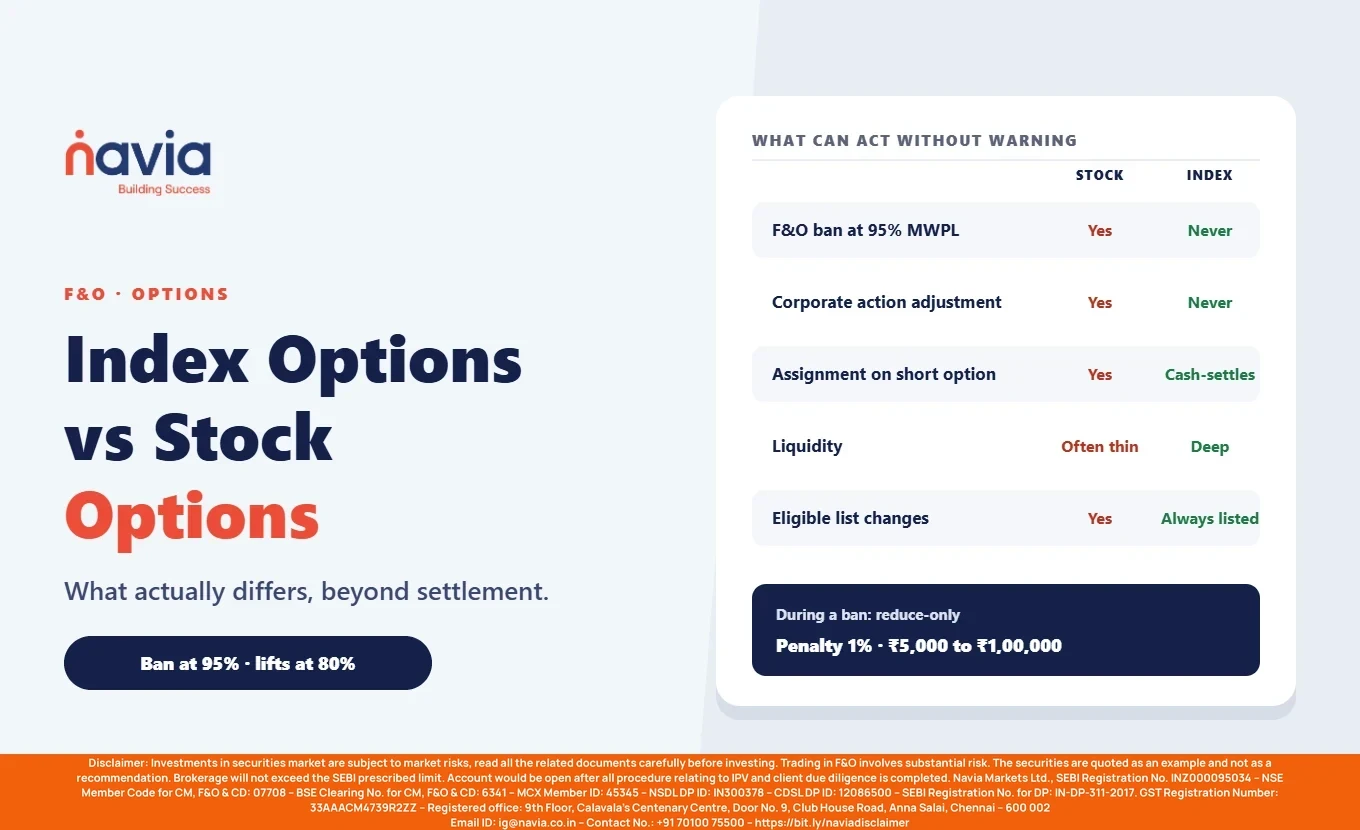
The difference that catches traders out is not settlement. It is that an individual stock can be locked out of fresh F&O positions and an index never can. When aggregate open interest in a stock’s derivatives reaches 95% of its market-wide position limit (MWPL), the exchanges put it into a ban period: from the next trading day you may only reduce existing positions, not open new ones, until open interest falls back to 80% or below. Index derivatives have no MWPL and are never banned. Four other things differ too — corporate actions, assignment, liquidity and eligibility — and together they matter more to how a position behaves than the cash-versus-delivery distinction most comparisons lead with.
Key takeaways
Why a stock can be banned and an index cannot
An index is a calculated number. There is no share count, no register of holders, and nothing to corner. A single company’s shares are finite, so the exchanges cap how much derivative exposure the market as a whole may hold against one stock. That cap is the market-wide position limit.
The MWPL meaning is straightforward: it is set per stock and derived from the shares held by non-promoters — the free float. The precise basis was revised by SEBI in 2025, and published sources still describe it differently, so check the current formula on the exchange rather than relying on any figure quoted in an article, including this one. What has not changed is the mechanism built on top of it.
Index derivatives have no equivalent. There is no MWPL on Nifty, Bank Nifty or Sensex, and no ban period. Position limits do exist for index derivatives, but they apply to what a single participant may hold, not to the market as a whole — so they can constrain you, and they can never freeze the contract for everyone.
That is the structural difference. Everything in the next section follows from it.
What the F&O ban period actually restricts
The rule is specific and it is worth knowing precisely, because the penalty is charged on the position, not on the intent.
Entry: when aggregate open interest across exchanges exceeds 95% of MWPL, no fresh positions are permitted in that security’s derivatives from the next trading day.
One thing changed here that most published explanations have not caught up with. Open interest for this purpose is now delta-adjusted — measured as Future Equivalent Open Interest, which combines your futures and options into a single figure weighted by sensitivity to the underlying, rather than counting lots. Futures carry a delta of 1; options carry between 0 and 1 depending on how far in or out of the money they are. Compliance is also no longer checked only at day-end. NSE Clearing’s own guidance describes intraday monitoring, with members able to monitor positions and take corrective trades between 2 PM and 3:30 PM; brokers have announced additional random intraday checks. Treat intraday monitoring as a given and confirm the current mechanics with the exchange.
During the ban: you may trade only to reduce your position. Squaring off works. Rolling to the next expiry does not — a roll opens a fresh position in the banned security, and brokers state plainly that neither a fresh position nor a rollover is permitted. Nor is an intraday position you intend to square off the same day.
Exit: normal trading resumes once aggregate open interest comes down to 80% or below of MWPL.
The penalty for getting it wrong: 1% of the value of the increased position, with a floor of ₹5,000 and a ceiling of ₹1,00,000.

First, a ban is announced for the next trading day, so the stock you traded freely this afternoon may be closed to you tomorrow morning.
Second, a hedged position can breach the rule without you adding anything. Closing one leg of a hedge raises your delta-adjusted exposure, and raising exposure is what the rule prohibits — even though you only placed a closing order. Where that happens, your broker’s risk desk may cancel pending orders in the stock and square the position off on a best-effort basis. The timing is the broker’s policy rather than an exchange rule, so ask yours what it does and when.
NSE and BSE publish the F&O ban list — the securities in ban period — each trading day, and the MWPL list showing how close each stock sits to its limit. The MWPL NSE page is the authority; check it before you place an order in a single stock, never a figure saved last week.
Corporate actions: stock options adjust, index options do not
This one surprises people, and it is permanently true.
When a company announces a split, a bonus issue or a special dividend, the exchange adjusts the outstanding option contracts so that the position’s value is preserved across the event. The strike price changes. The lot size, or market lot, changes. The contract you are holding on Monday is arithmetically the same position on Tuesday, but none of the numbers on your screen are the ones you entered.
An index is not a company. It does not split, issue bonuses or pay dividends — index levels already reflect the constituents’ corporate actions through the index methodology. No index option is ever adjusted.
Practically: if you hold a stock option through a corporate action, check the adjusted strike and lot before you act on it. If you hold an index option, the contract you bought is the contract you hold.
Exercise and assignment
An in-the-money stock option that is left to expire is exercised, and the short side is assigned — meaning an obligation in the underlying shares. Assignment is not something you choose; it happens to you because somebody else exercised.
An in-the-money index option is cash-settled against the final settlement price. There is no assignment and no obligation beyond the cash difference.
For a buyer the distinction is mostly administrative. For a seller it is a different risk altogether, and it is the reason stock option selling carries obligations that index option selling does not. Our post on physical settlement of stock F&O covers what delivery actually involves, the margins that build before expiry and how to avoid it.

Liquidity, and the cost that is not brokerage
Index options concentrate the market’s activity into a handful of strikes on a handful of indices. Stock options spread the same activity across hundreds of contracts, and outside a few heavily traded names the result is thin.
Thin means a wide bid-ask spread, and the spread is a real cost that never appears on your contract note. On an illiquid stock option strike it can exceed everything you pay in brokerage, exchange charges and taxes combined — and unlike those, it is paid twice, once on entry and once on exit.
Before you trade a stock option, look at the bid and the ask on the exact strike and expiry you intend to use, not at the last traded price. A premium that last printed at ₹12 is not available at ₹12 if the book shows ₹10 bid and ₹14 offered.

Not every stock has options
Every index in the F&O segment has derivatives. Stocks must qualify — the exchanges maintain an eligibility list based on liquidity and market capitalisation criteria, and that list is reviewed and changes. A stock can be added, and a stock can be excluded, in which case existing contracts run to expiry but no new series are introduced.
So “can I trade options on this stock” is a question with a changing answer. Check the current eligible list on the exchange before you plan a position in a specific name.
Settlement and expiry, briefly
These are the two differences most comparisons lead with, and they are genuinely simpler than the ones above.
Settlement: index options are cash-settled; in-the-money stock options are physically settled, meaning delivery of shares. The full mechanics, margins and costs are in our post on physical settlement of stock F&O.
Expiry: index options have weekly contracts; stock derivatives are monthly only — there are no weekly contracts on individual stocks. The expiry day itself has been realigned more than once, so take it from the exchange calendar rather than from memory. Our post on weekly F&O expiry covers how premiums behave as expiry approaches.
So which should you trade?
That is not a question anyone should answer for you, and the honest framing is a trade-off rather than a recommendation.
Index options give you liquidity, no ban risk, no assignment and no corporate action surprises — and no exposure to a single company’s story. Stock options give you that exposure, and with it the ban period, assignment, adjustments and a thinner book.
What matters is that you know which set of rules you have signed up to before the position is open, not when the ban list is published or the strike changes overnight.
Conclusion
Most comparisons of index and stock options stop at cash versus delivery. That is the difference least likely to catch you, because it only matters at expiry and you can close before then.
The ones that matter are the ones that act without warning: a ban announced for tomorrow, a strike adjusted overnight, an assignment you did not choose, a spread that takes more than your brokerage. All four apply to stock options and none apply to index options.
Trading in F&O involves substantial risk. If you want to see the contracts, charges and margins before you take a position, the options trading account page sets them out.
Did you find this article helpful?
Your feedback helps us write better content.

Frequently Asked Questions
What is the difference between index options and stock options?
Index options are cash-settled on an index level and are never put into a ban period. Stock options are physically settled when in the money, can be assigned, are adjusted for corporate actions, and can be locked out of fresh positions when open interest reaches 95% of the stock’s market-wide position limit.
What is MWPL?
The market-wide position limit — the cap on total derivative open interest the market may hold in one stock, derived from the shares held by non-promoters. It exists only for individual stocks. Index derivatives have no MWPL.
Why is a stock in the F&O ban period?
Because aggregate open interest across exchanges exceeded 95% of its MWPL. From the next trading day no fresh positions are permitted in its derivatives until open interest falls to 80% or below.
Can I trade a stock that is in F&O ban?
Only to reduce an existing position. You can square off. You cannot roll to the next expiry, and you cannot open a fresh position, including an intraday one. A breach attracts a penalty of 1% of the increased position, with a minimum of ₹5,000 and a maximum of ₹1,00,000.
Are index options ever banned?
No. There is no market-wide position limit on index derivatives and no ban period. Participant-level position limits apply, but they restrict what one participant may hold rather than freezing the contract for everyone.
Do options get adjusted for a stock split or bonus?
Stock options do. The exchange adjusts the strike price and the lot size so the position’s value is preserved across the corporate action. Index options are never adjusted.
Do stock options have weekly expiry?
No. Stock derivatives have monthly contracts only. Weekly contracts exist on index derivatives.