How to Convert Physical Shares to Demat Without Your Request Being Rejected
Quick answer
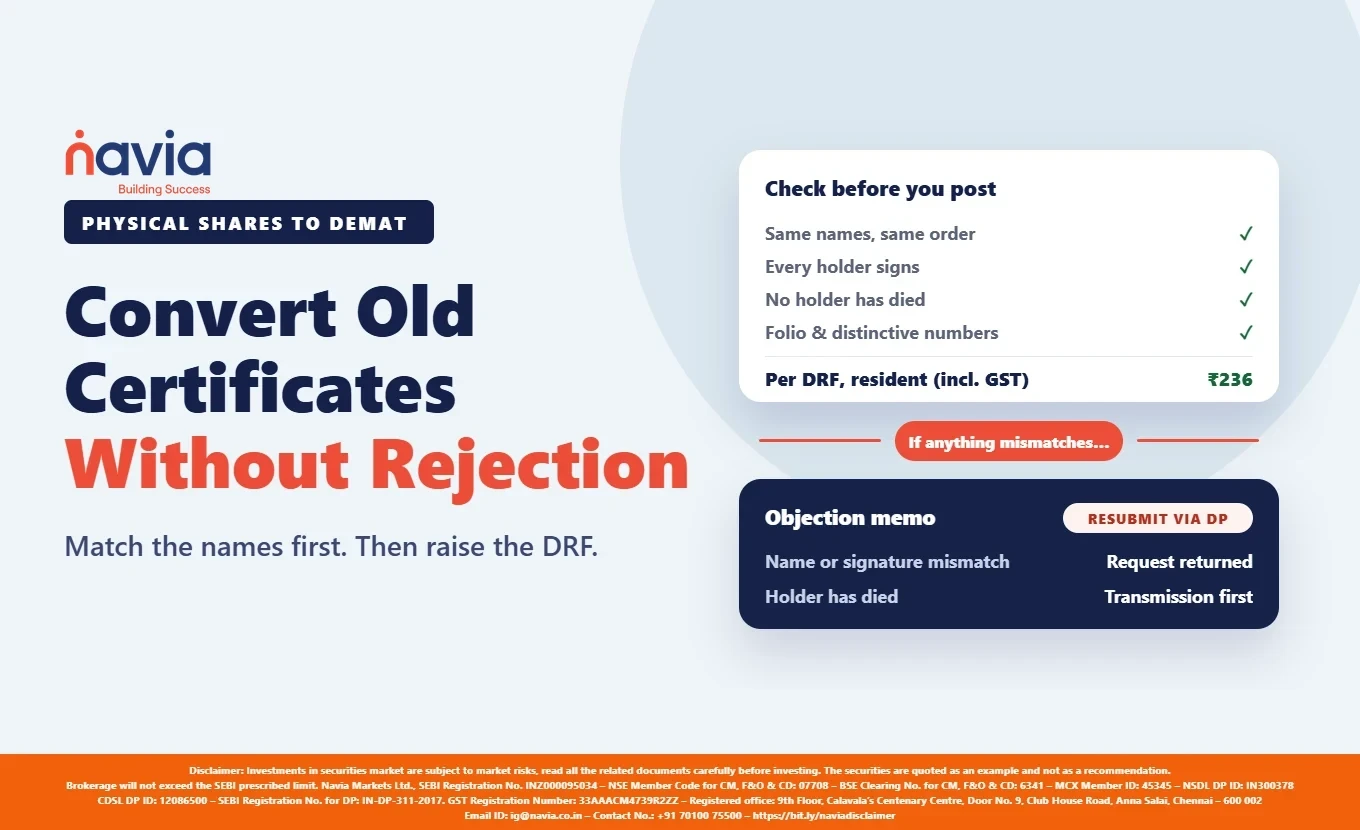
To convert physical shares to demat you need a demat account held in exactly the same names as the certificate, a Dematerialisation Request Form for each company, and the original certificates handed to your depository participant. At Navia the charge is ₹200 per DRF covering up to five certificates, plus GST — ₹236 in all. The process itself is simple. What catches people is the matching: a name spelled differently, a signature that no longer resembles the one the registrar holds, or a joint holder who has since died will send the request back with an objection memo rather than shares into your account. Fix those before you post the certificates, not after.
Key takeaways
What dematerialisation of shares means
The process of dematerialisation of shares begins with understanding what it does. The dematerialisation of shares meaning is simple enough: a paper share certificate becomes an electronic balance in your demat account. The certificate is surrendered and destroyed; what you own does not change, only the form it is held in.
It stopped being optional in practice. SEBI closed the route for transferring shares in physical form in April 2019, so a paper certificate can still be held but cannot be sold or transferred until it is dematerialised. If you have found an old physical share certificate in a file or inherited one, converting it is the only way to realise it.
The process for dematerialisation of shares, step by step
Navia’s guide to converting physical shares carries the sample NSDL and CDSL forms.
What it costs
| Charge | Resident | NRI |
|---|---|---|
| Per DRF, up to 5 certificates | ₹200 | ₹500 |
| Each certificate beyond 5 | ₹25 | ₹50 |
GST of 18% applies. Navia’s depository charge schedule, which is not reproduced on the pricing page — a single DRF works out to ₹236.
Some registrars also ask for a request letter for dematerialisation alongside the form; your DP will say whether that company’s registrar does. Confirm with Navia how the two lines combine when you hold more than five certificates of one company, since a DRF covers five and the schedule also prices additional certificates individually.
What gets your request rejected
This is the part worth reading twice, because every item below is a reason the registrar sends back an objection memo instead of shares. SEBI’s own investor material lists them:
Two of these deserve more than a line.
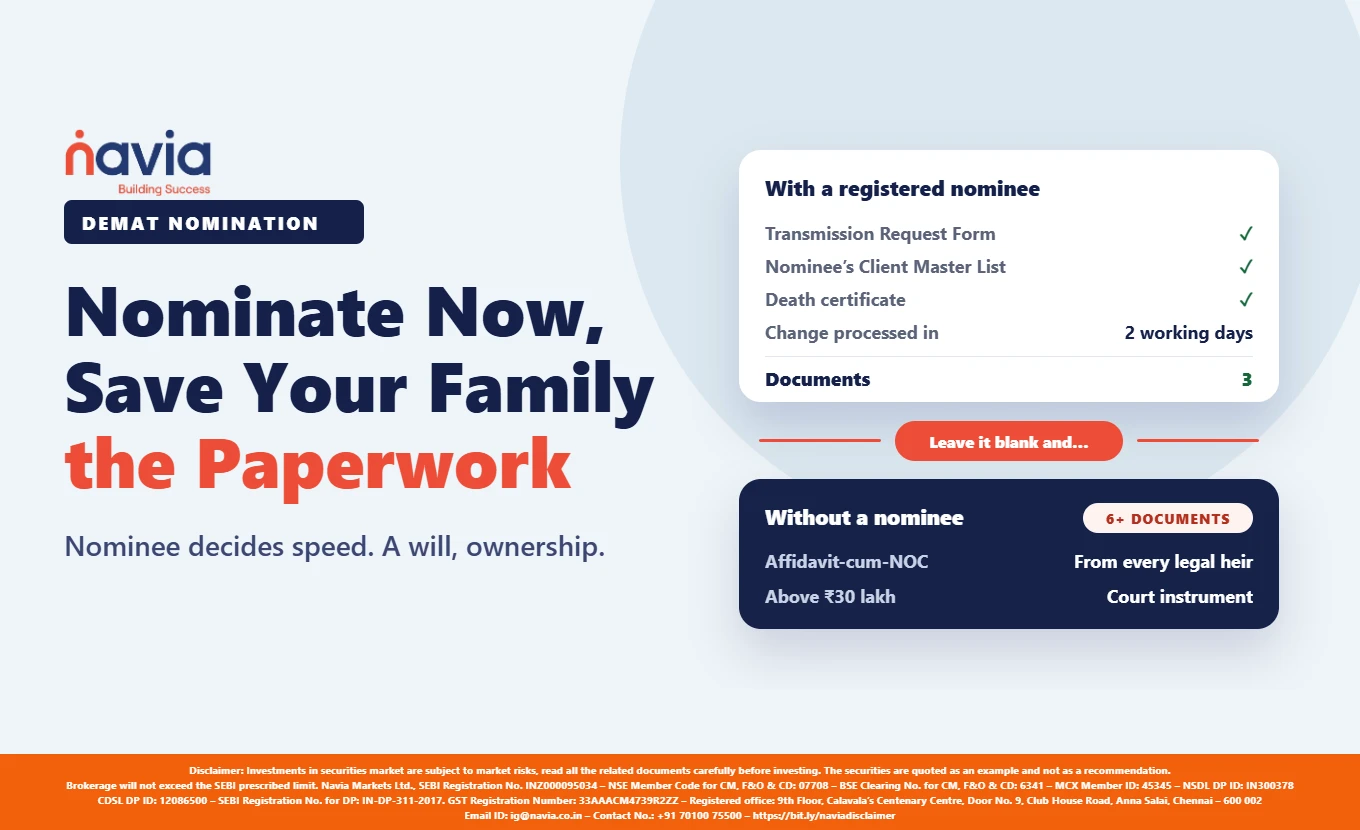
A deceased holder is not a dematerialisation problem. If a name on the certificate belongs to someone who has died, the holding has to pass through transmission first — the certificate cannot simply be converted into an account that excludes them. Our post on nomination in your demat account sets out what transmission requires and how the document set changes with the value of the holding.
A renamed or merged company is not a dead end. Certificates from companies that have since changed name, merged or moved registrar are still valid. The registrar has the mapping; your DP needs the current ISIN rather than whatever is printed on the paper.
If the request is rejected, the status shows in your transaction statement and the memo tells you what to fix. You correct it and resubmit through the DP. Nothing is lost.
If the certificate is lost
A lost physical share certificate cannot be dematerialised, and you do not go to your broker first. You approach the company’s registrar for a duplicate.
The documentation is lighter than most people expect, and lighter than it used to be. Under SEBI’s simplified procedure, for holdings below a value threshold you need only a written notice of the loss quoting the folio, certificate and distinctive numbers, an affidavit and indemnity bond in SEBI’s prescribed formats, and Form ISR-4. No FIR and no newspaper advertisement are required below that threshold, and no surety. Above it, both the FIR and the advertisement do apply. The threshold was ₹5 lakh under SEBI’s circular of 25 May 2022 and was raised to ₹10 lakh at the end of 2025 — confirm the figure that currently applies with the registrar before you start.
One detail saves a step: a duplicate is issued in dematerialised form, not as fresh paper. So you will not need a separate DRF for it — you will need the demat account ready in the correct names, which is the same first move as everything else here.
One detail catches people out, though. The registrar does not credit the shares directly. It issues a Letter of Confirmation, and that letter is valid for 120 days. Within that window you have to take it to your depository participant to have the securities dematerialised. Treat the letter as a deadline, not a receipt — the account should already be open and in the right names before it arrives.
Going back: rematerialisation
Rematerialisation of shares is the reverse — converting an electronic balance back into paper, using a Remat Request Form. It is rare, and worth knowing it costs more than it saves: Navia’s schedule prices it at ₹15 per certificate for every hundred shares or part thereof, plus a ₹50 handling charge and GST. Given that physical shares cannot be transferred, there is seldom a good reason to go back.
Conclusion
The paperwork is not the hard part. Matching is. Before you part with original certificates, check three things: that the demat account carries exactly the names on the certificate in the same order, that every holder can sign as the registrar expects, and that no holder has died. Those three account for most objection memos.
If you are holding certificates and have no demat account yet, that is the first step — open a demat account in the same names as the certificate, then raise the DRF.
Did you find this article helpful?
Your feedback helps us write better content.

Frequently Asked Questions
How do I convert physical shares to demat?
Open a demat account in the same names as the certificate, complete a Dematerialisation Request Form for each company, and submit the original form with the original certificates to your depository participant. The DP forwards them to the registrar, who verifies and credits the shares.
What is dematerialisation of shares?
Converting a physical share certificate to demat form — a paper certificate becomes an electronic holding in a demat account. The certificate is surrendered and destroyed; ownership is unchanged. Since SEBI closed physical transfers in April 2019, shares must be in demat form to be sold or transferred.
What are the dematerialisation of shares charges at Navia?
₹200 per DRF covering up to five certificates for residents, ₹25 for each certificate beyond that, and ₹500 and ₹50 respectively for NRIs. GST applies, so a single DRF comes to ₹236.
Why was my demat request form rejected?
Most often a mismatch — the holder names or certificate details not matching the registrar’s records, a signature that does not match, the wrong ISIN or quantity, or a missing death certificate where a holder has died. The registrar issues an objection memo stating the reason; you correct it and resubmit through your DP.
Can I dematerialise shares if one holder has died?
Not directly. The holding has to go through transmission first, which needs a death certificate and, depending on the value and whether a nominee was registered, further documents. Dematerialisation follows.
What if my physical share certificate is lost?
Apply to the company’s registrar for a duplicate. Below SEBI’s value threshold you need a written notice of the loss, an affidavit and indemnity bond in the prescribed formats, and Form ISR-4 — no FIR, no newspaper advertisement and no surety. Above the threshold, an FIR and a newspaper advertisement are also required. The duplicate is issued directly in demat form, so no separate DRF is needed.
What is rematerialisation of shares?
The reverse of dematerialisation — converting electronic holdings back to physical certificates through a Remat Request Form. At Navia it costs ₹15 per certificate per hundred shares or part thereof, plus ₹50 handling and GST. Rarely worthwhile, since physical shares cannot be transferred.