Choosing a Broker for MCX Commodity Trading
Quick answer
Most people pick a commodity broker on brokerage, and on MCX that is often the one number that no longer separates them. Navia charges ₹0 on commodity futures and options, and where the brokers you are comparing all quote zero, the rate tells you nothing. What separates one commodity trading account from another is what happens around the edges: how much margin the broker blocks beyond the exchange minimum, what the statutory charges add up to when brokerage is zero, what the penalty is when margin falls short, and — the question almost nobody asks — what the broker does as your contract approaches delivery. Navia does not offer physical delivery of commodities. Open positions must be closed before the tender period begins, and anything still open on expiry day is squared off. Ask every broker that question before you open the account, not in the last week of a contract.
Key takeaways
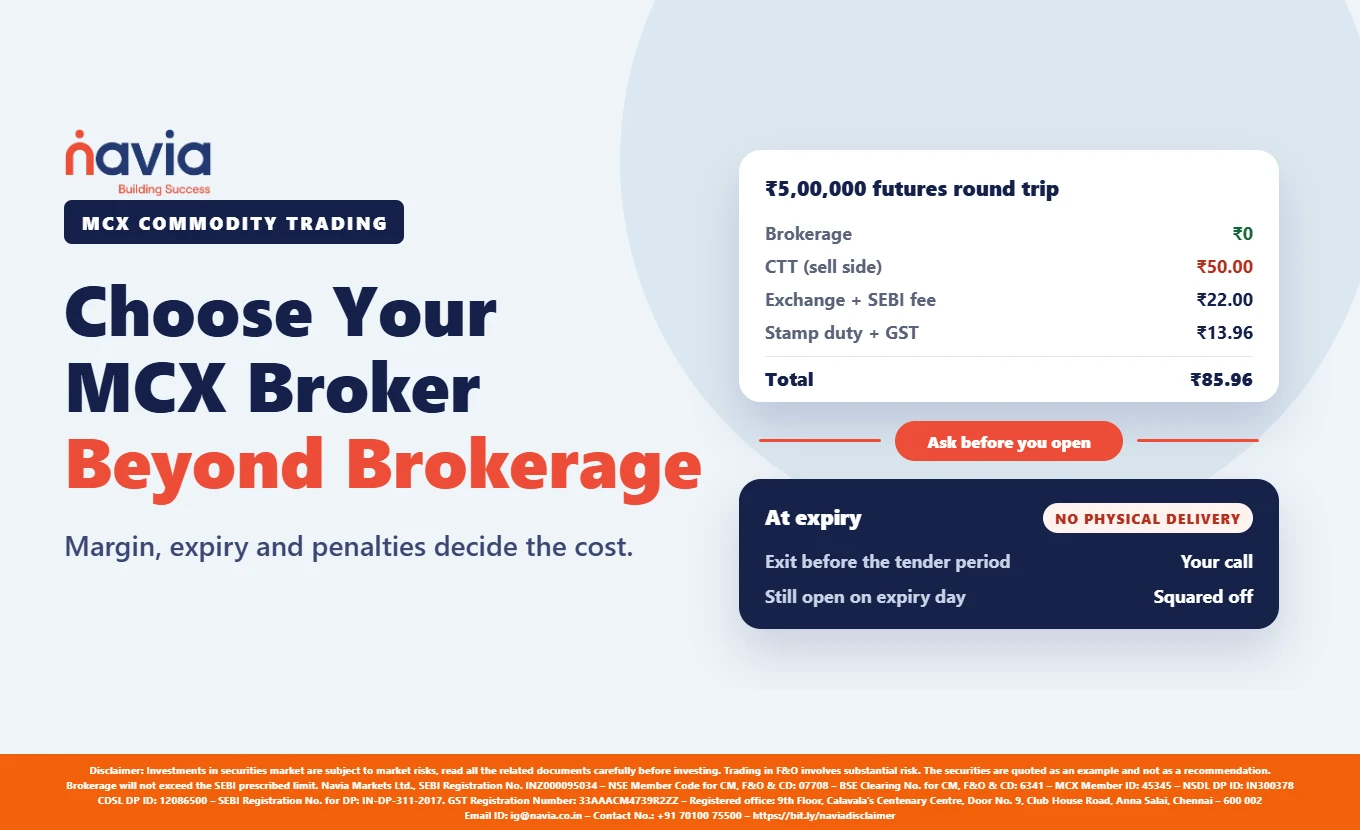
- Brokerage is no longer the differentiator. With ₹0 brokerage, the entire cost of a round trip is statutory. On a ₹5,00,000 contract that works out to roughly ₹86, and ₹50 of it is Commodity Transaction Tax (CTT) — a tax no broker can discount.
- CTT is charged on the sell side only, at 0.01% on non-agricultural futures and 0.05% on option premium. Your buy leg carries no CTT at all, so cost is not symmetric across the trade.
- Margin is SPAN plus exposure, published daily by the exchange. Ask whether your broker blocks the exchange figure or adds a buffer, and ask what the additional margin schedule looks like in the days before expiry.
- Navia does not offer physical delivery. Positions must be exited before the tender period. Navia’s own policy describes that window as beginning three days before expiry, which is shorter than SEBI’s minimum of five working days — take the date from the contract specification.
- A margin shortfall is penalised on a slab, starting at 0.5% of the shortfall and rising to 5% a day once it persists — plus 18% GST on the penalty itself.
What an MCX commodity account actually is
MCX is India’s largest commodity derivatives exchange, regulated by SEBI, and it trades futures and options on bullion, energy and base metals — gold, silver, crude oil, natural gas, copper, zinc and aluminium among them. If you have not traded commodities before, our guide to commodity trading in India covers the mechanics; this post assumes you have decided to trade and are choosing who to trade through.
To trade them you need a broker that is a member of MCX. Navia’s MCX Member ID is 45345. Since the commodity segment was brought under SEBI, a single trading account can carry equity, derivatives and commodities together rather than a separate commodity-only account, which is how Navia’s commodity trading account is structured.
That is the easy part. The six questions below are the ones that decide what the account actually costs you.
What margin will the broker block?
This is the single largest working-capital question in commodity trading, and the one most comparison tables skip.
MCX margin is not a fixed percentage. It is SPAN margin plus exposure margin, recalculated by the exchange every session. SPAN is derived from the contract’s own volatility; exposure is an additional slab on top. The total moves day to day, and it moves most when you least want it to — in a volatile session.
Daily MCX margin is published by the exchange in the MCX margin file. An MCX margin calculator simply reads from that file, which means any calculator is only as current as the file behind it — check today’s margin list before you size a position, not a figure you saved last month.
Illustrative arithmetic on a contract worth ₹5,00,000:
| Component | Rate | Amount |
|---|---|---|
| SPAN margin | 8% | ₹40,000 |
| Exposure margin | 1.5% | ₹7,500 |
| Total initial margin | 9.5% | ₹47,500 |
Rates shown are illustrative, to demonstrate the structure. The live figure for any contract comes from the exchange’s daily margin file — check it before you size a position.
Three things to establish with any broker:
- Does the broker block the exchange margin, or exchange margin plus a buffer? A buffer is not wrong — it absorbs intraday margin revisions — but you should know it exists before it surprises you.
- Is there a position cap on the platform? Navia’s stated maximum open position margin is ₹1 crore for commodity derivatives and ₹5 crore for equity derivatives, raised on request.
- Does additional margin get levied before expiry, and on what schedule? MCX levies extra margin on crude oil and natural gas during the last three trading days before expiry. For in-the-money options, physical delivery margin begins four days before expiration and steps up each day.
What you pay when brokerage is zero
Commodity brokerage charges are only one line of what you pay, and at ₹0 they are the line that no longer moves. Every remaining rupee of MCX trading charges is statutory. Here is a round trip on a ₹5,00,000 commodity futures contract at Navia’s published rates:
| Charge | Rate and side | Amount | Share |
|---|---|---|---|
| Brokerage | ₹0 | ₹0.00 | — |
| CTT | 0.01%, sell only | ₹50.00 | 58.2% |
| Exchange transaction charges | 0.0021%, both legs | ₹21.00 | 24.4% |
| SEBI turnover fee | 0.0001%, both legs | ₹1.00 | 1.2% |
| GST | 18% on brokerage + exchange + SEBI fee | ₹3.96 | 4.6% |
| Stamp duty (futures) | 0.002%, buy only | ₹10.00 | 11.6% |
| Total | ₹85.96 |
Computed from the rates published on Navia’s pricing page. The commodity quoted is an example and not a recommendation. Statutory rates are set by the authorities and change — confirm the current schedule before you trade.
Two things fall out of that table.
CTT is the cost. At 58% of the total it dwarfs everything a broker controls. It applies to non-agricultural commodities only — agricultural contracts are exempt — and it is levied on the seller, at 0.01% on futures and 0.05% on option premium. Sell a ₹20,000 option premium and CTT is ₹10.
The charge is not symmetric. CTT falls only on your sell leg, stamp duty only on your buy leg. A comparison that quotes a flat “cost per trade” is averaging two different numbers.
The full rate card sits on the pricing page, our post on Navia brokerage charges walks through it segment by segment, and the brokerage calculator will break a specific contract into its lines. Use one of those rather than working from a percentage in your head.
Commodity futures expiry — the question to ask first
Most MCX contracts are compulsory-delivery contracts. A contract still open at expiry results in an obligation to deliver or take delivery of the actual commodity — a kilogram of gold, thirty kilograms of silver. Some contracts are cash-settled instead, closing out at a due date rate with no commodity changing hands — our crude oil on MCX contract specs post shows CRUDEOIL and CRUDEOILM both listed as cash settled. Which logic applies is set in the contract specification, and on any contract you intend to hold near expiry it is the first thing to check.
Navia’s stated policy is that it does not offer physical delivery of commodities. Clients are required to close open futures positions before the MCX tender period. If a client has not closed out, Navia closes the position, and the client bears the resulting loss. On expiry day, in-the-money and close-to-the-money option positions are squared off to avoid delivery.
On the deadline itself, do not work from a general figure. SEBI’s circular of 26 July 2019 requires a staggered delivery period of at least five working days on every compulsory-delivery contract, agricultural and non-agricultural — that is the window in which open positions can be marked for delivery. Navia’s tender period article describes the window as beginning three days before expiry, which is shorter than the regulatory minimum. Check the staggered delivery start date on the contract specification for the contract you actually hold, and exit before it opens.
Note what that means in practice, because it cuts both ways. It protects you from an obligation you cannot meet. It also means you do not control the exit — if you are still holding, the timing of the close-out is the risk desk’s, not yours. And Navia’s own documentation is explicit that if the position cannot be squared off, it may still result in compulsory physical delivery with all costs falling on the client.
Physical delivery on MCX is not a theoretical risk; it is the default outcome of doing nothing. Ask any commodity broker three things:
- Do you offer physical delivery, or do you square off?
- On which day, exactly, do you close unexited positions?
- What additional margin is levied in the run-up, and on what schedule?
A broker that cannot answer the second question precisely is a broker whose risk desk will answer it for you.
What a margin shortfall costs
Margin requirements move daily. A shortfall is not hypothetical, and the penalty is a slab, not a flat fee. Navia’s published schedule:
| Situation | Penalty on the shortfall |
|---|---|
| Below ₹1 lakh and below 10% of applicable margin | 0.5% |
| ₹1 lakh or more or 10% or more of applicable margin | 1.0% |
| Shortfall persisting beyond 3 days | 5% for each further day |
| More than 5 shortfall instances in a calendar month | 5% for each further instance |
| MCX: 3 or more reported shortfalls in a month | 5% from the 4th instance onward |
18% GST applies on the penalty itself, and the entry is posted to the ledger on T+6.
The structure matters more than the base rate. A 0.5% penalty is small; 5% a day on a shortfall you have not noticed is not. Ask how and when the broker notifies you — Navia’s documentation describes margin shortfall intimation as best-effort, which is honest and worth knowing.
Platform and segment coverage
Worth confirming before you commit, because switching later means moving positions:
- Which contracts are available — bullion, energy, base metals, and whether commodity options are offered alongside futures, since the two have different margin and different CTT treatment.
- Whether margin is unified across segments or siloed per segment, which determines whether idle equity collateral can support a commodity position.
- Whether the charting and alerting tools you rely on cover MCX contracts, not just equity.
How to open a commodity trading account
MCX account opening follows the same eKYC path as any other segment — PAN, Aadhaar, bank proof, and an Aadhaar OTP e-Sign — so commodity trading account opening online is a matter of minutes rather than days. What differs is that commodities are a derivatives segment, and exchange KYC norms require income or net-worth proof on file before a derivatives segment is activated. Keep a recent bank statement, salary slip or ITR acknowledgement ready and the process does not stall.
At Navia the MCX trading account sits inside the same login as equity and derivatives, so there is no separate commodity-only account to manage.
The checklist
Six questions, in the order that matters:
- Do you offer physical delivery, and on exactly which day do you square off unexited positions?
- Do you block exchange margin or exchange margin plus a buffer?
- What is the additional margin schedule in the days before expiry?
- What does a round trip cost once CTT, exchange charges, SEBI fee, GST and stamp duty are added?
- What is the margin shortfall penalty slab, and how am I notified?
- What is the maximum open position the platform allows?
Answer those six for any broker and you will know more than a brokerage comparison can tell you.
Conclusion
Commodity trading is leveraged, and leverage is the reason the edges matter more than the headline rate. A ₹47,500 margin controlling a ₹5,00,000 contract means a 9.5% move against you takes the whole deposit — and the square-off arrives well before that.
Brokerage at ₹0 is worth having. It is simply not the thing that will decide how this goes. The margin the broker blocks, the day it closes your position, and what it charges when you are short — those will.
Trading in commodity derivatives involves substantial risk, including the risk of losing more than you planned on a position that moves modestly against you. If you want to see the terms in full before you commit, you can open a commodity trading account online with Aadhaar e-Sign — the page sets out the contracts, charges and platform tools in full.
Did you find this article helpful?
Your feedback helps us write better content.

Frequently Asked Questions
What is an MCX broker?
A broker holding membership of the Multi Commodity Exchange, which allows it to place client orders in MCX commodity futures and options. Membership is the minimum requirement; what differentiates one from another is margin policy, expiry handling and the statutory cost of a round trip. Navia’s MCX Member ID is 45345.
What are MCX commodity trading charges at Navia?
Brokerage is ₹0 on commodity futures and options. The remaining charges are statutory: CTT at 0.01% on the sell side of non-agricultural futures and 0.05% on option premium sold, exchange transaction charges of 0.0021% on futures and 0.0418% on options, SEBI turnover fee of 0.0001%, 18% GST on those, and stamp duty of 0.002% on the buy side of a futures trade. On a ₹5,00,000 futures round trip that totals about ₹86.
How much margin is needed for MCX trading?
SPAN margin plus exposure margin, recalculated by the exchange daily and published in the margin file. It varies by contract and by volatility rather than being a fixed percentage. Additional margin applies in the days before expiry, and for in-the-money options physical delivery margin begins four days before expiration.
Does Navia offer physical delivery of commodities?
No. Navia’s stated policy is that it does not offer physical delivery. Open futures positions must be closed before the tender period, and in-the-money and close-to-the-money options are squared off on expiry day. Navia’s policy describes the tender window as starting three days before expiry; SEBI requires a staggered delivery period of at least five working days, so take the actual start date from the contract specification.
What is the tender period in MCX?
The window before a contract’s expiry during which delivery intentions are submitted. SEBI requires a staggered delivery period of at least five working days on compulsory-delivery contracts. Navia’s policy describes the window as beginning three days before expiry and requires clients to close open positions before it starts, so check the staggered delivery start date on the contract specification you hold.
Is a separate account needed for commodity trading?
No. A single trading account can carry equity, derivatives and commodities. You will need income or net-worth proof on file, as commodities are a derivatives segment.
How do I choose the best commodity trading broker in India?
Compare the things a broker controls: how much margin it blocks over the exchange requirement, how it handles expiry and physical settlement, its margin shortfall penalty slab, its platform position limits, and the full statutory cost of a round trip rather than brokerage alone. A zero-brokerage rate on its own does not identify the best commodity trading account for you.
How do I open a commodity trading account online?
Complete eKYC with PAN, Aadhaar and bank proof, then e-Sign with an Aadhaar OTP. Because commodities are a derivatives segment, you will also need income or net-worth proof on file. An online commodity trading account at Navia carries equity, derivatives and commodities under one login, so there is no separate MCX commodity trading account to open.
Are all MCX contracts physically settled?
No. Most are compulsory-delivery contracts, where an open position at expiry becomes an obligation to deliver or receive the commodity. Others are cash-settled at a due date rate, including crude oil and natural gas. The settlement logic is stated in each contract specification — check it before holding a contract close to its expiry date.