

What Is STT, and What Do You Actually Pay Per Segment?
Quick answer
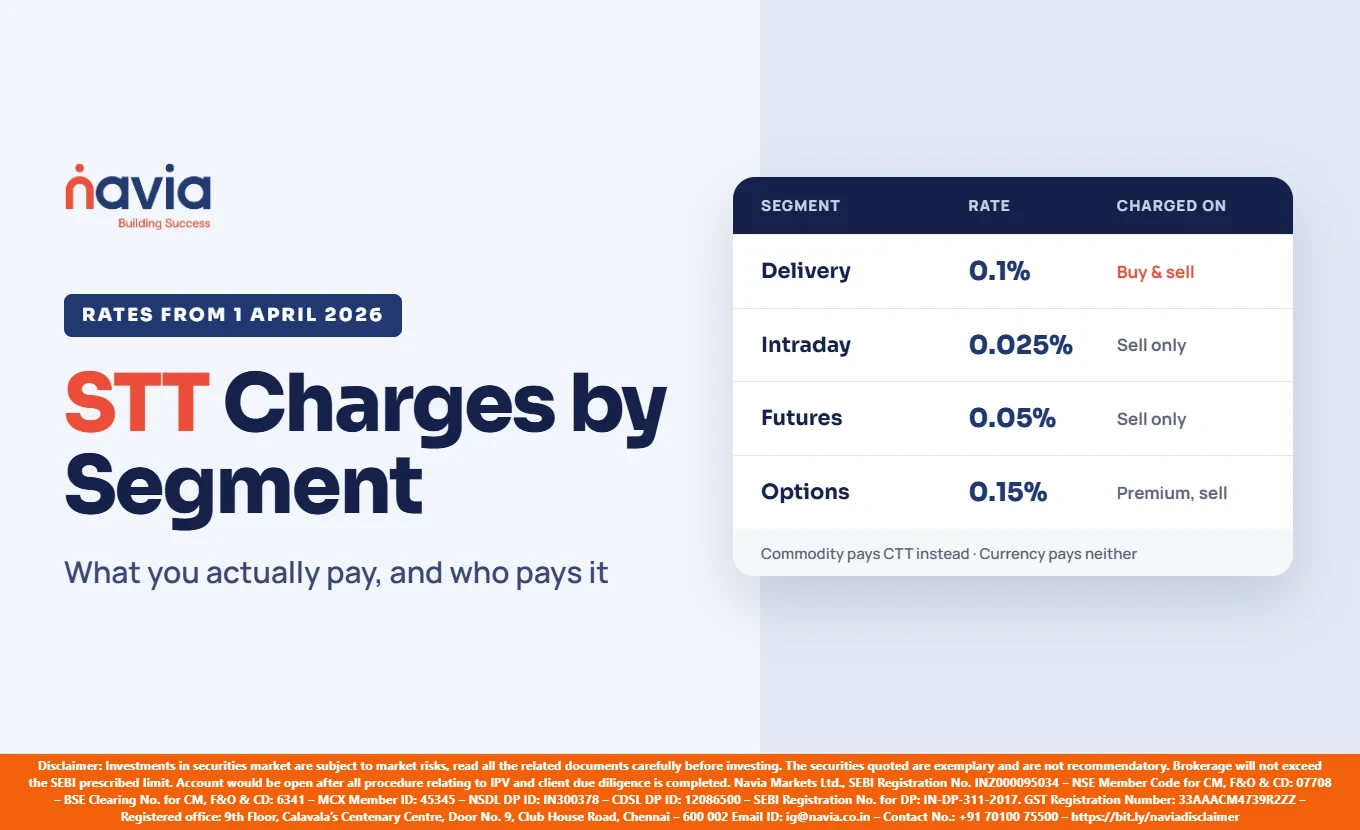
STT is the Securities Transaction Tax, charged on the value of a trade in a listed security and collected by the broker. Securities transaction tax rates differ by segment: from 1 April 2026, 0.1% on each leg of an equity delivery trade, 0.025% on an intraday sale, 0.05% on a futures sale, 0.15% on an option sale.
Delivery is the only segment taxed on both legs; everywhere else only the sale is charged. On an option exercised rather than squared off, the purchaser pays 0.15% of intrinsic value. Commodity trades pay Commodities Transaction Tax instead.
Key takeaways
- Equity delivery is the only segment charged on both legs — 0.1% when you buy and 0.1% when you sell. Everything else is sell-side only.
- Equity options are 0.15% of the premium, paid by the seller, raised from 0.10% on 1 April 2026. Futures went from 0.02% to 0.05%.
- On an option that is exercised, STT is 0.15% of intrinsic value and the purchaser pays it — the one row where the buyer is liable.
- Commodity derivatives do not attract STT at all. They attract Commodity Transaction Tax, at different rates. Currency derivatives attract neither.
- Equity mutual fund and ETF units are 0.001% on sale and nil on purchase.
What is STT and when is it charged?
A tax on the transaction itself, not on your profit.
STT is levied on the value of a trade in a listed security and is collected by the broker and remitted to the exchange, so it appears on the contract note whether the trade made money or lost it. Navia does not set it and cannot waive it — no broker can, because the rate is statutory and identical everywhere.
STT is charged per leg rather than per position. That distinction is what makes the segment table below worth reading: in most segments only the sale is taxed, so the cost of a round trip is not simply twice the cost of one side.
What are the STT rates in 2026?
Every equity segment, as in force from 1 April 2026.
| Segment and leg | STT rate | Payable by | Charged on |
|---|---|---|---|
| Equity delivery — purchase | 0.100% | Purchaser | Transaction value (VWAP) |
| Equity delivery — sale | 0.100% | Seller | Transaction value (VWAP) |
| Equity intraday — sale | 0.025% | Seller | Transaction value (VWAP) |
| Equity MF / ETF units — purchase | Nil | — | — |
| Equity MF / ETF units — sale | 0.001% | Seller | Transaction value (VWAP) |
| Equity futures — sale | 0.05% | Seller | Traded price |
| Equity options — sale of option | 0.15% | Seller | Option premium |
| Equity options — option exercised | 0.15% | Purchaser | Intrinsic value |
STT sits alongside the exchange transaction charge, SEBI turnover fee, stamp duty and GST — the charges that remain even at zero brokerage covers the rest of the contract note.
What changed on 1 April 2026?
Three derivatives rates went up. The cash segment did not move.
The option sale rate rose from 0.10% to 0.15% of premium, the futures sale rate from 0.02% to 0.05% of traded price, and the rate on an exercised option from 0.125% to 0.15% of intrinsic value. All three took effect for transactions from 1 April 2026 under the Finance Act 2026. Delivery and intraday equity rates are unchanged.
Any article still quoting 0.10% for options is describing the position up to 31 March 2026. Why the rates were raised covers the reasoning and the revenue estimate.
How much STT do you pay on delivery and intraday?
Delivery is taxed twice. Intraday is taxed once, at a quarter of the rate.
STT on delivery trading is 0.1% of the transaction value on the purchase and 0.1% again on the sale, which makes equity delivery the only segment where the buyer is routinely taxed. On a ₹1,00,000 round trip that is ₹100 each way, ₹200 in total.
STT on intraday trading is 0.025% and applies to the sale alone. The same ₹1,00,000 turned over intraday attracts ₹25, because the buy leg is not taxed and the rate is a quarter of the delivery rate. Units of an equity mutual fund or ETF are charged 0.001% on sale and nothing on purchase.
What is the STT on options, and who pays on exercise?
0.15% of premium from the seller — and 0.15% of intrinsic value from the buyer if it is exercised.
The STT charges on options that most people mean are the 0.15% levied on the option premium when a contract is sold, raised from 0.10% on 1 April 2026. Sell ten lots of a Nifty option at a premium of ₹100 with a lot of 65 and the premium value is ₹65,000, so STT is ₹97.50. The STT rate on equity futures works the same way at 0.05%, charged on traded price rather than premium.
The exercise row is the one worth knowing. STT on option exercise is charged at 0.15% of intrinsic value and, uniquely, the purchaser pays it. Let an in-the-money option run to expiry instead of squaring it off and the charge lands on you as the buyer, not on the writer. The charge is small on a small position, but it is a line most traders have never seen explained.
Do commodity and currency trades pay STT?
Commodity pays a different tax. Currency pays neither.
Commodity derivatives are outside STT altogether. They attract Commodities Transaction Tax, charged under Chapter VII of the Finance Act 2013 at its own rates, and it applies to non-agricultural commodities. Currency derivatives attract no STT and no CTT.
| Transaction | Rate | Payable by |
|---|---|---|
| Commodity derivative (futures) — sale | 0.01% | Seller |
| Option on a commodity derivative — sale | 0.05% | Seller |
| Option on a commodity derivative — exercised | 0.0001% | Purchaser |
| Currency derivatives | Nil | — |
What does STT cost on a real trade?
Less than most people assume on cash, more than they assume on options.
An STT calculation example makes the segment difference concrete. Buy and sell ₹1,00,000 of a stock on delivery and STT is ₹200 — ₹100 on each leg at 0.1%. Turn over the same ₹1,00,000 intraday and STT is ₹25, charged only on the sale at 0.025%.
Now sell one lot of a Nifty option at a premium of ₹150 with a lot size of 65. The premium value is ₹9,750 and STT at 0.15% is ₹14.63 on that single leg. Buying the option back to close costs no STT, because the purchase of an option is not a taxable leg. Across a day of writing options the 0.15% compounds quietly, which is why it moved the break-even for active sellers when it rose in April 2026.
Can you claim STT against tax?
That depends on how you report the activity.
Where trading is reported as business income, STT is allowable as a business expense. Where gains are reported as capital gains, STT is not deductible in computing the gain, so it reduces what you receive without reducing what you are taxed on. How to show stock market income in your ITR sets out how the two routes differ. Navia is not a tax adviser and the treatment turns on facts specific to you, so confirm the position with yours before filing.
Conclusion
STT is a fixed cost of participating, identical at every broker in India, and the only thing that varies between segments is which leg is taxed and at what rate. Delivery pays twice at 0.1%, intraday once at 0.025%, futures once at 0.05%, options once at 0.15% of premium, and an exercised option once more at 0.15% of intrinsic value to the buyer.
Commodity sits outside the regime entirely on CTT, and currency outside both. What you can change is the charge sitting next to STT on the same contract note: brokerage calculator will show you the full breakdown for a trade before you place it.
Educational content, not investment advice. STT and CTT rates are statutory and are revised by Finance Act; the rates shown are those in force from 1 April 2026. Confirm the current rates before you trade.
Did you find this article helpful?
Your feedback helps us write better content.

Frequently Asked Questions
What are the STT charges in 2026?
Equity delivery is 0.1% on both the purchase and the sale. Equity intraday is 0.025% on the sale only. Equity futures are 0.05% and equity options 0.15% of premium, both on the sale. An exercised option is 0.15% of intrinsic value, payable by the purchaser. Equity mutual fund and ETF units are 0.001% on sale.
What is the STT on options?
Equity options attract STT of 0.15% of the option premium, paid by the seller, with effect from 1 April 2026. The rate was 0.10% until 31 March 2026. If the option is exercised rather than squared off, a separate 0.15% applies to the intrinsic value and the purchaser pays it.
How much STT is charged on intraday trading?
Intraday equity trades attract STT of 0.025% on the sale only. Nothing is charged on the buy leg, which is why an intraday round trip costs a quarter of what the same value costs on delivery.
Who pays STT, the buyer or the seller?
The seller, in every segment except two. Equity delivery is charged on both sides at 0.1% each, and an exercised option is charged to the purchaser at 0.15% of intrinsic value. Everywhere else only the sell leg is taxed.
Do commodity trades attract STT?
No. Commodity derivatives attract Commodities Transaction Tax under Chapter VII of the Finance Act 2013, not STT. CTT is 0.01% on the sale of a commodity derivative and 0.05% on the sale of an option on one. Currency derivatives attract neither tax.
Can STT be claimed back or deducted?
If you report trading as business income, STT is allowable as a business expense. If you report gains as capital gains, STT is not deductible in computing the gain. Navia is not a tax adviser, and the treatment depends on how you file — confirm it with yours.