Margin Trading Facility (MTF) Brokers: What to Compare Before You Borrow
Quick answer
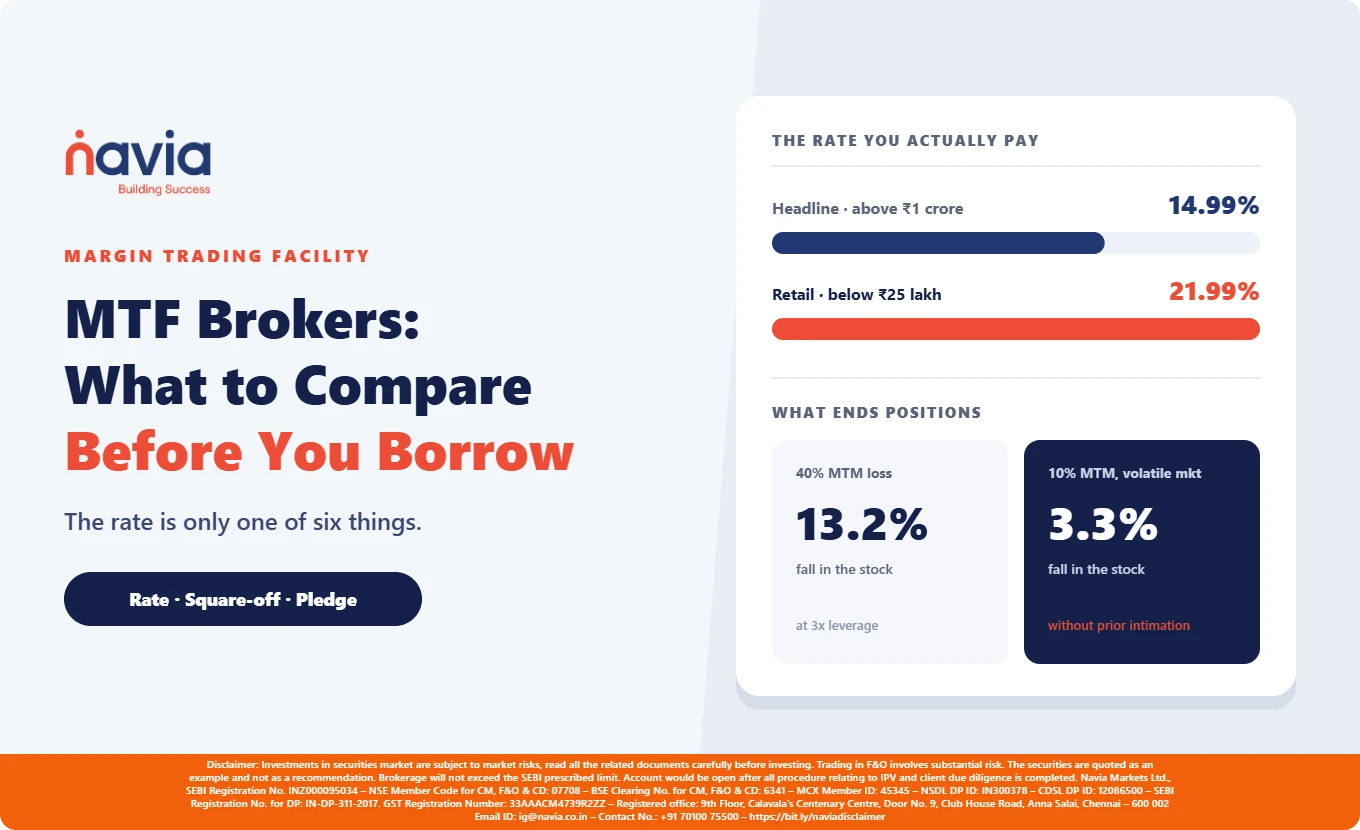
Most people choose a margin trading facility (MTF) provider on the interest rate. MTF interest is priced in bands, by how much you borrow — at Navia, from 14.99% a year above ₹1 crore to 21.99% below ₹25 lakh — so the first thing to work out is which band your own position falls in. But the rate is not what ends positions. The square-off trigger is: a 40% MTM loss, and in volatile markets 10% or more — which, at roughly 3x leverage, is a fall of about 3.3% in the stock. Six things are worth comparing before you borrow, and the rate is only one of them.
Key takeaways
- The rate is a slab. Below ₹25 lakh funded you pay 21.99%, not 14.99%. On ₹67,000 funded that is ₹40.37 a day against ₹27.52 at the top tier.
- Interest is charged on the funded amount, specifically the end-of-day debit balance after cash margin — not on the full position value.
- The square-off trigger decides outcomes, not the rate. A 10% MTM loss in a volatile market is about a 3.3% move against you at 3x leverage.
- Eligibility can change under you. Only Group I securities qualify, and a stock leaving that classification while you hold it can force an exit you did not choose.
- Pledge is mandatory. Funded shares are pledged in the depository system, and both the pledge and the unpledge carry a charge — at Navia, 0.02% of the value of the securities, minimum ₹50 per transaction.
What is a margin trading facility?
A margin trading facility — MTF — lets you buy shares in the cash segment with money your broker funds, against margin you put up yourself. You own the shares, the broker funds part of the purchase, and you pay interest until you sell or repay.
SEBI sets the minimum margin. For Group I securities that are part of the F&O segment it is VaR + 3 times the applicable ELM; for Group I securities outside F&O it is VaR + 5 times ELM. Navia caps MTF leverage at 3x, so in practice the margin you put up works out to at least 33% of the position. Navia collects slightly more than the SEBI minimum as a buffer against daily mark-to-market losses.
At the 33% floor, a ₹1,00,000 position means ₹33,000 of your own money and ₹67,000 funded — roughly 3x leverage. That is the maximum: a more volatile stock carries a higher VaR and ELM, so it needs more margin and gives you less leverage. Every figure below uses the 33% floor, which is the most leveraged case and therefore the tightest one.
The interest rate is a slab, not a single number
This is the first thing to check, and the place most comparisons go wrong. The rate depends on how much is funded:
| Funded amount | Annual rate | Per day | Cost per day on ₹50,000 |
|---|---|---|---|
| Above ₹1 crore | 14.99% | 0.041% | ₹20.53 |
| ₹75 lakh – ₹1 crore | 15.99% | 0.044% | ₹21.90 |
| ₹50 lakh – ₹75 lakh | 17.99% | 0.049% | ₹24.64 |
| ₹25 lakh – ₹50 lakh | 19.99% | 0.055% | ₹27.38 |
| Below ₹25 lakh | 21.99% | 0.060% | ₹30.12 |
A retail borrower funding under ₹25 lakh sits in the bottom row. That is 7 percentage points above the headline figure, and about 47% more per day.

When you compare providers, compare the rate in the band you will actually borrow in. A floor rate quoted for crore-plus borrowing tells you nothing about what a ₹67,000 position costs.
What is MTF interest actually charged on?
The second thing to check, and it changes the cost by roughly half if you get it wrong.
Interest applies to the funded amount, not the position value. At Navia it is calculated on the end-of-day debit balance — the MTF ledger balance minus your cash margin — and posted to the ledger weekly. If your cash margin exceeds the ledger balance on a given day, there is no net debit and no interest for that day.
On that ₹1,00,000 position with ₹67,000 funded, at the 21.99% retail tier:
- ₹40.37 a day
- ₹1,210.96 over 30 days
- ₹3,632.87 over 90 days
Which means the stock has to rise about 1.21% in 30 days just to cover the interest before you make anything. Hold the same position at the top tier instead and 30 days costs ₹825.48 — a ₹385 difference on one modest position.

What MTF charges apply beyond the interest?
Interest is the largest cost but not the only one. Check each of these:
- Pledge and unpledge charges, on both creating and releasing the pledge. Navia publishes these at 0.02% of the securities’ value, subject to a minimum of ₹50 per transaction.
- DP charges when you finally sell, levied per scrip and carrying 18% GST.
- Any shortfall or penalty charges if margin falls short.
Our post on Navia brokerage charges sets out the full rate card, and the brokerage calculator will break a specific trade into its lines.
Which stocks qualify, and what happens when the list changes
Only Group I securities, as classified by SEBI and the exchanges, are eligible for MTF. Navia funds over 1,000 stocks on that basis.
The part worth understanding is that this classification is not permanent. Group I membership depends on liquidity and impact-cost criteria the exchanges review periodically, so a stock can leave the group. What happens to a position you already hold if its stock leaves the group is not something most providers document, and it is worth asking before you borrow rather than after — the answer can mean adding margin or exiting a stock that has not moved against you at all. Ask any MTF broker two questions: where the current MTF stock list is published, and what notice you get if a holding drops off it.
The pledge step most borrowers miss
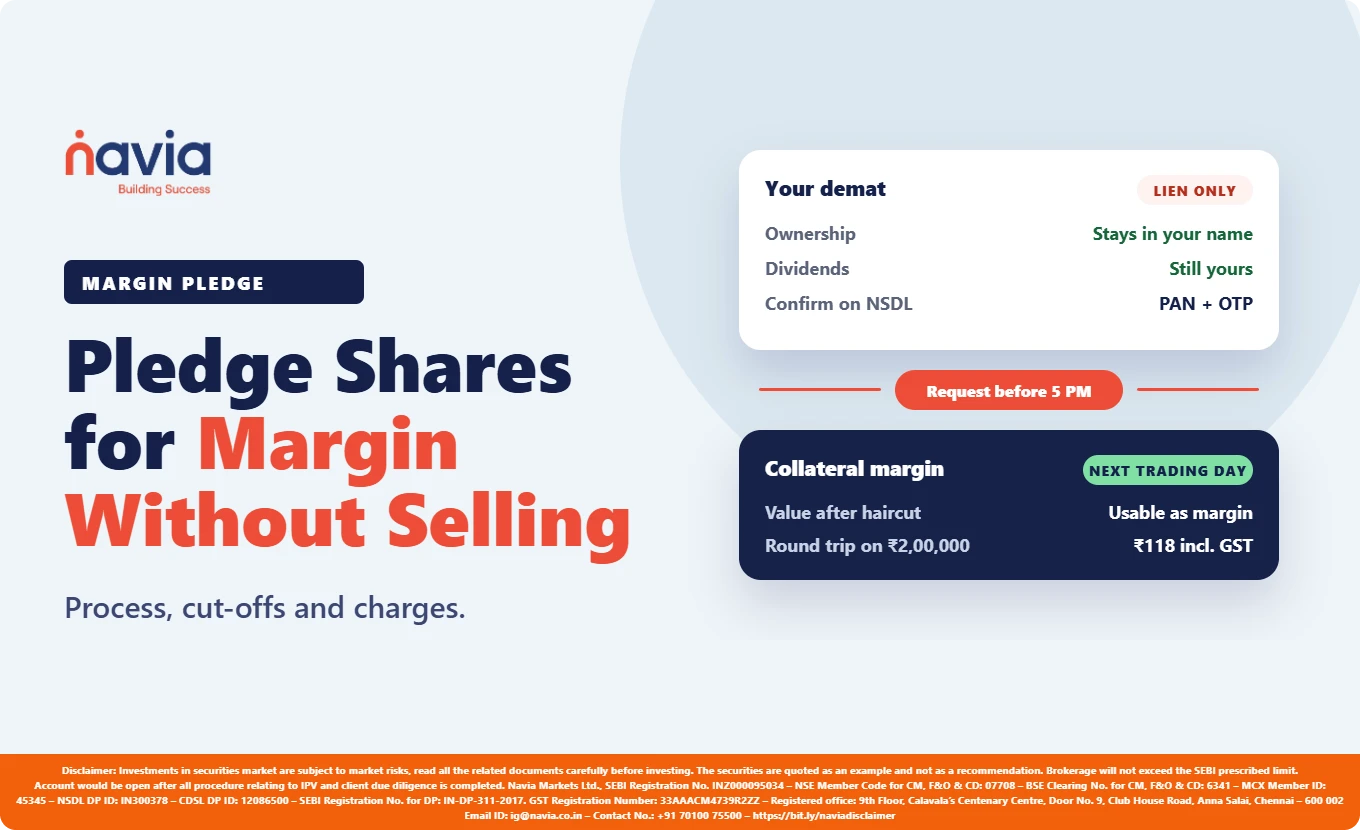
Shares bought under MTF must be pledged in the depository system — a requirement since September 2020, not a broker preference. The pledge is created in your name at NSDL or CDSL, and you confirm it through the depository rather than on the broker’s platform.
Two things to check: whether the provider creates the CDSL MTF pledge or NSDL MTF pledge automatically, and what both the pledge and the unpledge cost. Navia publishes this basis: the depository charge is levied per scrip per request, so holding several funded stocks multiplies it. Confirm the equivalent basis with any other provider — the two readings give very different totals.
Our post on pledging shares for margin covers the mechanics in full.
What gets your position squared off?
This is the variable that decides whether you keep the position, and almost nobody compares it.
Navia’s position square-off policy sets out the triggers. MTM percentage is measured against the margin you had available when the position started — not against the position value. The thresholds:
- A 40% MTM loss — positions may be squared off, intraday and carry-forward.
- In volatile markets, 10% MTM or more — positions may be squared off without prior intimation.
- Negative Net Available Margin at the start of the day — the risk desk may square off to cover the shortfall.
- Navia reserves the right to square off with or without prior notice depending on market conditions, and may liquidate funded or pledged shares if margins are not maintained.
Translate those into stock prices at the 3x maximum and they look very different:
| Trigger | Loss on ₹33,000 margin | Equivalent fall in the stock |
|---|---|---|
| 40% MTM | ₹13,200 | 13.2% |
| 10% MTM (volatile markets) | ₹3,300 | 3.3% |
A 3.3% move is an ordinary day for a mid-cap. That is the number to ask every provider about, and it is the one least likely to appear in a comparison table.

The six questions to ask before you borrow
- 1What rate applies to the amount I will actually fund — not the floor rate.
- 2Is interest charged on the funded amount or the position value, and is it daily on the end-of-day debit?
- 3At what MTM percentage do you square off, and what is the volatile-market threshold?
- 4How much notice do I get before a square-off, and is it partial or full?
- 5Where is the eligible stock list published, and what happens if a holding leaves it?
- 6What do the pledge, unpledge and exit charges add up to on the number of scrips I plan to hold?
Answer those six for any provider and you will know more than the rate comparison tells you.
Conclusion
Borrowing to buy shares magnifies both directions. At 3x leverage a 33% fall takes your entire margin, and the square-off arrives well before that. The interest rate matters — a 7-point spread between slabs is real money — but it is a slow cost you can see coming. The square-off trigger, the eligibility list and the pledge mechanics act suddenly, and they are worth asking about first.
Did you find this article helpful?
Your feedback helps us write better content.

Frequently Asked Questions
What is a margin trading facility?
A facility that lets you buy shares in the cash segment using money your broker funds, against margin you provide. You own the shares and pay interest on the funded amount until you sell or repay. SEBI sets minimum margins, which work out to at least 33% of the position for eligible securities.
What are the MTF charges at Navia?
Interest on a slab from 14.99% a year above ₹1 crore funded to 21.99% below ₹25 lakh, charged on the end-of-day debit balance. On top of that: pledge and unpledge charges, and DP charges plus GST when you sell.
Is MTF interest charged on the full position value?
No. It is charged on the funded amount — the MTF ledger balance minus your cash margin, measured at the end of each day. On a ₹1,00,000 position with ₹33,000 of your own margin, interest applies to ₹67,000, not ₹1,00,000.
Why is an MTF pledge needed?
Since September 2020, securities can be accepted as margin only through a pledge in the depository system. Shares funded under MTF are pledged at NSDL or CDSL in your name, and you confirm the pledge through the depository. Both creating and releasing the pledge carry a charge. At Navia the depository charge is levied per scrip per request, so several funded stocks multiply it.
When does a broker square off an MTF position?
When margins are not maintained. At Navia the stated triggers are a 40% MTM loss, 10% MTM or more in volatile markets without prior intimation, and negative Net Available Margin at the start of the day. MTM percentage is measured against the margin available when the position started, so at roughly 3x leverage a 10% MTM loss is about a 3.3% fall in the stock.
Which stocks can be bought using MTF?
Only Group I securities as classified by SEBI and the exchanges — over 1,000 stocks at Navia. The classification is reviewed periodically, so a stock can leave the group. What happens to a position you already hold if that occurs is rarely documented — ask your provider before you borrow.