GST on Brokerage: What It’s Charged On and What It Isn’t
Quick answer
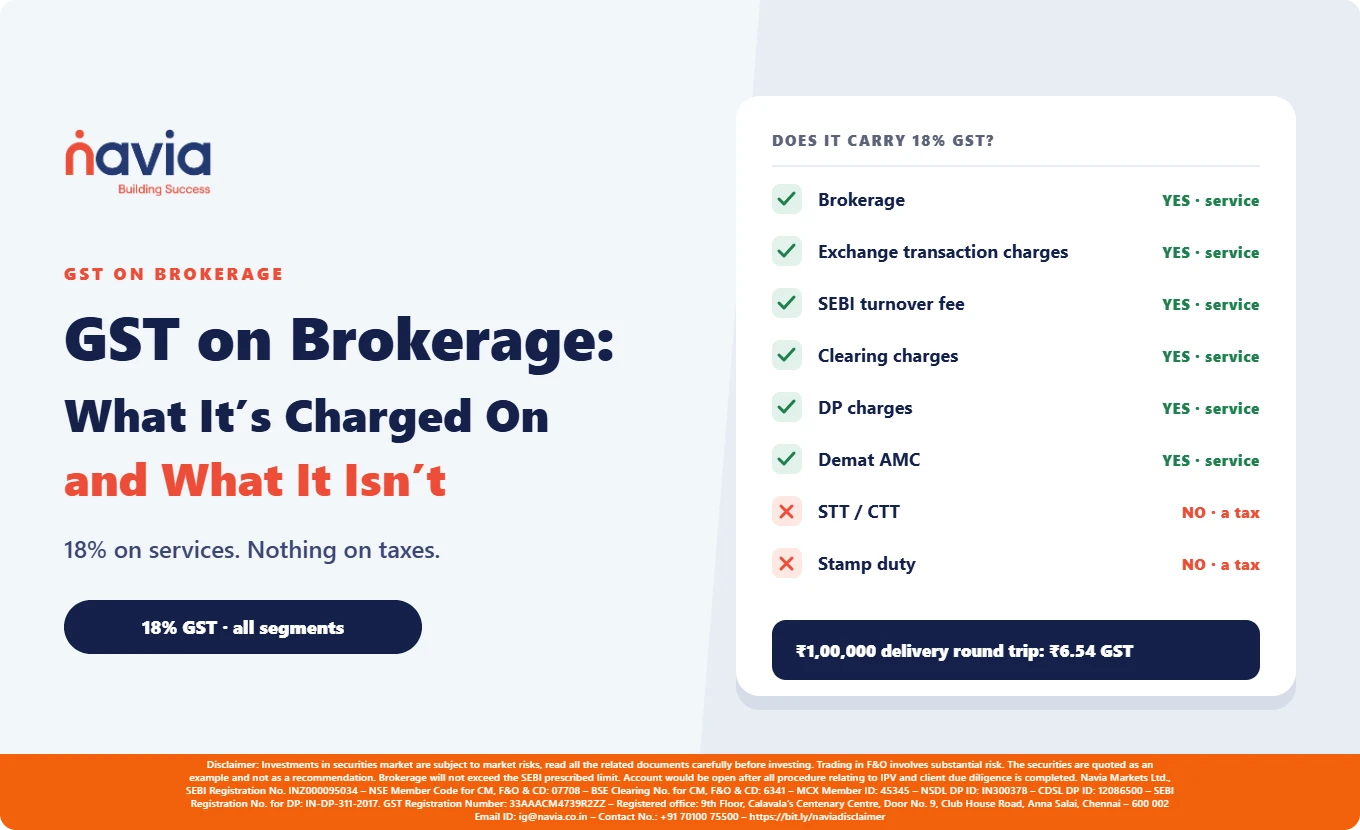
The rate of GST on brokerage is 18%, and it is charged on services — not on taxes. That single distinction explains most of what confuses people on a contract note. GST applies to brokerage, exchange transaction charges, the SEBI turnover fee, clearing charges, DP charges and demat AMC. It does not apply to STT or to stamp duty, because those are government levies your broker merely collects and passes on. When brokerage is ₹0, the GST base shrinks but does not disappear. On a ₹1,00,000 equity delivery round trip at Navia, you still pay ₹6.54 of GST — and ₹5.40 of that comes from the DP charge, not from trading at all.
Key takeaways
- GST is 18%, levied on services, not on taxes. Everything on a contract note falls into one of those two buckets, and that tells you instantly whether GST is added.
- STT and stamp duty carry no GST. On the ₹1,00,000 example they come to ₹215 — the largest part of the bill, and entirely outside the GST base.
- Zero brokerage removes the biggest service charge, so it removes most of the GST. It does not remove GST, because exchange, SEBI, clearing and DP charges remain.
- The DP charge is where retail GST actually comes from — 83% of the GST on that delivery round trip.
- Clearing charges belong in the GST base. In an options trade they can be nearly half of it, and leaving them out understates your GST materially.
What is the rate of GST on brokerage?
The rate of GST on brokerage is 18%, and it has been since GST replaced service tax in July 2017. There is no separate GST rate on brokerage for equity, F&O, currency or commodity — the same 18% applies across every segment. NSE lists it under “Stock brokers Services” in its schedule of levies, and that wording is the key to the whole subject.
GST is a tax on the supply of services. A broker executing your order is supplying a service. So is the exchange matching it, the clearing corporation settling it, and the depository holding the shares. Each of those charges carries 18% GST.
What GST never does is tax a tax.
What is GST charged on?
The charges that carry GST are all service charges:
| Charge | GST at 18%? | Whose service |
|---|---|---|
| Brokerage | Yes | Your broker |
| Exchange transaction charges | Yes | The exchange |
| SEBI turnover fee | Yes | The regulator |
| Clearing charges | Yes | The clearing corporation |
| DP charges | Yes | The depository participant |
| Demat AMC | Yes | The depository participant |
| Auto square-off, call & trade, advisory | Yes | Your broker |
| STT / CTT | No | A tax, not a service |
| Stamp duty | No | A State levy, not a service |
The reason STT and stamp duty sit outside is not an exemption anyone negotiated. They are taxes in their own right. GST is charged on the fee somebody earns for doing something; nobody earns STT.
This also means the value of the shares themselves is never taxed under GST. Securities are outside the scope of GST entirely, which is why a ₹1,00,000 purchase does not attract ₹18,000 of anything.
What do you pay when brokerage is ₹0?
Brokerage is usually the largest service charge on a retail trade, so removing it removes most of the GST base. What survives is everything the exchange, the regulator and the depository charge.
Take a ₹1,00,000 equity delivery round trip, bought and sold, with brokerage at ₹0:
| Line | Amount | In the GST base? |
|---|---|---|
| Brokerage | ₹0 | Yes, but it is zero |
| Exchange transaction charges (both legs) | ₹6.14 | Yes |
| SEBI turnover fee (both legs) | ₹0.20 | Yes |
| DP charge (sell side) | ₹30.00 | Yes |
| GST at 18% | ₹6.54 | — |
| STT (both legs) | ₹200.00 | No |
| Stamp duty (buy side) | ₹15.00 | No |
| Total charges | ₹257.88 | — |
Two things stand out. GST is ₹6.54 on a ₹257.88 bill — about 2.5% of what you actually pay. And ₹215 of that bill, the STT and stamp duty, carries no GST at all.

So the honest answer to “what GST do I pay when brokerage is zero” is: a small amount, and almost none of it is about trading.
Why the DP charge is where your GST comes from
Of that ₹6.54, the DP charge alone accounts for ₹5.40 — 83% of it.
The DP charge is levied when shares leave your demat account on a sale. At Navia it is 0.03% of transaction value with a minimum of ₹30 and a maximum of ₹300, plus GST, and it is levied per scrip. On a ₹1,00,000 sale of a single holding that works out to exactly ₹30, and 18% of ₹30 is ₹5.40. Sell three holdings the same day and the charge applies three times — ₹90 of DP charges and ₹16.20 of GST, not ₹30 and ₹5.40.
Because the charge has a floor, smaller sales pay the same ₹30 and therefore the same ₹5.40 of GST. The GST on a ₹5,000 sale is identical to the GST on a ₹1,00,000 sale. We cover how that floor behaves in DP charges: what changes when you sell over ₹1 lakh.

The practical point: for a delivery investor at zero brokerage, GST is effectively a tax on selling, not on trading.
Clearing charges: the line most calculators leave out
Equity delivery and intraday carry no clearing charge, which is why one does not appear in the table above. Futures, options and commodity trades do. A clearing charge is a fee the clearing corporation earns for settling the trade, so by the services-not-taxes rule it sits inside the GST base, and Navia’s published rate card treats it that way.
It is not a rounding detail. Take one Nifty options lot of 65, bought at a premium of ₹100 and sold at ₹120:
- Exchange transaction charges across both legs: ₹5.08
- SEBI turnover fee: ₹0.01
- Clearing charges: ₹4.29
- GST at 18% on all three: ₹1.69
- STT on the sell leg: ₹11.70, carrying no GST
Clearing charges are 46% of the GST base on that trade. A calculator that omits them understates your GST by nearly half. If you are reconciling a contract note against an online estimate and the GST line does not match, this is the first place to look.

How to calculate GST on share trading yourself
Three steps, and you can do it on any contract note:
- 1Add up the service charges. Brokerage, exchange transaction charges, SEBI turnover fee, clearing charges where they apply, and the DP charge on a sale.
- 2Leave out the taxes. STT or CTT, and stamp duty. These never enter the calculation.
- 3Multiply by 0.18. That is your GST.
If you want it done for you with Navia’s published rates already filled in, the Navia brokerage calculator breaks a trade into its individual lines before you place it. The full rate card across every segment is in Navia brokerage charges.
Conclusion
GST on brokerage is one of the simplest charges on a contract note once you know the rule: 18% on what people charge for services, nothing on what the government charges as tax. Brokerage, exchange, SEBI, clearing, DP and AMC are in. STT and stamp duty are out, and together they are usually the larger number.
Zero brokerage does not remove GST, but it removes the largest line from the base. What is left for a delivery investor is a few rupees, most of it attached to the DP charge on the day you sell.
Did you find this article helpful?
Your feedback helps us write better content.

Frequently Asked Questions
What is the rate of GST on brokerage?
18%. GST on brokerage charges has applied at that rate since GST replaced service tax in July 2017, and it is the same across equity, F&O, currency and commodity segments. There is no reduced rate for any type of trade.
Is GST charged on STT?
No. STT is a tax in its own right, collected by the broker and paid to the government, so GST is not applied on top of it. The same is true of stamp duty, which is a State levy on the transfer of securities. GST applies only to charges for services.
Do I pay GST if my broker charges zero brokerage?
Yes, though less of it. GST is charged on all the service components of a trade, not just brokerage. With brokerage at ₹0 you still pay 18% on exchange transaction charges, the SEBI turnover fee, clearing charges where they apply and the DP charge on the sell leg. On a ₹1,00,000 equity delivery round trip that comes to ₹6.54.
How do I calculate GST on share trading?
Add the service charges — brokerage, exchange transaction charges, SEBI turnover fee, clearing charges and the DP charge on a sale — then multiply the total by 0.18. Exclude STT, CTT and stamp duty, which carry no GST.
Is GST charged on DP charges?
Yes. The DP charge is a fee for a depository service, so 18% GST applies. At Navia the charge is 0.03% with a minimum of ₹30 on the sell side, levied per scrip, so the minimum GST is ₹5.40 for each holding you sell. For most retail delivery trades this is the largest single source of GST.
Can I claim the GST back?
Not as an individual investor. Input tax credit is available only to GST-registered persons using the service for business purposes, and trading in securities on your own account does not qualify. For a retail investor the 18% is a final cost.