

Navia Brokerage Charges: ₹0 and What Else You Pay
Knowing what a trade will cost before you place it is part of trading with a clear head. With Navia, the brokerage part is simple, it is zero. The charges that remain are set by the government and the exchanges, and they depend on what you trade. Here is the full picture.
💡 Quick Answer
Navia charges ₹0 brokerage for life on every segment — equity delivery, intraday, F&O, commodities, ETFs and IPOs — with 0% commission on direct mutual funds. What you pay are the statutory charges set by the government and regulators, which change by segment, plus a DP charge when you sell from demat.
Does Navia charge brokerage?
No, on trades you place yourself. Navia charges ₹0 brokerage for life on equity delivery, intraday, futures and options, commodities, ETFs and IPOs, and 0% commission on direct mutual funds. There is no account opening fee and no annual maintenance charge, for life. If you have seen a third party website quoting a percentage brokerage or an AMC for Navia, that information is out of date. Navia’s pricing, explained, and the pricing page carry the current and correct charges.
What charges apply when you trade on Navia?
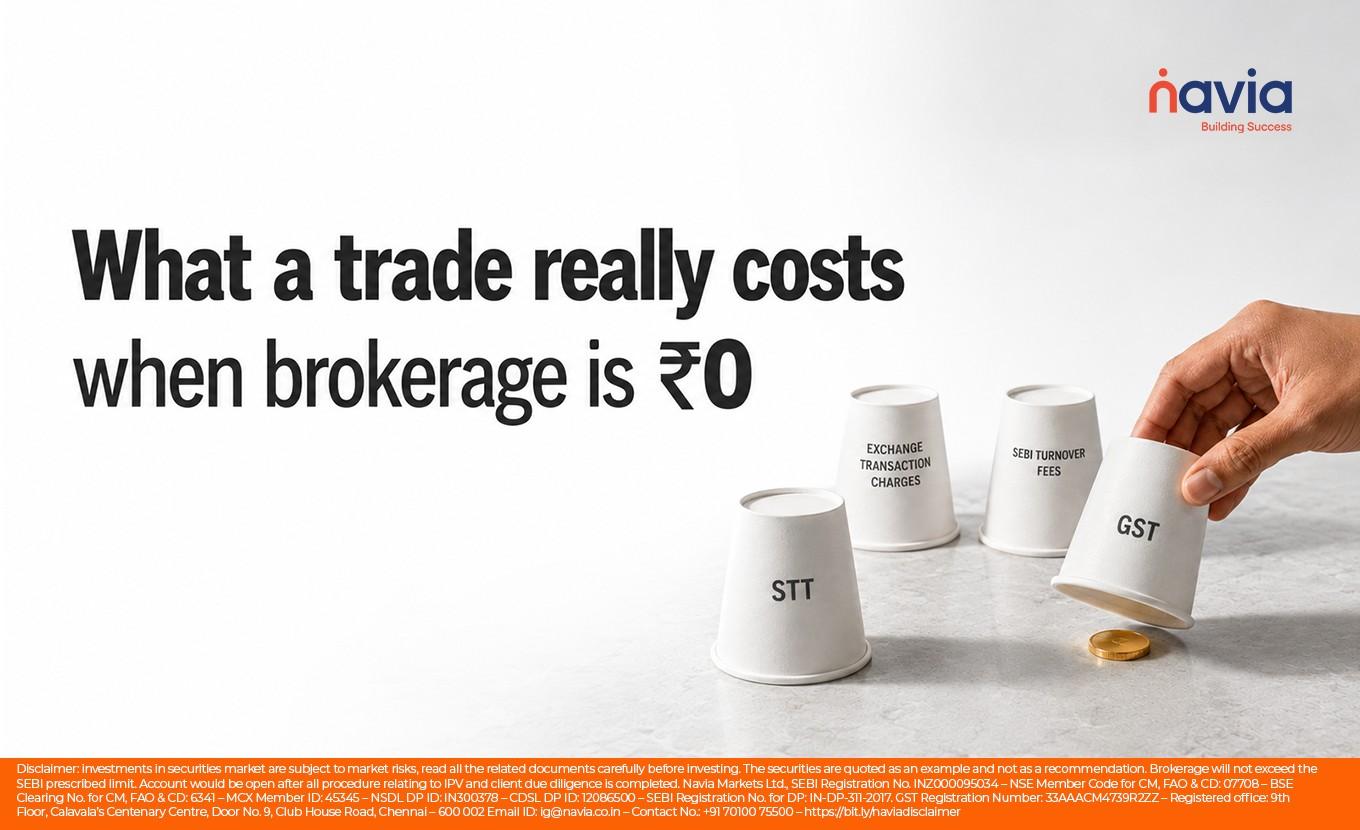
Every trade has three layers of cost. The first is brokerage, which at Navia is ₹0. The second is statutory charges, which no broker can waive because they are set by the government, SEBI and the exchanges. These are Securities Transaction Tax (STT), exchange transaction charges levied by the NSE, BSE or MCX, GST at 18%, a SEBI turnover fee and stamp duty. The third is operational charges, mainly a DP charge when you sell shares from demat, plus clearing charges on derivatives and a call and trade fee for phone orders. Only the first and third layers differ between brokers.
Navia charges by segment
What you actually pay depends on what you trade, because the statutory charges change by segment. Here is how a trade breaks down on Navia.
| Segment | Brokerage | Main statutory charges | DP charge |
|---|---|---|---|
| Equity delivery | ₹0 | STT 0.1% on buy and sell; exchange 0.0030699%; stamp duty 0.015% on buy; GST 18% | 0.03%, min ₹30, max ₹300 + GST, per scrip on sell |
| Equity intraday | ₹0 | STT 0.025% on sell; exchange 0.0030699%; stamp duty 0.003% on buy; GST 18% | None |
| Futures | ₹0 | STT 0.05% on sell; exchange 0.0018299%; stamp duty 0.002% on buy; GST 18% | None |
| Options | ₹0 | STT 0.1% on premium, sell; exchange 0.0355299% on premium; stamp duty 0.003% on buy; GST 18% | None |
| Mutual funds (direct) | ₹0 | None on direct plans | None |
Rates are as of FY 2026 to 2027 and are set by the government and regulators. Exchange transaction charges vary by exchange and are subject to change.
What a Navia trade costs: an example
Take a ₹1,00,000 equity delivery trade, bought and later sold. The brokerage at Navia is ₹0. STT is about ₹100 on the buy and ₹100 on the sell, exchange charges and GST come to a few rupees, stamp duty is about ₹15 on the buy, and the DP charge on the sell works out to ₹30, the minimum under the 0.03% rate. So the trade costs roughly ₹250 in all, none of it brokerage. On an intraday or F&O trade the mix changes, with lower STT and no DP charge, but the principle holds: brokerage is ₹0 and the statutory charges are the real cost. The exact figure depends on live rates.
Where to find every charge that applies
Navia’s pricing page lists every charge that applies, segment by segment — the statutory charges set by the government and the exchanges, and Navia’s own operational charges. Because brokerage is ₹0, those are the only costs on your trade. Checking them before a large or frequent order means there are no surprises on your contract note.

A note on cost and risk
Knowing your charges helps you trade efficiently, but it does not change the risk of the market. Prices can fall as well as rise, so read the scheme and risk documents before you invest, and treat cost as one factor alongside safety and service.
Conclusion
Navia’s brokerage is ₹0, so the cost of a trade is really the statutory charges that every broker collects, plus a small DP charge when you sell from demat. Knowing these before you trade, and checking them on the pricing page, means you always know your true cost. You can open a free account with ₹0 brokerage on the Navia All in One App. Navia Markets is registered with SEBI (Reg. No. INZ000095034).
Key Takeaways
- Navia charges ₹0 brokerage for life on equity delivery, intraday, futures and options, commodities, ETFs and IPOs, with 0% commission on direct mutual funds. Account opening and annual maintenance are also free.
- What you actually pay are the statutory charges — STT, exchange transaction charges, GST at 18%, the SEBI turnover fee and stamp duty. No broker can waive them, so they are identical wherever you trade.
- The rates change by segment: STT is 0.1% on both sides for equity delivery, 0.025% on the sell for intraday, 0.05% on the sell for futures and 0.1% on the premium for options.
- The DP charge is 0.03% of transaction value, subject to a minimum of ₹30 and a maximum of ₹300 plus GST, charged per scrip and only when you sell from demat. It does not apply to intraday or F&O trades.
- On a ₹1,00,000 equity delivery trade bought and sold, the whole cost works out to roughly ₹250 — ₹100 STT each side, about ₹15 stamp duty, a ₹30 DP charge and a few rupees of exchange charges and GST — none of it brokerage.
Did you find this article helpful?
Your feedback helps us write better content.

Frequently Asked Questions
Does Navia charge any brokerage?
No. Navia charges ₹0 brokerage for life on equity delivery, intraday, F&O, commodities, ETFs and IPOs, with 0% commission on direct mutual funds, for trades you place yourself. You still pay statutory charges set by the government and regulators.
What charges do I pay on a Navia trade if brokerage is zero?
Statutory charges, that is STT, exchange transaction charges, GST, the SEBI turnover fee and stamp duty, plus a DP charge when you sell shares from demat and a few operational charges on some trades. These are the same at every broker.
Do Navia’s charges change by segment?
The brokerage is ₹0 on every segment, but the statutory charges differ. STT is 0.1% on both sides for equity delivery, 0.025% on the sell for intraday, and applies to the sell side on F&O. A DP charge applies only when you sell shares from demat.
Does Navia charge an AMC or account opening fee?
No. Account opening is free and there is no annual maintenance charge on your demat account, for life. There are no subscription or platform fees either. Some third party sites list an old AMC for Navia, which is not current.
What are Navia’s DP charges?
A DP charge of 0.03% of the transaction value, with a minimum of ₹30 and a maximum of ₹300, plus GST, applies when you sell shares from your demat account. It does not apply to intraday or F&O trades, which are cash settled.
How do I check my exact charges before trading on Navia?
Navia’s pricing page lists every charge that applies. The Statutory charges tab gives the STT, exchange transaction, stamp duty and GST rates for each segment, and the Other charges tab covers DP, clearing and call and trade charges. Because brokerage is ₹0, those rates are the whole cost of your trade. The page also has a savings slider that estimates what you save in brokerage over a year based on how many orders you place a day, and the exact rupee figure for a completed trade appears on your contract note.
DISCLAIMER: Investment in securities market are subject to market risks, read all the related documents carefully before investing. The securities quoted are exemplary and are not recommendatory. Full disclaimer: https://bit.ly/naviadisclaimer.