

How to Open an HUF Demat Account: Documents and Process
Quick answer
An HUF demat account cannot be opened online. Navia opens it in physical mode only, which is why the paperwork matters more here than for an individual account. You email [email protected], an onboarding executive sends the Non-Individual Account Opening Form, the Karta signs every page and affixes the HUF seal, and the set is posted to Navia’s corporate office.
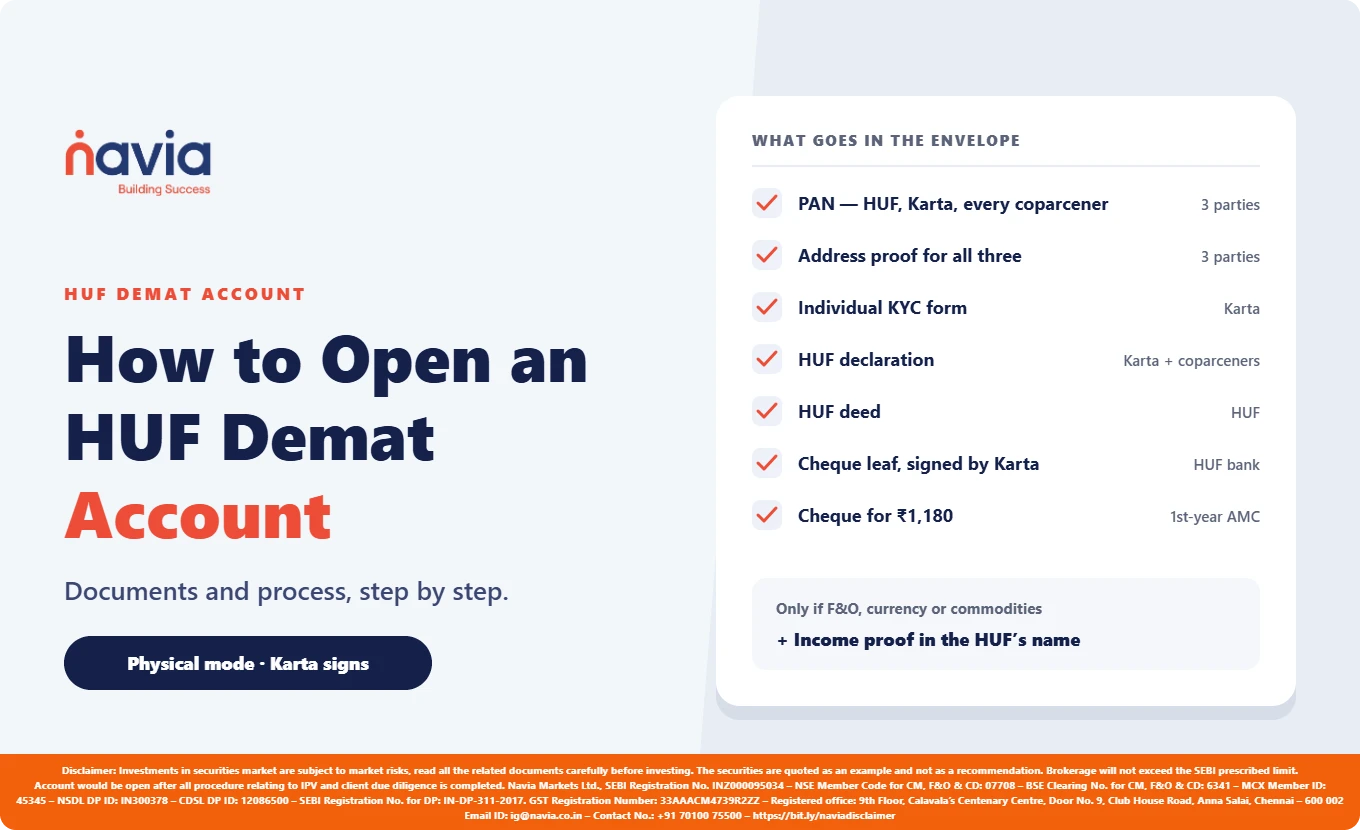
Nine documents travel with it, including self-attested PAN for the HUF, the Karta and every coparcener, the HUF deed, a cheque leaf signed by the Karta, and a cheque for ₹1,180 — the first year’s annual maintenance charge of ₹1,000 plus GST.
Key takeaways
- HUF demat accounts are offline only. There is no eKYC route; the form and documents are signed in wet ink and posted.
- The document set covers three parties — the HUF itself, the Karta, and every coparcener — not just the person signing.
- The ₹1,180 cheque is the first year’s AMC (₹1,000 + GST), not an account opening fee. Navia’s KB states no opening fee for an HUF account.
- An HUF account does carry an annual maintenance charge, unlike Navia’s resident individual demat accounts, which are ₹0 AMC for life.
- F&O, currency and commodity activation needs income proof in the HUF’s name on top of the base set.
Can an HUF open a demat account?
Yes. A Hindu Undivided Family is a separate legal entity with its own PAN, and it can hold securities in its own name.
What is an HUF demat account in practice? It is an account where the holdings belong to the family unit rather than to any individual member. The account is operated by the Karta, the senior-most member who acts on the HUF’s behalf, while the other members — the coparceners — have a beneficial interest but do not operate the account.
That structure is why the paperwork is heavier than for an individual account. The depository participant has to establish that the HUF exists, that the person signing is its Karta, and who the coparceners are.
Can you open an HUF demat account online?
No. Navia opens HUF accounts in physical mode only.
Navia’s support documentation states plainly that an HUF account cannot be opened online and that the process has to be completed in physical mode. There is no Aadhaar eKYC or digital signature route for it, which is the single biggest difference from opening an individual account.
This is worth knowing before you start, because a search for how to open an HUF demat account online, or for how to open HUF demat account online, will return plenty of pages implying it is a five-minute job. For an HUF it is not. Budget for printing, wet-ink signatures across a document set, the HUF seal, and a postal round trip.
What documents are required for HUF account opening?
Nine items, covering the HUF, the Karta and every coparcener.
The HUF account opening documents fall into three groups: identity and address for each party, proof that the HUF exists, and the cheque. Here is the full list of documents required for an HUF demat account.
| # | Document | Whose |
|---|---|---|
| 1 | Self-attested PAN card | HUF, Karta and all coparceners |
| 2 | Individual KYC form | Karta |
| 3 | Address proof — passport, Aadhaar, voter ID, driving licence or latest bank statement, self-attested | HUF, Karta and coparceners |
| 4 | Copy of a cheque leaf from the HUF’s bank account, signed by the Karta | HUF |
| 5 | HUF declaration, signed by the Karta and coparceners | HUF |
| 6 | Cheque for ₹1,180 payable to Navia Markets Ltd. | HUF |
| 7 | HUF deed | HUF |
| 8 | Female Karta declaration, where the Karta is a woman | Karta |
| 9 | Income proof — only if activating F&O, currency or commodities | HUF |
The item people most often miss is the first one. PAN is needed for every coparcener, not only for the Karta — so a family of four means four PAN copies plus the HUF’s own.

What is the step-by-step process?
Four steps, and the sequence matters because the form comes from Navia rather than from a download page.
- 1Email [email protected] to start. An onboarding executive is assigned and guides you through the rest. Starting here rather than with a generic account-opening link is what gets you the right form.
- 2Obtain and complete the Non-Individual Account Opening Form. The HUF form is the non-individual form, not the retail one.
- 3Have the Karta sign the form and every supporting document, and affix the HUF seal. Wet-ink signatures throughout, and the seal on the documents that call for it.
- 4Post the completed set to Navia’s corporate office. The address is on Navia’s contact page. Keep a copy of everything you send.
If you also want derivatives enabled, add the income proof described below to the same envelope. Sending it later means a second round trip.

What does an HUF demat account cost?
There is no account opening fee stated for an HUF account. The HUF demat account charges you pay upfront are the first year’s annual maintenance charge.
The ₹1,180 cheque that travels with the application is ₹1,000 of AMC plus GST. It is not an opening charge, and it is the figure most people misread.
| Item | Amount |
|---|---|
| Account opening fee | None stated |
| Annual maintenance charge | ₹1,000 a year |
| AMC with 18% GST | ₹1,180 |
This is where an HUF account differs from an individual one. Navia’s resident individual demat accounts carry ₹0 annual maintenance for life. An HUF account does not — it carries the ₹1,000 annual charge above. If you are comparing the two, that recurring charge is the real difference, not the opening cost.

Navia’s guide to demat account charges covers the charges that apply to any demat account alongside this one. To see what trading itself costs once the account is live, use the Navia brokerage calculator. Brokerage will not exceed the SEBI prescribed limit.
What extra documents does F&O activation need?
One income proof in the HUF’s name, signed by the Karta with the HUF seal.
Any one of the following satisfies it:
- Six months of bank statements, or passbook copies
- Latest income tax return acknowledgement
- Net worth certificate
- Demat holding statement
The requirement applies to F&O, currency derivatives and commodities alike, and the document must be in the HUF’s name — the Karta’s personal bank statement does not satisfy it. Trading in F&O involves substantial risk.
Who signs — and what if the Karta is a woman?
The Karta signs everything. Where the Karta is a woman, one additional declaration is required.
The Karta is the member who operates the account and binds the HUF. Coparceners sign the HUF declaration, but they do not operate the account or place orders.
Navia’s document list provides for a female Karta declaration, required where the Karta is a woman — so a woman acting as Karta is accommodated in the process. It is a single additional form, not a different process, but omitting it will hold up the application. Navia is not a legal adviser, and who may act as Karta turns on the family’s own position; confirm it with your advisers if there is any doubt.
Conclusion
The HUF account itself is straightforward. The paperwork is what delays it, and almost always for the same reason: a missing PAN or address proof for a coparcener.
Collect PAN and address proof for the HUF, the Karta and every coparcener before you start, keep the HUF deed and seal to hand, and write the ₹1,180 cheque for the first year’s AMC. If you are also weighing up an individual account alongside it, Navia’s demat account checklist covers what to compare. If derivatives are wanted, put the income proof in the same envelope.
Educational content, not investment advice. Document requirements and charges are those published at the time of writing and are revised from time to time; confirm the current list and fee with your onboarding executive before posting your application.
Did you find this article helpful?
Your feedback helps us write better content.
Frequently Asked Questions
Can an HUF open a demat account?
Yes. A Hindu Undivided Family is a separate legal entity with its own PAN and can hold securities in its own name. The account is operated by the Karta on the family’s behalf, while coparceners hold a beneficial interest without operating it.
Can an HUF demat account be opened online?
No. Navia opens HUF accounts in physical mode only — there is no eKYC or digital signature route. The form and supporting documents are signed in wet ink by the Karta, stamped with the HUF seal, and posted to Navia’s corporate office.
What documents are required for HUF account opening?
Self-attested PAN for the HUF, the Karta and every coparcener; an individual KYC form for the Karta; address proof for all three parties; a cheque leaf from the HUF bank account signed by the Karta; an HUF declaration signed by the Karta and coparceners; the HUF deed; a ₹1,180 cheque; and a female Karta declaration where applicable.
What is the ₹1,180 cheque for?
That cheque is the first year’s annual maintenance charge — ₹1,000 plus GST — not an account opening fee. Navia’s support documentation states no opening fee for an HUF account.
Does an HUF demat account have an annual maintenance charge?
Yes, ₹1,000 a year plus GST. This differs from Navia’s resident individual demat accounts, which carry ₹0 annual maintenance for life.
What extra documents does an HUF need for F&O?
One income proof in the HUF’s name, signed by the Karta with the HUF seal: six months of bank statements or passbook copies, the latest ITR acknowledgement, a net worth certificate, or a demat holding statement. The same requirement covers currency derivatives and commodities.