

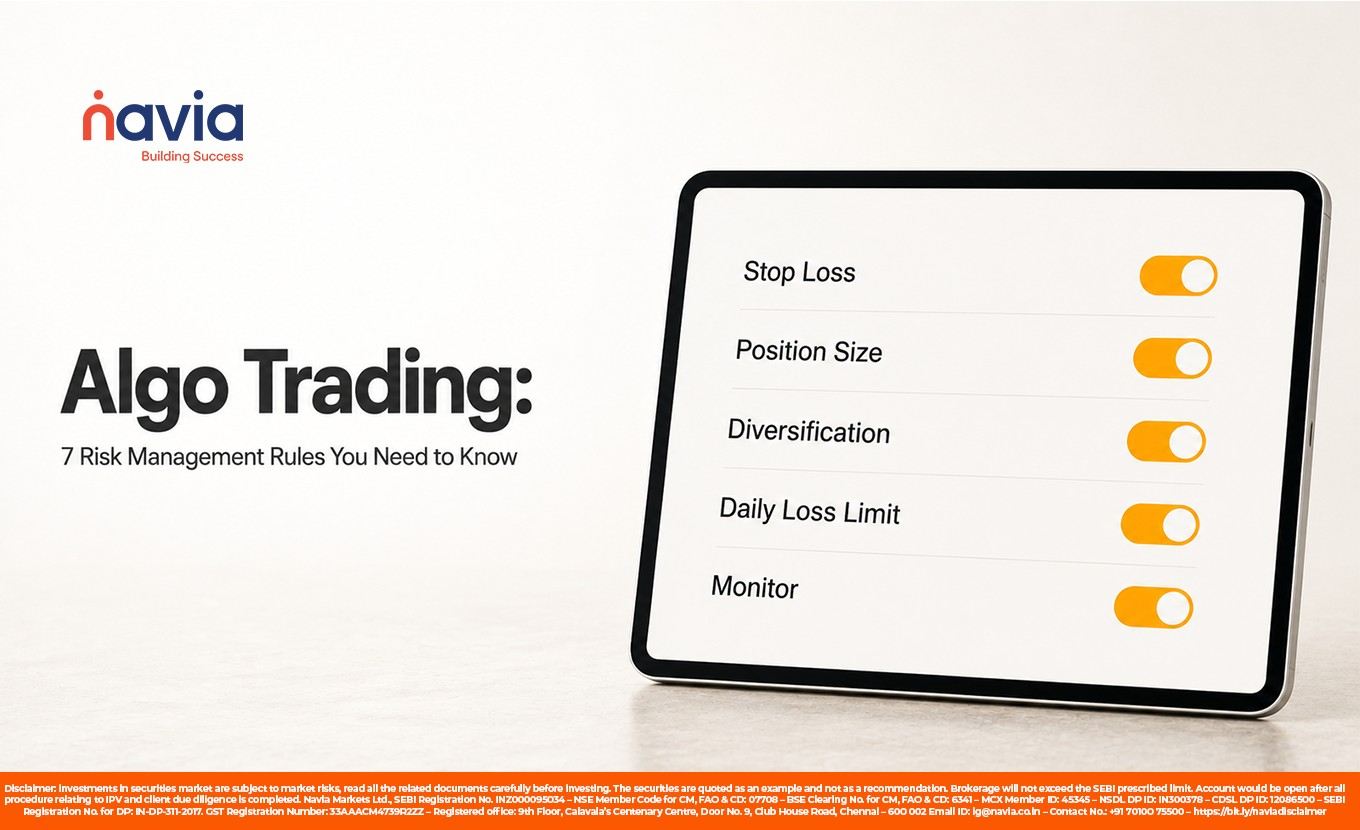
Algo Trading: 7 Risk Management Rules You Need to Know
- Why Does Risk Management Matter in Algo Trading?
- Rule 1: Size Every Position With Care
- Rule 2: Always Use a Stop-Loss
- Rule 3: Set Daily Loss and Drawdown Limits
- Rule 4: Keep a Kill Switch Ready
- Rule 5: Do Not Over-Optimize Your Strategy
- Rule 6: Monitor Your Algos in Real Time
- Rule 7: Diversify to Spread Your Risk
- The Recovery Math You Should Never Forget
- Conclusion
- Frequently Asked Questions
Algo trading can execute trades based on predefined rules and conditions. But automation carries risks too. A weak strategy can lead to losses quickly. This is why risk management matters.
Effective algo trading risk management can help traders manage potential losses and trading exposure. Here are 7 simple rules to help manage risk and safeguard your trading capital.
Why Does Risk Management Matter in Algo Trading?
An algo follows predefined rules without making discretionary decisions based on emotions. If a strategy contains a flaw, it may repeat the same actions across multiple trades. That is one of the risks of automated trading.
Effective risk management can help limit trading exposure and manage potential losses when a trading strategy does not perform as expected.
Rule 1: Size Every Position With Care
Position sizing is an important part of risk management. It helps determine how much capital you allocate or expose to a single trade.
Some traders use fixed percentage limits, such as 1% or 2% of their total capital. However, the appropriate level depends on the trader, strategy, and risk tolerance.
A position size limit can help manage exposure to losses from an individual trade. It cannot guarantee that losses will remain within a specific amount or prevent significant losses under all market conditions.
Rule 2: Always Use a Stop-Loss
A stop-loss can help define an exit level for a trade if the price moves against your strategy. Set it based on your trading plan rather than at a random level.
Some traders use technical reference points, such as a swing high or swing low, when defining a stop-loss. The appropriate level depends on the strategy and market conditions.
Including a stop-loss as part of your risk management plan can help manage trading exposure. However, a stop-loss does not guarantee execution at the specified price, especially during volatile market conditions or price gaps.
Rule 3: Set Daily Loss and Drawdown Limits
Even well-tested systems can experience losing periods. Set daily loss and drawdown limits based on your trading strategy, capital, and risk tolerance.
Some traders use predefined percentage limits, such as a daily loss limit or a maximum drawdown threshold. These levels can vary depending on individual circumstances.
When a limit is reached, review the strategy and market conditions before continuing. Such limits can help manage trading exposure, but they cannot guarantee the prevention of losses or protect trading capital under all market conditions.
Rule 4: Keep a Kill Switch Ready
A kill switch can help stop or disable algo trading when manual intervention becomes necessary. It may be useful during unusual market conditions or when a system behaves unexpectedly.
Traders can use a kill switch or other risk controls to pause automated activity and review the situation. A malfunctioning or poorly designed algo may create unintended trading exposure.
Applicable regulatory and platform requirements may also include controls for managing or disabling algorithmic trading activity. A kill switch can support risk management, but it cannot eliminate market, technology, or execution risks.
Rule 5: Do Not Over-Optimize Your Strategy
A strategy can appear effective under certain historical market conditions but perform differently when market conditions change. Over-optimization happens when you repeatedly adjust rules to closely match past price movements.
This can make a trading strategy appear more reliable than it may be across different market environments. Keep your rules clear and avoid unnecessary adjustments.
Evaluate your algo trading strategy across a range of market conditions. Simple strategies may be easier to understand and manage, but no approach can guarantee future performance.

Rule 6: Monitor Your Algos in Real Time
Algo trading does not always mean a completely hands-off approach. Traders should regularly monitor their systems, including open positions, drawdown, and daily profit or loss.
Real-time monitoring can help identify unexpected system behaviour, execution issues, or changes in trading conditions. Regular checks may allow traders to review and respond to potential issues.
However, monitoring cannot prevent all losses or eliminate market, technology, or execution risks.
Rule 7: Diversify to Spread Your Risk
Avoid concentrating all your trading capital in a single algo or trading strategy. Diversifying across different strategies or assets can help spread trading exposure.
However, diversification works best when the strategies or positions do not carry similar risks. Traders can also review correlations to understand whether seemingly different positions may react similarly under certain market conditions.
Diversification is an important part of risk management, but it cannot eliminate losses or guarantee protection during adverse market conditions.
The Recovery Math You Should Never Forget
Recovering from a large drawdown can require a disproportionately larger gain. For example, a 50% loss requires a 100% gain on the remaining capital to return to the original value.
This is why managing downside risk is an important part of any trading approach. In algo trading, risk management can help traders control exposure and assess potential losses. However, no risk management approach can guarantee the protection of capital or prevent losses.
You can learn, test, and track your trades on the Navia All in One App.
Conclusion
Algo trading can execute predefined instructions quickly, but speed also makes risk management important. These seven rules can help traders manage trading exposure and potential losses.
Size each position with care. Use a stop-loss as part of your trading plan. Set drawdown limits. Keep a kill switch available where applicable. Avoid over-optimization. Monitor your algo regularly. Diversify your trading capital across strategies or exposures where appropriate.
No risk management approach can guarantee profits or prevent all losses. However, combining appropriate controls may help traders manage risk more systematically in algo trading.
Did you find this article helpful?
Your feedback helps us write better content.
Frequently Asked Questions
What is risk management in algo trading?
Risk management involves managing potential losses and trading exposure in algo trading. It can include position sizing, stop-loss orders, and drawdown limits as part of a broader trading approach.
How much should I risk per trade?
The appropriate risk level depends on your trading capital, strategy, and risk tolerance. Some traders use predefined percentage limits to manage exposure to an individual trade.
What is a kill switch in algo trading?
A kill switch can stop or disable algo trading when manual intervention becomes necessary. It can help pause automated activity and allow the trader to review the situation.
What is drawdown in trading?
Drawdown refers to the decline in account value from a previous peak to a subsequent low. The impact of a drawdown can vary depending on its size and the trader’s overall approach.
Why is over-optimization risky?
Over-optimization happens when a trading strategy is repeatedly adjusted to closely match past market conditions. The strategy may then perform differently when market conditions change.
Does risk management guarantee profit?
No. Risk management cannot guarantee profits or prevent all losses. It can help traders manage trading exposure and potential losses.
Can beginners use these rules?
Yes. Beginners can learn about algo trading risk management concepts such as position sizing, stop-loss orders, and drawdown limits. They should understand how each control works and consider their own strategy and risk tolerance.
DISCLAIMER: Investment in securities market are subject to market risks, read all the related documents carefully before investing. The securities quoted are exemplary and are not recommendatory. Full disclaimer: https://bit.ly/naviadisclaimer.