Can a Foreign National Open a Demat Account in India? Rules, Uses and How Navia Helps
Many people who aren’t Indian citizens end up owning Indian shares. A software engineer in Germany gets stock options from an Indian startup. An American co-founder holds shares in the Indian company they helped build. A British national inherits shares from a relative in Chennai. Each of them asks the same thing: can a foreign national open a demat account in India?
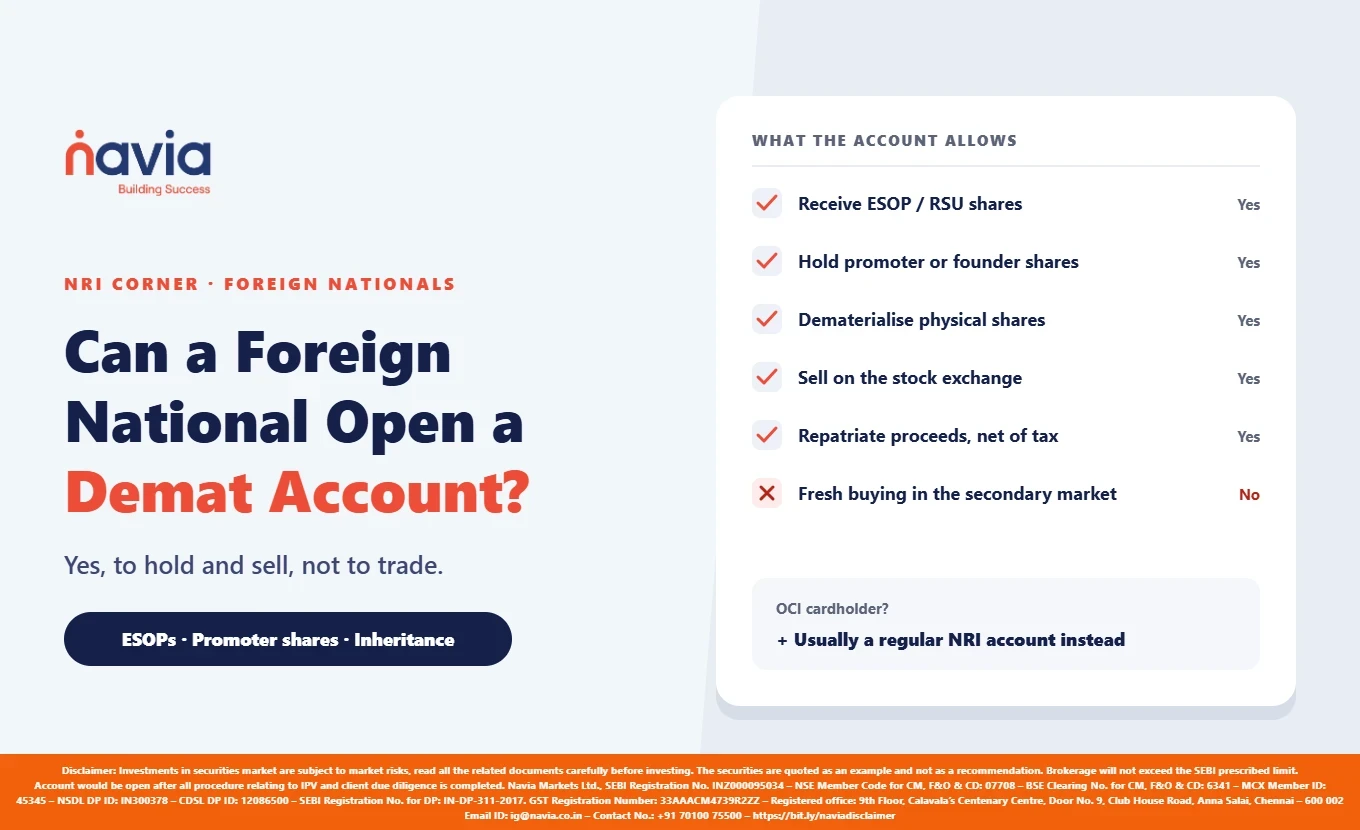
Yes, but only for specific purposes. A foreign national can open a demat and trading account in India to hold and sell shares they got through a permitted route, such as ESOPs, promoter holdings or inheritance. They can’t use it to buy and trade Indian stocks the way a resident or NRI investor does. This article explains who counts as a foreign national, why you might need this account, what you can and can’t do with it, and how Navia handles the process from opening to repatriation.
Key takeaways
- Foreign nationals can open a demat and trading account in India to hold, dematerialise and sell shares acquired through permitted routes.
- The account is meant for ESOP / RSU shares, promoter or founder holdings, inherited shares and physical share certificates.
- Fresh buying in the secondary market isn’t allowed through a Foreign National account.
- Sale proceeds can be repatriated to your home country, net of taxes, once the required documents are in place.
- OCI cardholders are generally treated like NRIs and can usually open a regular NRI account instead.
Who Is a Foreign National?
Under India’s foreign exchange rules (FEMA), a foreign national is a person who doesn’t hold Indian citizenship and lives outside India. This is different from:
- NRI (Non-Resident Indian): an Indian citizen who lives outside India.
- OCI / PIO cardholder: a foreign citizen of Indian origin. For investment purposes, OCI cardholders are generally treated at par with NRIs.
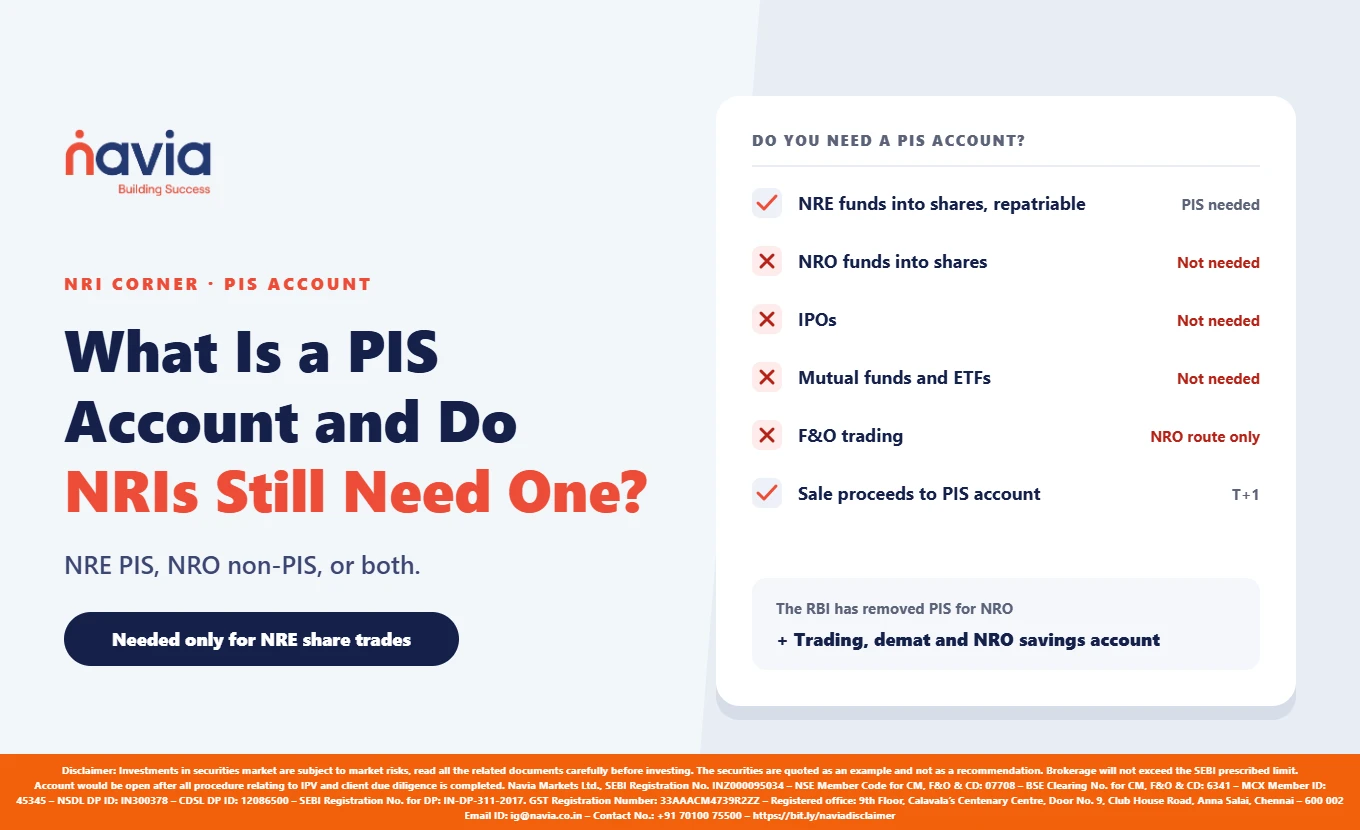
The difference matters because NRIs and OCIs can invest in Indian shares through PIS or Non-PIS routes. Other foreign nationals can’t. Their holdings in Indian companies usually come through the Foreign Direct Investment (FDI) route, such as ESOPs or promoter shares, and they need a demat account built for that purpose.
Why Would a Foreign National Need a Demat Account in India?
A foreign national usually doesn’t open an Indian demat account to trade. They open one to deal with Indian shares they already own or are entitled to. The most common reasons:
1. Selling ESOPs or RSUs from an Indian company
Indian startups and listed companies often grant stock options to employees and directors abroad, and to staff of their overseas subsidiaries and parent companies. When the options are exercised, the shares are credited in demat form. To hold and later sell them on the stock exchange, the employee needs an Indian demat and trading account.
2. Promoter or founder shareholding
Foreign co-founders, promoters and early investors in Indian companies hold equity that must sit in a demat account, especially once the company lists or is preparing an IPO. A Foreign National account lets them hold those shares and sell them when they’re allowed to.
3. Inherited Indian shares
A foreign national can inherit shares from a relative in India. To transfer the shares into their own name, and eventually sell them, they need a demat account in India.
4. Dematerialising physical share certificates
SEBI no longer allows the transfer of shares held in physical form. If you hold old paper share certificates of Indian companies, you have to convert them to electronic (demat) form before you can sell or transfer them.
5. Taking the money home
Selling through a regulated Indian broker creates the clean paper trail of contract notes, tax records and bank credits that banks need before they’ll send the proceeds abroad. Without a proper account, it’s very hard to realise the value of Indian shares and move it out of India.
Important
A Foreign National demat and trading account is only for holding and selling shares acquired through ESOP allotment, promoter holding or other permitted routes. It can’t be used for fresh investments in the secondary market.
What You Can and Can’t Do With a Foreign National Account
| Activity | Allowed? | Notes |
|---|---|---|
| Receive ESOP / RSU shares from an Indian company | Yes | Credited to your demat account after the options are exercised. |
| Hold promoter or founder shares | Yes | Subject to lock-in and company or SEBI rules. |
| Receive inherited shares | Yes | Through the transmission process with supporting documents. |
| Dematerialise physical certificates | Yes | Converted to electronic form through the depository participant. |
| Sell eligible shares on NSE / BSE | Yes | Through your Navia trading account. |
| Repatriate sale proceeds abroad | Yes | Net of taxes, with supporting documents. |
| Buy new shares in the secondary market | No | Not allowed for a Foreign National account. |
| Trade intraday or in Futures & Options | No | Not available for this account type. |
Foreign National vs NRI vs OCI Accounts
| Basis | Foreign National | NRI | OCI / PIO |
|---|---|---|---|
| Citizenship | Foreign | Indian | Foreign (of Indian origin) |
| Typical account | Foreign National trading & demat account | NRE (PIS) or NRO (Non-PIS) trading & demat account | Generally the same as an NRI |
| Fresh stock investment | Not allowed | Allowed | Generally allowed |
| Main purpose | Hold and sell ESOP, promoter or inherited shares | Invest and trade in Indian markets | Invest and trade in Indian markets |
| Repatriation | Sale proceeds repatriable with documents | Depends on whether you use the NRE or NRO route | Depends on whether you use the NRE or NRO route |
If you’re an OCI cardholder or an Indian citizen living abroad, you’ll usually get more flexibility from a regular NRI trading and demat account.
Documents Required to Open a Foreign National Demat Account
The exact list depends on how you acquired your shares, so our team will confirm it with you. Typically, you’ll need:
- Passport, a self-attested copy (notarised or apostilled where required)
- PAN card, which is mandatory. Foreign nationals can apply for one using Form 49AA
- Overseas address proof, such as a utility bill, bank statement or driving licence
- Visa or residence permit of your country of residence, if applicable
- Recent passport-size photographs
- Bank account details for receiving sale proceeds
- Proof of how you got the shares, for example:
- ESOP / RSU allotment letter from the company
- Promoter shareholding documents
- Transmission documents for inherited shares
- Original physical share certificates for dematerialisation
- Signed account opening form with KYC and FATCA declarations
How to Open a Foreign National Account with Navia
Selling Your Shares and Repatriating the Money
For most foreign nationals, the end goal is to sell the shares and move the money home. With Navia, a foreign national can repatriate funds from the sale of ESOP or promoter holdings, as long as the shares are held in a Navia demat and trading account.
To process repatriation, you’ll typically need:
- Allotment letter from the company showing the allotment details, exercise price and fair market value
- RBI reporting document for the ESOP or promoter holding, with its FC-GPR / FC-TRS acknowledgement number. This is usually issued through the company.
- Tax documents such as Form 15CA / 15CB, as required by your bank
To start, raise a ticket on the Navia Support Portal and upload the required details and documents. Our team will guide you through the rest.
Good to know
Payments for exercising ESOPs or buying promoter shares must be made from a Non-PIS or savings bank account, not a PIS account.
Tax Points to Keep in Mind
- Capital gains tax applies in India when you sell shares. The rate depends on how long you held them (short-term or long-term).
- ESOPs are taxed twice: once as a perquisite when you exercise them (usually handled by your employer) and again as capital gains when you sell.
- Tax treaties (DTAA) between India and your country of residence can help you avoid double taxation. Keep your Tax Residency Certificate (TRC) and Form 10F ready.
- You may need to file an Indian income tax return to report the gains or claim a refund of excess tax deducted.
Tax rules change from time to time, so we recommend checking with a chartered accountant before you sell.
Why Choose Navia for a Foreign National Account?
Navia is one of the few brokers in India that gives quick, efficient support for opening demat and trading accounts for foreign nationals. Here’s what you get:
- A dedicated NRI and Foreign National desk with one-to-one support across time zones, from choosing the right account to activation.
- Specialist handling of ESOP and promoter shares, including help understanding the documents your company needs to provide.
- Help with dematerialisation of physical share certificates.
- Guidance on repatriation, so the sale proceeds reach your home country.
- Pre-filled forms to reduce errors and speed up onboarding.
- Multiple support channels: email, phone, WhatsApp and the Navia Help Centre.
- Full NRI services for family members who are NRIs or OCI cardholders, including NRE, NRO and F&O through the NRO route.
Conclusion
A foreign national can open a demat account in India, but it serves a specific purpose: holding, dematerialising and selling Indian shares acquired through ESOPs, promoter holdings or inheritance, and repatriating the proceeds. It isn’t a route for regular trading. Paperwork, RBI reporting documents and repatriation rules can be confusing when you’re dealing with them from another country, so the broker you choose makes a real difference. Navia’s dedicated desk works with you from the first email until the money reaches your home bank account.
Did you find this article helpful?
Your feedback helps us write better content.

Frequently Asked Questions
Can a foreign national open a demat account in India?
Yes. A foreign national can open a demat and trading account in India to hold and sell shares acquired through permitted routes, such as ESOPs or RSUs from an Indian company, promoter or founder holdings, inheritance, or physical share certificates that need to be dematerialised.
Can I buy Indian stocks with a Foreign National account?
No. The account is only for holding and selling shares acquired through ESOP allotment, promoter holding or other permitted routes. Fresh investments in the secondary market aren’t allowed.
Can I take the sale proceeds back to my home country?
Yes. Sale proceeds from ESOP or promoter holdings can be repatriated, net of taxes, when the shares are held with Navia and you provide documents such as the company’s allotment letter and the FC-GPR / FC-TRS acknowledgement.
I’m an OCI cardholder. Do I need a Foreign National account?
Usually not. OCI cardholders are generally treated like NRIs for investment purposes and can open a regular NRI (NRE or NRO) trading and demat account, which also allows fresh investments.
Is a PAN card mandatory for a foreign national?
Yes. A PAN is required to hold and transact in Indian securities. Foreign nationals can apply for one using Form 49AA.
Can I open the account fully online from abroad?
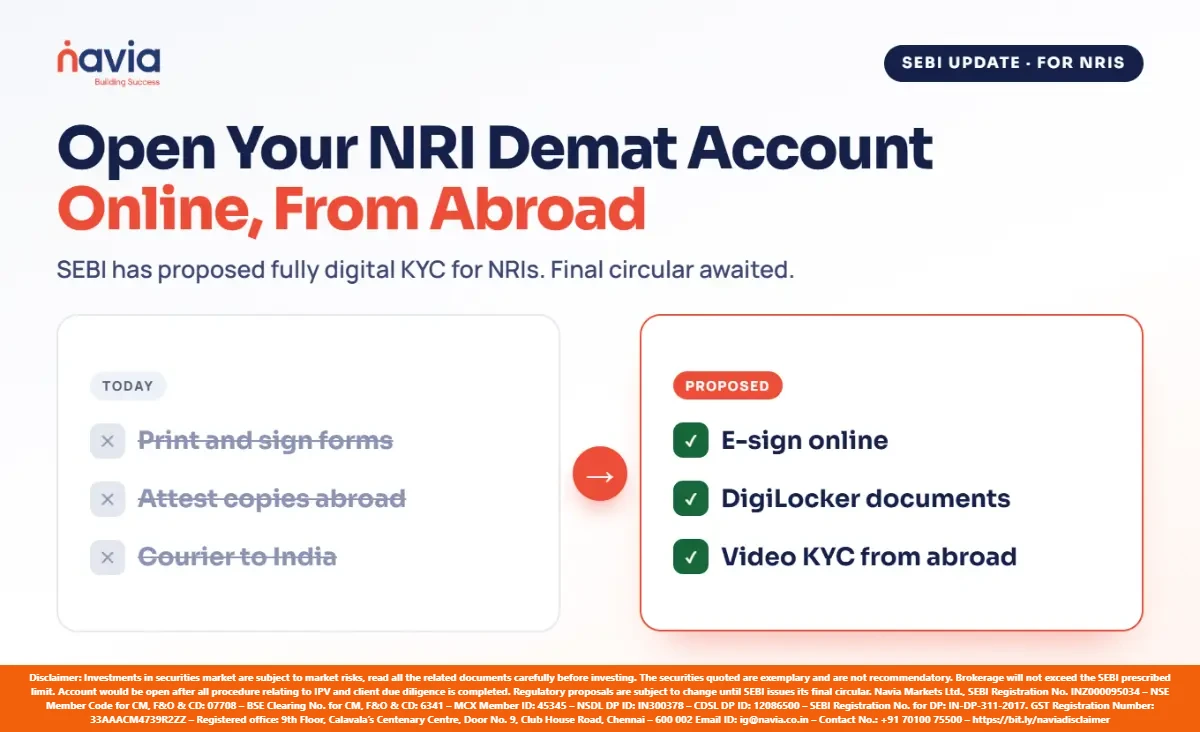
Not at present. Accounts for clients living abroad are opened through physical forms and couriered documents. Navia sends you pre-filled forms to make the process easier, and will add digital onboarding when regulations allow it.
What happens to inherited shares held in physical form?
They first have to be transmitted to your name and then dematerialised. Once they’re in your demat account, you can sell them and repatriate the proceeds, subject to applicable rules and taxes.
Disclaimer: This article is for general information only and isn’t legal, tax or investment advice. Eligibility, documents and repatriation depend on FEMA, RBI and SEBI rules, which can change. Please contact Navia or consult a qualified professional for advice specific to your situation. Investments in securities markets are subject to market risks. Read all related documents carefully before investing. Full disclaimer: https://bit.ly/naviadisclaimer