How Many Demat Accounts Can You Use for an IPO?
Quick answer
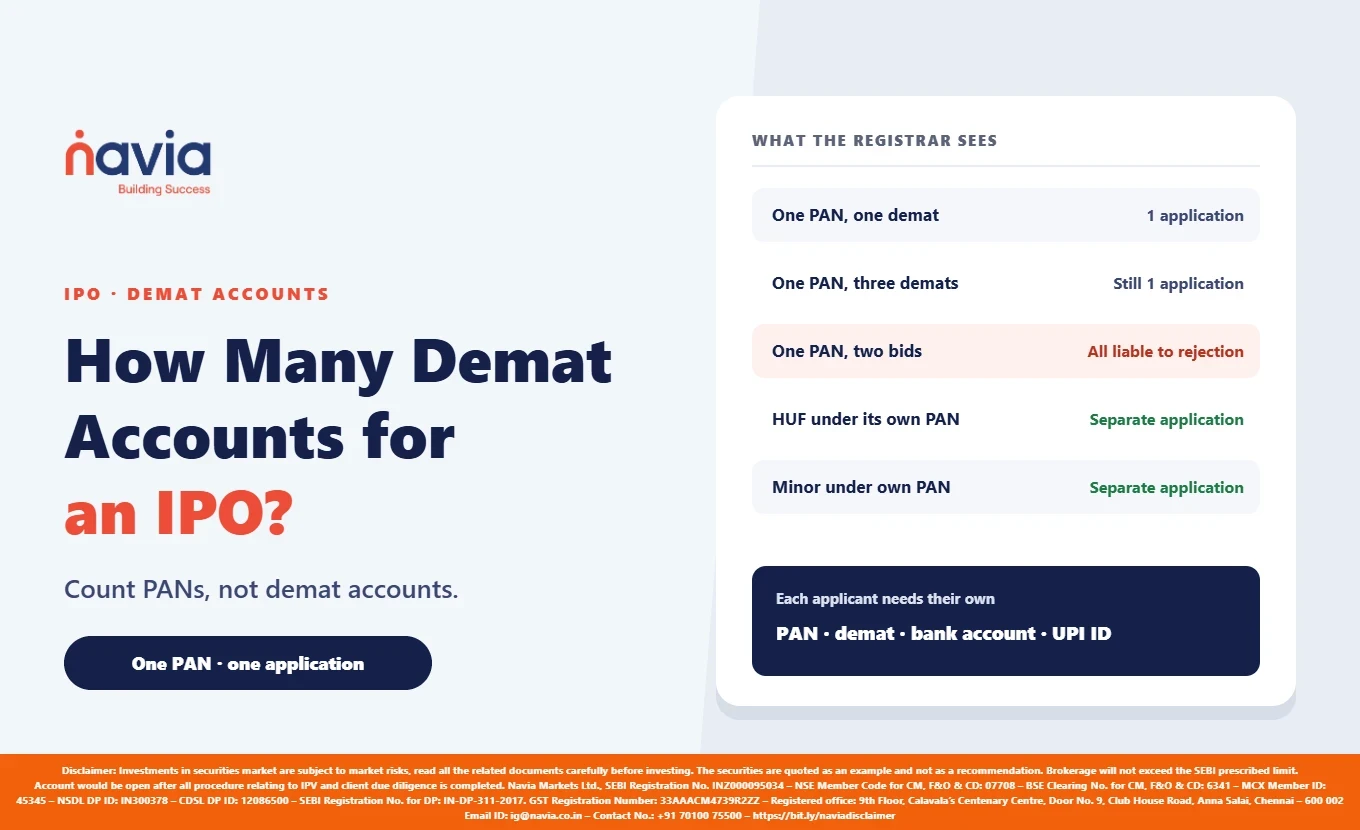
As many as you like — and it will not help, because the limit was never on the demat account. It is on the PAN. One PAN gets one application in an IPO, and ten demat accounts for IPO applications held under that same PAN still get you one. Send a second and the registrar does not pick the better of the two — both are liable to be cancelled. A genuine second application needs a second PAN: a spouse, parent or adult child applying as themselves, an HUF under its own PAN, or a minor child under theirs. Each of them needs their own demat account, their own bank account and their own UPI ID — SEBI states that a third-party UPI ID, or an investor using a third-party bank account, will not be considered for allocation.
Key takeaways
Demat accounts for IPO applications: the limit is on your PAN
This is the thing most people have backwards. Your demat account is where allotted shares are credited; it is not what the registrar uses to identify you. PAN is. When the basis of allotment is drawn up, every bid is grouped by PAN, and that is where a second application under one PAN stops being an extra chance and becomes a defect.
So can I apply for an IPO from a different demat account is yes technically, no usefully. Route a bid through whichever demat account you like; you cannot route two through two accounts under one PAN and expect both to survive.
The same applies to the variations people try:
How to manage multiple demat accounts for IPO purposes is housekeeping, not strategy: use whichever account you want the shares in, and apply once.

What actually happens when one PAN applies twice
Not a warning letter, and not the first application standing while the second is dropped. All applications under that PAN are liable to be rejected. Navia’s own guidance on applying through UPI puts it plainly: submit only one valid application per PAN for a particular IPO, because multiple applications from one PAN for the same issue result in all applications being cancelled.
That is the asymmetry. A duplicate does not give you two entries — it takes away the one you had, at a point when nothing can be resubmitted because the window has closed.
The rule bars more than one application within the net offer — the pool retail and non-institutional bids are drawn from. A reserved portion sits outside it. So if an issue carries an employee reservation and you are an eligible employee, or a shareholder quota and you hold shares in the listed parent, a bid in that reserved category can stand alongside your retail bid under the same PAN. What it does not buy you is two bids inside the net offer: retail through one broker and retail through another is still a duplicate. Whether a reserved portion exists, who qualifies and what it is capped at is set out in that issue’s red herring prospectus — read the RHP rather than assuming.
A second application means a second PAN
This is where the common advice goes wrong. “Apply through family members’ demat accounts” is true as far as it goes, and dangerous where it stops, because it leaves out the part that makes it legitimate.
A family member’s application is not your application made through them. It is their application:
If any of that is not true, you are not spreading applications — you are filing a third-party application, and the SEBI position is unambiguous: a third-party UPI ID, or an investor using a third-party bank account, will not be considered for allocation. Navia’s support guidance says the same thing at the account level: the UPI ID must be linked to a bank account in your own name, and an application made with somebody else’s UPI ID will be rejected.
So can I apply for an IPO in the name of family members and friends from my savings bank account has a short answer. No. An adult relative can apply, from their own account, with their own money — a different sentence to the one people are hoping for, and the only one that survives contact with the registrar.

The two routes that genuinely add a PAN to your household
Both are real, and both need an account you may not already have.
An HUF has its own PAN
A Hindu Undivided Family is assessed as a separate entity with its own PAN. So an HUF can apply alongside the individual applications of its members — still one application per PAN, but the HUF’s PAN is not the Karta’s.
The account is opened by the Karta, with the coparceners signing the HUF declaration. It cannot be opened online — the forms are signed and posted with a cheque for ₹1,180 (₹1,000 AMC plus GST). The document list is in our guide to opening an HUF demat account.
Said plainly: an HUF is a tax and succession structure first. Open it for its own reasons, not as an IPO device — and Navia is not a tax adviser.
A minor can hold a demat account and apply
A minor demat account is opened in the child’s sole name, under the child’s own PAN, and operated by the guardian until the child turns 18. It can hold securities, receive IPO allotments and apply in public issues, but cannot buy shares on the market and cannot be a joint account.
That makes can a minor demat account apply for an IPO one of the few questions here with a clean yes, and it is why a minor demat account is the second account most families end up opening.
Two things to plan for. Income on a minor’s investments is generally clubbed with the higher-earning parent’s income, so take advice on the tax position. And at 18 the account does not simply carry on — transactions are frozen until the now-adult holder completes fresh KYC in their own name.
Funding: whose account, and how much
Three figures govern the mechanics, none of them about the demat account.
| What | The position |
|---|---|
| Retail individual investor limit | Applications up to ₹2,00,000; above that the bid falls into the non-institutional category |
| UPI limit for IPO applications | ₹5 lakh per transaction on the UPI route |
| Cost to apply at Navia | ₹0 |
The first two measure different things, and the gap trips people up. ₹2 lakh is the category ceiling: bid above it and you are no longer a retail individual investor but a non-institutional one. ₹5 lakh is the per-transaction cap on the UPI route itself. Since a retail bid cannot exceed ₹2 lakh in the first place, the UPI cap almost never binds a retail applicant. SEBI’s investor guidance describes the UPI facility as available to retail individual investors, so if you intend to bid above ₹2 lakh, confirm the payment route with your broker before the issue opens rather than assuming UPI will take it. You can apply through Navia either way at no application charge.

The blocked-funds mechanism is the part people forget. Under ASBA the money is never paid out — the self-certified syndicate bank blocks it in the applicant’s own account and debits it only to the extent shares are allotted, unblocking the rest by T+2 under the T+3 listing timeline. Bidding at the cut-off price simply accepts the final issue price. The route through the app is in Navia’s IPO via UPI guide, and our post on applying for an IPO through UPI covers mandate timing and rejection reasons.
Third-party ASBA — one bank account blocking funds for another person’s application — has been restricted, and where offered it varies by bank and category. Confirm the current position with the bank before planning a minor’s or an HUF’s application around it. On the UPI route the question does not arise: the UPI ID and the account behind it must belong to the applicant.
Does applying under more PANs change the outcome?
It changes the arithmetic, not the odds on any one application.
When the retail portion is oversubscribed, allotment is not proportionate. One lot — the lot size set for the issue — is allotted to as many applicants as the portion can cover; where it cannot cover everyone, which applications succeed is settled by a draw and the successful ones receive one lot. Only where the portion stretches further does anything beyond one lot get allotted. So in a heavily oversubscribed book a bid for six lots is usually no better placed than a bid for one. How that draw is run is set out in our post on the IPO allotment and listing process.
So each additional valid PAN in a household is one more entry in that draw. That is a fact about the draw, not a strategy: it guarantees nothing, it is no reason to open accounts a family would not otherwise want, and an invalid application is worth less than none, because it can take the valid ones down with it.
Conclusion
Count PANs, not demat accounts. One PAN, one application — and a second demat account in your own name does nothing but give you somewhere else to look for the shares.
If there is a second PAN in the household that should be investing in its own right — an HUF, a child, an adult relative who has never opened an account — that is a real second application. If there is not, apply once and apply correctly.
You can apply to IPOs through Navia via UPI at no application charge, and open a demat account for the holder who needs one.
Did you find this article helpful?
Your feedback helps us write better content.

Frequently Asked Questions
How many demat accounts can I use for an IPO?
One application per PAN, regardless of how many demat accounts you hold. Extra demat accounts under the same PAN do not give you extra applications. Shares are credited to whichever demat account you name on the bid-cum-application form.
Can I apply for an IPO from a different demat account?
Yes, you can apply through any demat account you hold, but only once per PAN for the same issue. Two bids routed through two demat accounts under one PAN are duplicate applications, and all of them are liable to be rejected.
Can I apply for an IPO multiple times?
Not under the same PAN in the same issue. Applying twice does not improve anything — it puts every application under that PAN at risk of cancellation. Separate applications are possible only under separate PANs.
What happens if I submit multiple IPO applications from the same PAN?
All applications under that PAN for that issue are liable to be rejected, including the first one. Using different brokers, different bank accounts or different UPI IDs makes no difference, because the registrar consolidates bids by PAN.
Can a minor demat account apply for an IPO?
Yes. A minor’s demat account is held in the child’s sole name under the child’s own PAN and operated by the guardian. It can apply in public issues and receive allotments, though it cannot be used to buy shares on the market.
Can an HUF apply for an IPO separately?
Yes. An HUF has its own PAN and is assessed as a separate entity, so it can apply alongside the individual applications of its members — one application per PAN. The account is opened offline by the Karta.
Can I apply for an IPO in a family member’s name from my bank account?
No. The application belongs to the person whose PAN is on it, and the funds must be blocked in their own bank account using their own UPI ID. SEBI states that a third-party UPI ID or a third-party bank account will not be considered for allocation.
Can two IPO applications use the same UPI ID?
No. On the UPI route the UPI ID must be linked to a bank account in the applicant’s own name, and an application made with somebody else’s UPI ID will be rejected.
Is a demat account mandatory for an IPO?
Yes. Shares are allotted in electronic form, so a demat account is needed to receive them. It must be open and active before you apply.