

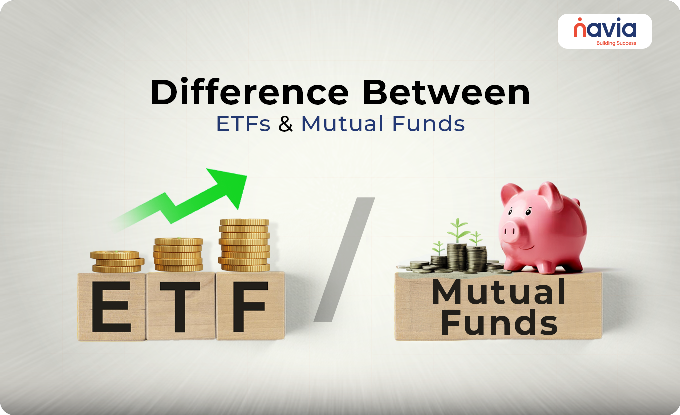
Difference Between ETFs and Mutual Funds
Investors are looking for diversified and professionally managed investment options. The two most popular options are Exchange-Traded Funds (ETFs) and Mutual Funds. Both allow investors to buy a variety of securities that differ significantly in cost, structure, taxation, and flexibility. The selection of ETF or Mutual Fund completely depends on the investor’s goals and strategy.
In this blog we’ll break down how ETF is different from mutual fund, comparing their pros and cons and also helping you to decide whether ETF or mutual fund is better for you.
💡 Quick Answer
ETFs trade on the exchange through the day like shares and need a demat account; mutual funds are bought and redeemed from the fund house at the end-of-day NAV and do not. ETFs carry lower expense ratios, disclose holdings daily, are usually passive, and gain tax efficiency from the in-kind creation and redemption process. Mutual funds carry higher management fees and distribution loads, disclose quarterly, can be active or passive, and support SIPs and lump-sum investing. Choose ETFs for cost and trading flexibility; choose mutual funds for active management and automated long-term investing.
Difference Between ETFs and Mutual Funds
There are so many differences between these two options, but most people don’t know about them. So, let’s see the major differences between ETFs and Mutual Funds. Scheme-level data for every fund house in India is published by AMFI.
| Aspect | ETF | Mutual Funds |
| Structure & Trading | Traded intraday on stock exchanges like individual shares | These are bought and redeemed from the fund house at the end-of-day NAV (Net Asset Value) |
| Demat Account | Necessary | Not necessary |
| Pricing | Offer real-time pricing | Have a settlement delay and less liquid during market hours |
| Expenses | Lower expense ratios | Higher management fees, distribution loads and administrative expenses |
| Tax Efficiency | Tax advantage due to the in-kind creation/redemption process | Distributing taxable categories frequently |
| Minimum Investment | Can be purchased with as little as one share | Allow lump-sum investments or SIPs |
| Management Style | Largely passive (index-tracking) | Actively manages or passive |
| Transparency | Disclose holdings daily and providing a greater insight | Release portfolios quarterly and offering less frequent updates |
| Suited For | Active investors | SIP investors and long-term holders |

ETF or Mutual Fund Which is Better?
If we compare difference between ETFs and Mutual Funds, there are some features that differentiate between these two options. Most of the points we already revised in the above section, but to understand it deeply here is a descriptive way.
- ETFs are traded in real-time throughout the day just like stocks, while mutual funds are transacted only at the end-of-day Net Asset Value (NAV).
- ETFs come with lower expense ratios, whereas mutual funds actively managed ones have higher costs.
- In terms of tax efficiency, ETFs have their in-kind redemption process, that helps to reduce capital gain taxes; mutual funds may trigger taxable events when portfolio changes occur.
- By choosing ETFs, it offers greater investment flexibility that allows investors to buy or sell at any time during the market hours, while mutual funds operate through SIPs or lump-sum investments.
- From a management perspective, ETFs are usually passively managed, but mutual funds have both active and passive management styles.
- In terms of transparency, ETF provides daily disclosure of holdings, but mutual funds disclose portfolios quarterly. And ETFs may instantly reinvest dividends; mutual funds dividends handling depends on specific scheme chosen by the investor.
Because ETFs are built to track an index rather than beat it, they are designed to deliver market Beta, while an active mutual fund is judged on the Alpha it adds. If those terms are new, alpha and beta in mutual funds explains how each is measured.
The cost difference is also worth putting in context: within mutual funds themselves, choosing between direct and regular plans changes the expense ratio before you even compare against an ETF. And if steady income rather than growth is the goal, a fixed income mutual fund is a different category again.
Both have various positive factors, so after analyzing them you can choose the best option. Below we are adding some situations that are suitable for both ETFs and Mutual Funds, let’s see what they are;
When To Choose ETFs;
- If you want cost-effective exposure
- If you want trading flexibility
- You’re in a taxable account and value tax efficiency
If you are weighing that choice, it helps to see how the category has scaled — the growth of ETFs in India covers the drivers, types and risks.
When To Choose Mutual Funds;
- If you prefer an active management
- If you have long-term goals like retirement, marriage, or children’s education
- You need an automated investments via SIPs
Conclusion
Both exchange-traded funds and mutual funds have important roles in investment portfolios. ETFs offer low cost, flexibility, and tax efficiency, while mutual funds suit long-term goals, active management, and automated SIPs
The choice depends on your financial goals, risk appetite, and time horizon; but there are many investors who combine both to balance cost, convenience and strategic exposure. So, you must understand your objectives, time horizons, and investment preferences before deciding. Navia offers tools to explore both ETFs and mutual funds so you can choose what fits your goals..
Key Takeaways
- ETFs trade intraday on the exchange like shares and require a demat account; mutual funds are transacted at the end-of-day NAV with the fund house and do not.
- ETFs carry lower expense ratios, while mutual funds add management fees, distribution loads and administrative expenses.
- ETFs gain tax efficiency from the in-kind creation and redemption process; mutual funds can trigger taxable events when the portfolio is rebalanced.
- ETFs disclose holdings daily and are largely passive; mutual funds disclose quarterly and can be actively or passively managed.
- Pick ETFs for cost and trading flexibility, mutual funds for active management and automated SIPs — many investors hold both.
Did you find this article helpful?
Your feedback helps us write better content.

Frequently Asked Questions
Which is better, ETF or Mutual Fund?
It depends on your needs; you can choose ETFs for cost efficiency and trading flexibility, and mutual funds for active management and automation.
How is ETF different from mutual funds?
ETFs trade intraday like stocks have lower costs, greater tax efficiency, and higher transparency compared to traditional mutual funds.
Can I set up a SIP for ETFs?
Yes. Some platforms allow ETF-based systematic investment plans, though frequency may vary.
Are ETF returns better than mutual funds?
It depends. Passive index ETFs often outperform many active mutual funds due to their lower expense ratios.
Do ETFs pay dividends in mutual funds?
Yes. ETFs may distribute dividends, which can be reinvested or taken as cash, similar to mutual funds.
DISCLAIMER: Investments in securities market are subject to market risks, read all the related documents carefully before investing. The securities quoted are exemplary and are not recommendatory. Full disclaimer: https://bit.ly/naviadisclaimer