

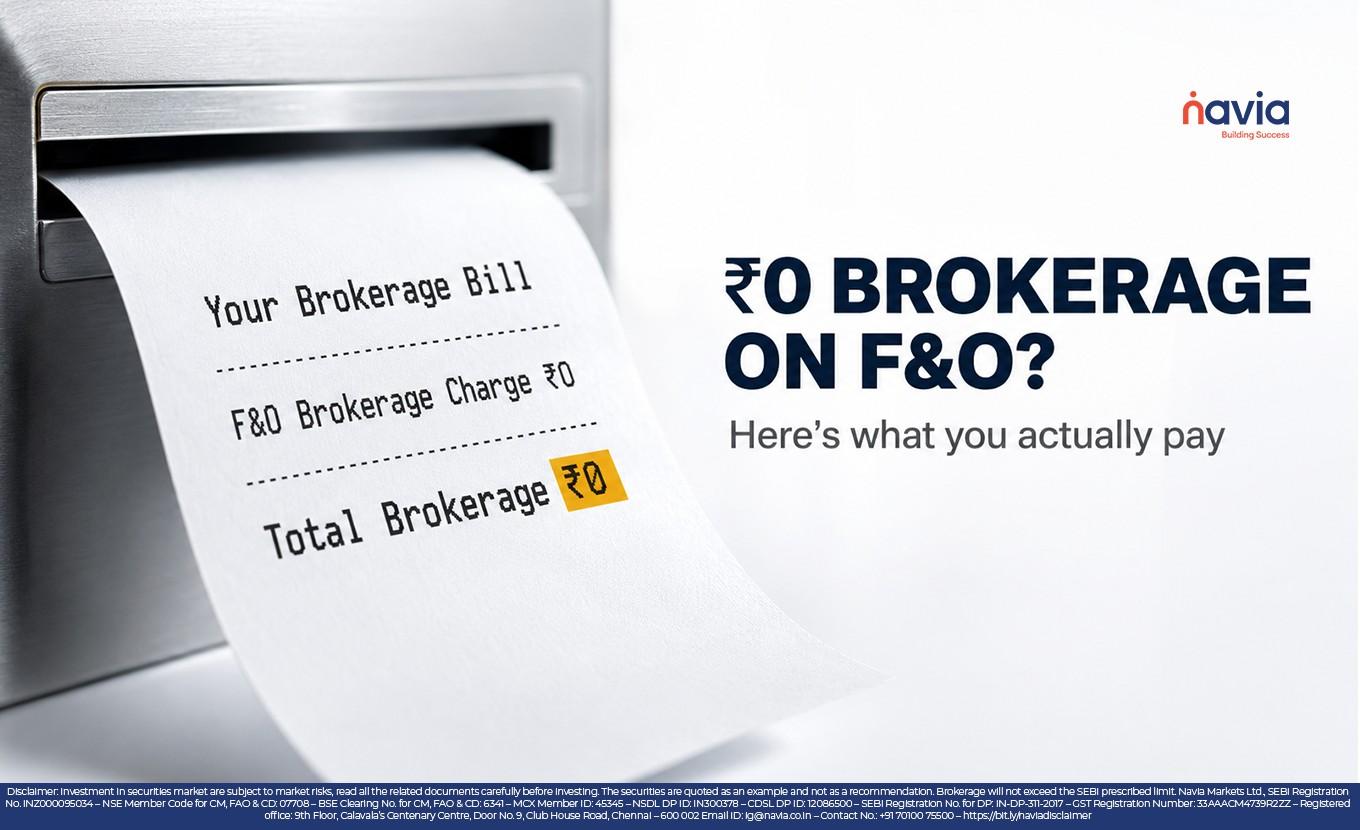
Zero Brokerage on F&O: 5 Charges You Still Pay in 2026
- Why zero brokerage is not zero cost
- 1. Securities Transaction Tax (STT)
- 2. Exchange transaction charges
- 3. GST at 18%
- 4. SEBI turnover fee
- 5. Stamp duty
- What about DP and other charges?
- Futures and options charges at a glance
- How do you check brokerage and charges on a futures and options trade?
- So what does zero brokerage save you?
- A word on futures and options risk
- Conclusion
- Frequently Asked Questions
Brokerage is only one line on a contract note, and on F&O it is often not the biggest. Here is every charge, and where ₹0 brokerage fits in.
💡 Quick Answer
Zero brokerage means no brokerage fee, but an F&O trade is not free. Five statutory charges still apply to every futures and options trade: STT, exchange transaction charges, GST, the SEBI turnover fee and stamp duty. Set by the government, SEBI and the exchanges, they are the same at every broker and none can be waived. On Navia, brokerage on eligible F&O is ₹0 while these apply, so know the full cost before you trade.
Why zero brokerage is not zero cost
Zero brokerage sets your broker’s fee to ₹0, and on Navia it is ₹0 on eligible equity, currency and commodity F&O. The taxes and regulatory charges below are fixed by law and by SEBI, and identical at every broker. These are the five charges you still pay.
1. Securities Transaction Tax (STT)
STT is a government tax charged only on the sell side, and it is usually the biggest F&O charge. From 1 April 2026 it is 0.05% of turnover on futures and 0.15% of the premium on options, plus 0.15% on intrinsic value if an option is exercised.
2. Exchange transaction charges
The exchange, NSE, BSE or MCX, charges a small fee on turnover, on both legs. On options it is charged on the premium and is higher than on futures, and the rate changes over time.
3. GST at 18%
Goods and Services Tax (GST) of 18% applies to the fee based charges: brokerage, exchange transaction charges, the SEBI turnover fee and clearing charges. It is not charged on STT or stamp duty, and with ₹0 brokerage it is smaller.
4. SEBI turnover fee
A small regulatory fee of ₹10 per crore of turnover that funds SEBI’s oversight of the market. It applies to almost every trade and is the same across brokers.
5. Stamp duty
Charged on the buy side under the Indian Stamp Act, and uniform across India since 1 July 2020. On F&O it is 0.002% of turnover on futures and 0.003% of the premium on options.
What about DP and other charges?
Normal F&O trades are cash settled, so Depository Participant (DP) charges do not apply, unless a stock position goes to physical delivery on expiry. Clearing charges and a call and trade fee may also apply, where brokers differ.
Futures and options charges at a glance
| Charge | Levied by | On futures | On options |
|---|---|---|---|
| Brokerage | Your broker | ₹0 at Navia | ₹0 at Navia |
| STT | Government | 0.05% of turnover on the sell side | 0.15% of premium (sell); 0.15% on exercise |
| Exchange transaction charges | NSE, BSE or MCX | Small % of turnover, both legs | Small % of premium, both legs (higher) |
| GST | Government | 18% on brokerage, transaction and SEBI fees | 18% on brokerage, transaction and SEBI fees |
| SEBI turnover fee | SEBI | ₹10 per crore of turnover | ₹10 per crore of turnover |
| Stamp duty | Government | 0.002% of turnover on the buy side | 0.003% of premium on the buy side |
| DP charges | Depository | Not on cash settled F&O | Not on cash settled F&O |
Rates are for FY 2026 to 2027 and are set by the government, SEBI and the exchanges. For a worked example on a real contract note, see how these charges add up.
How do you check brokerage and charges on a futures and options trade?
The simplest way is to work it out before you trade. Navia’s brokerage calculator lets you enter the segment, price and quantity of a trade and see the full cost, brokerage plus every statutory charge. Since brokerage on eligible F&O is ₹0, it shows the statutory charges you pay.
So what does zero brokerage save you?
Because the statutory charges are identical everywhere, brokerage is the only charge that changes between brokers. Zero brokerage removes it completely, which adds up for an active trader placing many orders.
A word on futures and options risk
Lower costs do not lower the risk of F&O. According to SEBI’s July 2025 study, about 91% of individual equity derivatives traders made net losses in FY 2024 to 2025, and SEBI requires brokers to disclose that most F&O traders lose money. Trade only with money you can afford to lose.
Conclusion
Zero brokerage is a real saving, but it is one part of the cost. STT, exchange charges, GST, the SEBI turnover fee and stamp duty apply to every trade and are the same everywhere. On the Navia All in One App, brokerage on eligible F&O is ₹0 and every statutory charge is shown transparently. Navia Markets is registered with SEBI (Reg. No. INZ000095034).
Key Takeaways
- Zero brokerage sets your broker’s fee to ₹0, but five statutory charges still apply to every F&O trade and none can be waived.
- STT is usually the biggest F&O charge — from 1 April 2026, 0.05% of turnover on futures and 0.15% of premium on options, charged on the sell side.
- GST of 18% applies only to fee based charges such as brokerage, exchange transaction charges, the SEBI turnover fee and clearing charges, not to STT or stamp duty.
- The SEBI turnover fee is ₹10 per crore of turnover, and stamp duty is 0.002% on futures and 0.003% of premium on options, charged on the buy side.
- Because statutory charges are identical everywhere, brokerage is the only charge that changes between brokers — on Navia it is ₹0 on eligible F&O.
Did you find this article helpful?
Your feedback helps us write better content.

Frequently Asked Questions
Is zero brokerage really free on F&O?
No. Statutory charges still apply: STT, exchange transaction charges, GST, the SEBI turnover fee and stamp duty. They are the same at every broker.
How much is STT on F&O now?
From 1 April 2026, 0.05% of turnover on futures and 0.15% of the premium on options, both on the sell side, plus 0.15% on intrinsic value if an option is exercised.
Does GST apply to F&O trades?
Yes, 18%, but only on brokerage, exchange transaction charges, the SEBI turnover fee and clearing charges. It is not charged on STT or stamp duty.
Does Navia charge brokerage on F&O?
Navia charges ₹0 brokerage per order on eligible equity, currency and commodity F&O. Statutory charges set by the government and regulators still apply.
DISCLAIMER: Investment in securities market are subject to market risks, read all the related documents carefully before investing. The securities quoted are exemplary and are not recommendatory. Full disclaimer: https://bit.ly/naviadisclaimer