

Corporate Fixed Deposits: Everything You Need to Know
- How Does a Corporate FD Actually Work?
- Who Issues Corporate FDs?
- Why Do Credit Ratings Matter So Much?
- Cumulative vs Non-Cumulative: Which Payout Should You Choose?
- How Is Corporate FD Interest Taxed?
- How Can You Invest in a Corporate FD Through Navia?
- What Are the Risks You Should Know?
- Conclusion
- FREQUENTLY ASKED QUESTIONS
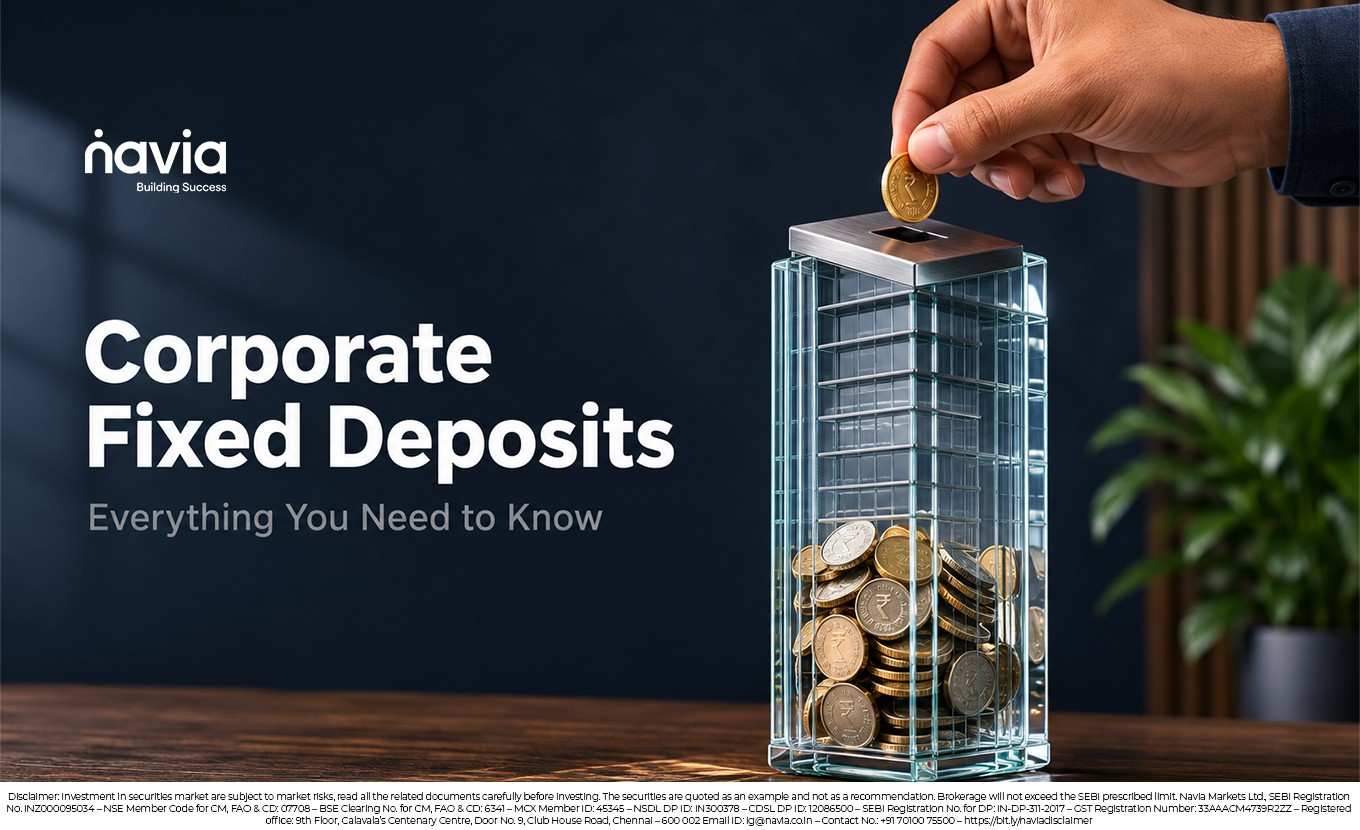
A corporate fixed deposit (Corporate FD) is a fixed-income investment offered by a company or Non-Banking Financial Company (NBFC). Unlike a bank fixed deposit, you lend money directly to the issuing company for a fixed tenure. In return, the issuer pays interest at a predetermined rate, which may be higher than that offered by some bank FDs. However, Corporate FDs carry issuer credit risk and are not covered by government-backed deposit insurance. Understanding this difference is important when evaluating Corporate FDs. This guide explains how Corporate FDs work, their key features, associated risks, and the applicable tax treatment.
💡 Quick Answer
A corporate fixed deposit is a fixed-income product where you lend directly to a company or NBFC for a fixed tenure at a predetermined interest rate — often higher than some bank FDs, but with issuer credit risk and no government-backed deposit insurance. Check the issuer’s credit rating (such as CRISIL AAA/AA+), choose cumulative or non-cumulative payout, and understand the tax treatment before investing.
How Does a Corporate FD Actually Work?
When investing in a Corporate FD, you choose the issuer, investment tenure, and preferred interest payout option. Depending on the terms of the deposit, interest may be paid periodically or at maturity. At the end of the tenure, the issuer repays the principal amount, subject to the terms of the Corporate FD. Unlike eligible bank deposits, Corporate FDs are not covered by government-backed deposit insurance, making it important to assess the issuer’s creditworthiness before investing.
Who Issues Corporate FDs?
Companies and NBFCs issue Corporate FDs to raise funds directly from investors. Common issuers include large NBFCs with an established lending history. These issuers may offer higher Corporate FD interest rates than some bank FDs. Today, Corporate FDs are also available through various digital investment platforms.
Why Do Credit Ratings Matter So Much?
Since Corporate FDs are not covered by government-backed deposit insurance, assessing the issuer’s financial strength is important. Credit rating agencies such as CRISIL evaluate issuers and assign a Corporate FD rating based on their creditworthiness. Higher ratings, such as AAA or AA+, generally indicate a stronger capacity to meet repayment obligations, while lower ratings may indicate higher Corporate FD risk. Reviewing the Corporate FD rating is an important step before making an investment decision.
Cumulative vs Non-Cumulative: Which Payout Should You Choose?
A cumulative Corporate FD pays the accumulated interest along with the principal at maturity. A non-cumulative Corporate FD pays interest at regular intervals, such as monthly, quarterly, or annually, as specified by the issuer. The choice between the two depends on an investor’s financial needs, cash flow preferences, and investment objectives.
How Is Corporate FD Interest Taxed?
Interest earned on a Corporate FD is generally treated as taxable income under the applicable income tax laws. The tax payable depends on the investor’s applicable income tax slab. Corporate FD Tax Deducted at Source (TDS) may also apply if the interest earned exceeds the threshold prescribed under the Income-tax Act. Investors should refer to the latest tax regulations or consult a qualified tax advisor for guidance based on their individual circumstances.
How Can You Invest in a Corporate FD Through Navia?
The Navia All in One App provides access to Corporate FDs through its partnership with Finspring. You can find this option under the Tools section of the app, where available Corporate FDs can be filtered by issuer and tenure. After comparing the listed interest rates and other details, you can proceed by selecting Invest Now.
The application process involves entering the investment amount, tenure, and preferred interest payout option. You will also need to complete the required Know Your Customer (KYC) verification using your PAN and Aadhaar, provide the necessary personal details, and add a bank account. You may also choose to add a nominee during the application process.
Before investing, review the terms and conditions of the selected Corporate FD, including any applicable lock-in period, premature withdrawal conditions, and other issuer-specific features.
Corporate FD Investment Steps at a Glance
| Step | What Happens |
|---|---|
| 1. Choose a Corporate FD | Filter available Corporate FDs by issuer and tenure, then compare interest rates and other details. |
| 2. Complete the Application | Enter the investment amount, tenure, and preferred interest payout option. |
| 3. Complete KYC | Provide PAN, Aadhaar, occupation, income details, and complete the required verification. |
| 4. Add a Nominee | Optional step that can be completed during the application process. |
| 5. Add a Bank Account | Provide bank account details for interest payouts and maturity proceeds, as applicable. |
| 6. Review and Submit | Review the application details and complete the payment to submit your Corporate FD application. |
What Are the Risks You Should Know?
Corporate FDs are subject to issuer credit risk and are not covered by government-backed deposit insurance. If the issuer faces financial difficulties, it may affect the timely payment of interest or repayment of the principal. Corporate FDs may also have issuer-specific premature withdrawal conditions that investors should review before investing. It is important to consider the issuer’s Corporate FD rating, investment tenure, and your own risk tolerance before making an investment decision.
Conclusion
Corporate FDs may offer higher interest rates than some bank fixed deposits, but they also carry issuer credit risk. Reviewing the issuer’s Corporate FD rating and understanding the terms and conditions are important before investing. Knowing the difference between cumulative and non-cumulative Corporate FDs can help investors choose an option that aligns with their financial needs. Through its partnership with Finspring, the Navia All in One App provides access to Corporate FDs through a digital application process. As with any investment, investors should evaluate the features, risks, and suitability of a Corporate FD before making an investment decision.
Key Takeaways
- A Corporate FD is a fixed deposit issued by a company or NBFC, where you lend directly to the issuer for a fixed tenure at a predetermined rate.
- Corporate FDs may pay more than some bank FDs but carry issuer credit risk and are not covered by government-backed deposit insurance.
- Check the issuer’s credit rating (such as CRISIL AAA or AA+) before investing — higher ratings generally indicate stronger repayment capacity.
- Choose cumulative (interest at maturity) or non-cumulative (periodic payouts) based on your cash-flow needs.
- Corporate FD interest is taxable at your slab rate, and TDS may apply above the prescribed threshold — verify current tax rules or consult an advisor.
FREQUENTLY ASKED QUESTIONS
What is a Corporate FD?
A Corporate FD is a fixed deposit offered by a company or NBFC, where investors earn interest at a predetermined rate over a specified tenure.
Is a Corporate FD safe?
The level of risk depends on the issuer’s financial strength and Corporate FD rating. Credit ratings can help investors assess the issuer’s creditworthiness, but they do not eliminate investment risk.
What is the TDS threshold for Corporate FDs?
Corporate FD TDS is applicable as per the provisions of the Income-tax Act. Investors should refer to the latest tax regulations or consult a tax advisor for the applicable threshold and tax treatment.
What is the difference between cumulative and non-cumulative Corporate FDs?
A cumulative Corporate FD pays accumulated interest at maturity, while a non-cumulative Corporate FD pays interest at regular intervals, such as monthly, quarterly, or annually, depending on the issuer’s terms.
How do I invest in a Corporate FD through Navia?
Open the Navia All in One App, go to the Tools section, select Corporate FDs, compare the available options, and complete the application process after reviewing the product details and terms.
Can I withdraw a Corporate FD early?
Premature withdrawal is subject to the terms and conditions of the respective issuer. Investors should review the applicable lock-in period, withdrawal conditions, and any associated charges before investing.
Did you find this article helpful?
Your feedback helps us write better content.

DISCLAIMER: This article is for general educational purposes only and does not constitute investment advice or a recommendation to invest in any specific FD, issuer, or platform. Interest rates, TDS thresholds, and credit ratings are subject to change; please verify current details on the Navia All in One App and the official RBI, Income Tax Department, and CRISIL websites. Corporate FDs are not insured and carry credit risk; please review the issuer’s credit rating and offer terms carefully before investing. Investments in fixed deposits and the securities market are subject to market and credit risks; please read all related documents carefully before investing.