

What Schools and Colleges Don’t Teach About Investing – The Behavioral Side
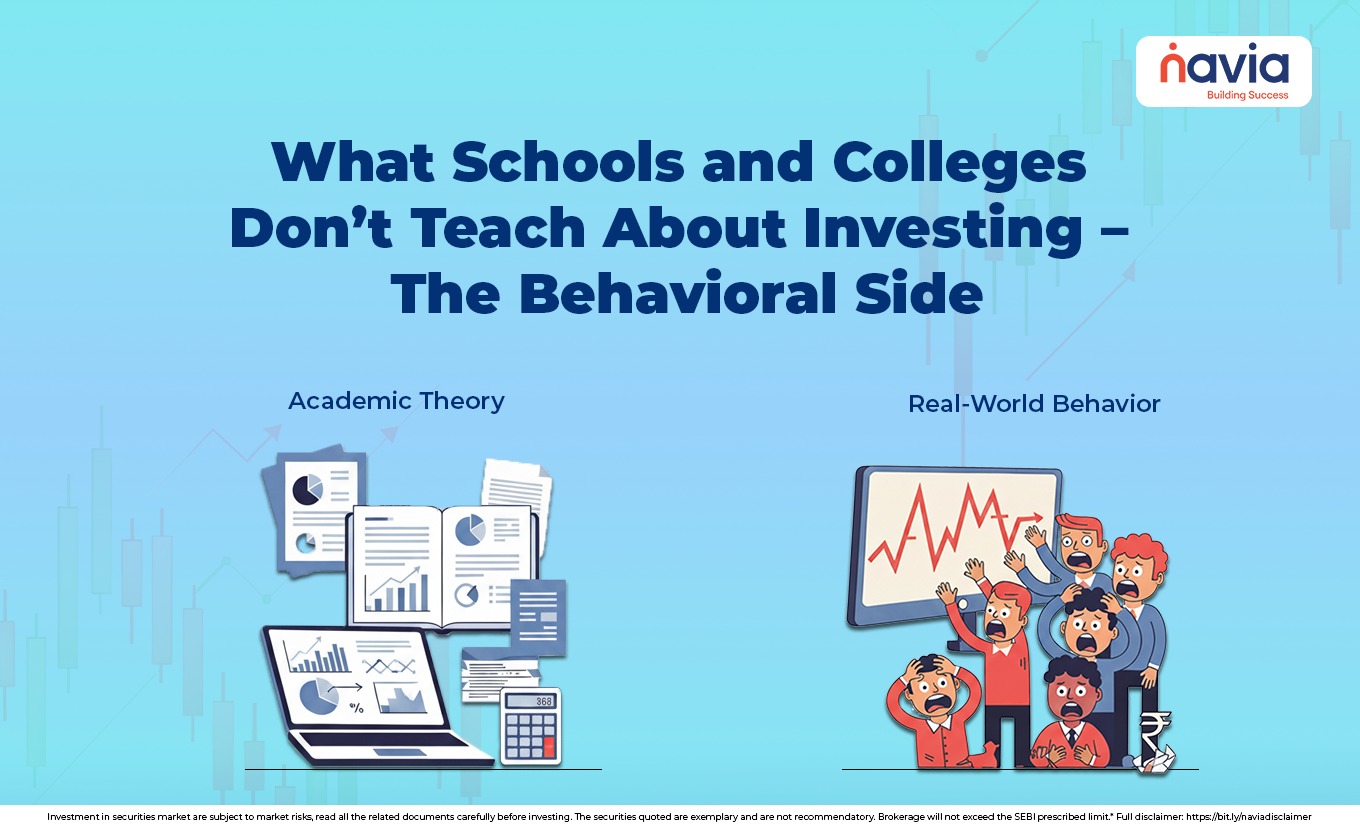
Most schools and colleges prepare us to earn money, but very few prepare us to manage and grow it wisely. While finance courses might cover balance sheets, ratios, or market theories, they often overlook the most critical factor in investing—human behavior.
💡 Quick Answer
The part of investing that classrooms skip is the behavioural part. Five habits do most of the damage: chasing short-term gains because everyone else is, Fear of Missing Out (FOMO) that overrides research, loss aversion that makes you cling to losing positions, overconfidence after a few good trades, and impatience that ends a long-term plan early. The antidotes are not more formulas — they are discipline, patience, self-awareness about your own biases, and a long-term frame.
The Human Side of Money
Investing isn’t just about numbers, it’s about emotions. Fear, greed, hope, and regret drive many investment decisions more than spreadsheets or formulas. Understanding and mastering these emotions is what separates successful investors from average ones.
Market sentiment can even be measured. Tools like the Market Mood Index and the Fear and Greed Index exist precisely because crowd emotion is a recurring, observable feature of markets rather than background noise.
Common Behavioral Pitfalls
Chasing Short-Term Gains
Many investors jump into the latest hot stock or trend because everyone else is doing it. This herd mentality often leads to buying high and selling low.
Fear of Missing Out (FOMO)
Seeing others profit quickly can push investors to act without research. This emotional rush often ends in disappointment.
Loss Aversion
Studies show that people feel losses twice as strongly as gains. As a result, investors may hold on to bad stocks for too long, hoping they’ll “come back.”
Overconfidence
A few good trades can trick investors into believing they can predict markets. Overconfidence leads to excessive risk-taking and painful losses. It is also why rare, unforeseeable shocks hurt so much — a risk explored in this guide to black swan events in the stock market.
Impatience
True wealth in equities is built over decades, not days. But many investors quit too early when they don’t see quick results.

The Skills That Matter
- ➣ Discipline – Stick to your plan even when markets swing wildly.
- ➣ Patience – Let compounding do the heavy lifting.
- ➣ Self-Awareness – Recognize your biases and avoid knee-jerk decisions.
- ➣ Long-Term Thinking – Focus on goals, not daily market noise.
A framework helps here. Dow Theory is one of the oldest attempts to describe market behaviour in terms of primary, secondary, and minor trends — a useful reminder that short-term noise and the underlying direction are two different things.
The Takeaway
Schools and colleges teach us how to make money, but not how to manage emotions around it. The truth is, investing is less about IQ and more about EQ—emotional intelligence. Master your behavior, and you’ll master your investments.
Key Takeaways
- Formal finance education covers balance sheets and ratios but rarely covers the behaviour that actually drives investor returns.
- Herd-chasing and Fear of Missing Out (FOMO) push investors to buy high and sell low — the exact opposite of the intended plan.
- Loss aversion makes losing positions unusually hard to exit, because the pain of a loss is felt more sharply than the pleasure of an equivalent gain.
- Overconfidence after a winning streak leads to oversized risk; impatience ends long-term plans before compounding can do its work.
- The four skills that counteract all of this are discipline, patience, self-awareness, and long-term thinking.
- Related reading: Market Mood Index, the Fear and Greed Index, black swan events, and Dow Theory.
Did you find this article helpful?
Your feedback helps us write better content.

DISCLAIMER: Investment in securities market are subject to market risks, read all the related documents carefully before investing. The securities quoted are exemplary and are not recommendatory. Full disclaimer: https://bit.ly/naviadisclaimer.