

What are Options Hedging Strategy? Mastering Risk in the Stock Market
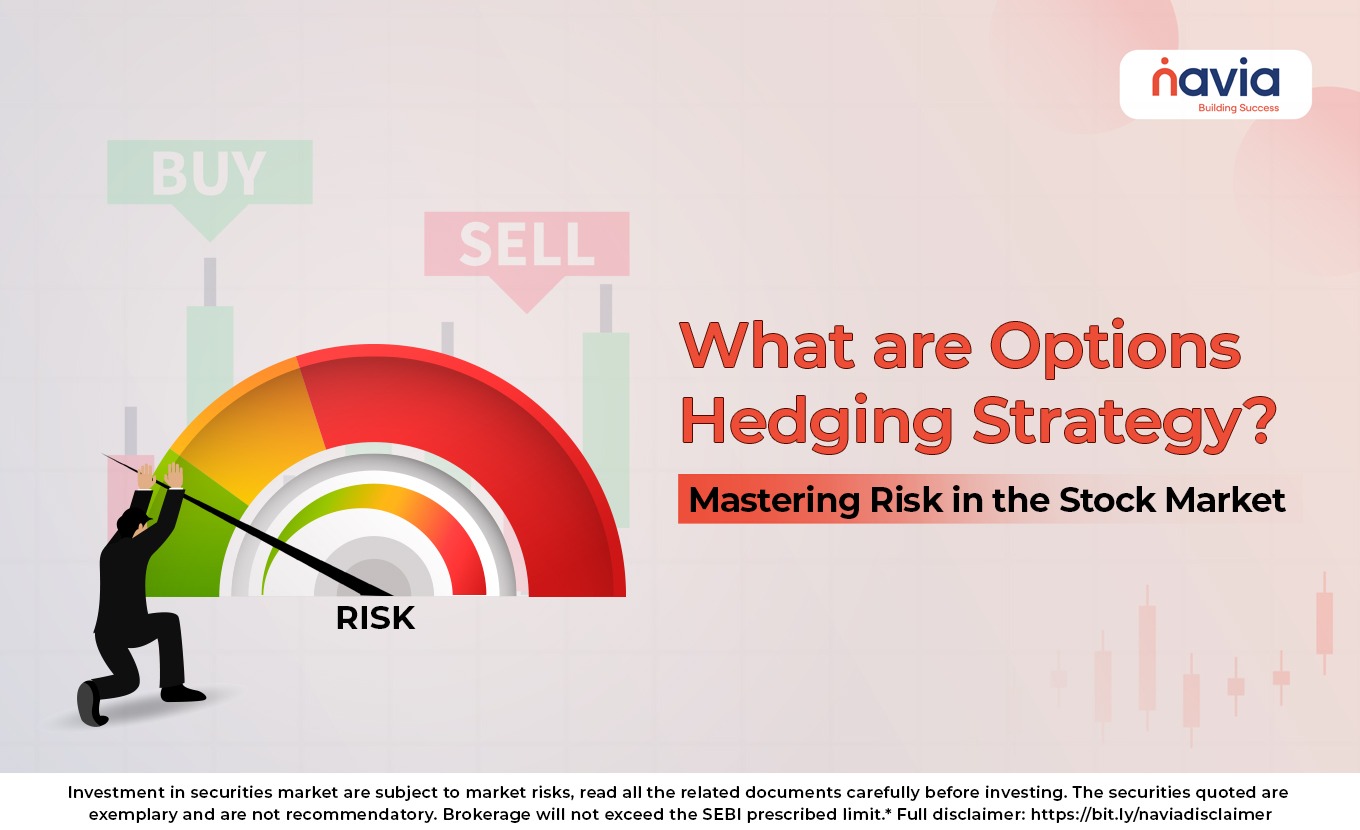
In stock marketing, there are two fast-paced derivatives segments involving futures and options. Both offer extraordinary opportunities to people with significant risk factors. Navigating this terrain requires more than just chasing profits; it needs a good strategy for defense, this defense mechanism called hedging.
Investors who are holding physical shares managing open derivative positions on the NSE and BSE, so understanding option hedging strategies are important. This comprehensive guide will help to understand what options hedging is, why it is essential, and the most effective stock options for hedging strategies used by professionals.
💡 Quick Answer
An options hedging strategy uses a relatively small option premium to cap the downside on a much larger existing stock or futures position — insurance rather than speculation. The four workhorses are the Protective Put (own the stock, buy a put, define your floor), the Covered Call (own the stock, sell an out-of-the-money call for income and a small cushion), the Collar (do both, often for close to zero net cost, capping loss and gain), and the Long Straddle or Strangle (hedge volatility itself when a large move is likely but its direction is unknown).
Understanding the Core: Options and Hedging
Before diving into the options’ hedging strategy, you must understand the two primary components of it.
Options: The Flexible Tool
Options are derivative financial contracts that give the holder the right but not the obligation to buy (call option) or sell (put option) an underlying asset at a specified price on or before the expiry date.
- ➣ Call Option: The right to buy an underlying asset and get profit from a price increase.
- ➣ Put Option: The right to sell an underlying asset and used to profit from a price decrease, and most importantly, used for insurance.
Hedging: The Insurance Policy
Hedging is an investment strategy that is designed to offset potential losses and gains because it may be incurred by a companion investment. It’s like purchasing insurance for your house; so, you can only pay a small premium to protect your assets from unforeseen negative events.
What are Options for Hedging Strategy?
As we already understand the meaning of options and hedging, an options hedging strategy is the combination of these two elements. It involves using options of contracts—which require a relatively small premium payment—to manage the risk of exposure of a much larger, existing position in stocks or futures.
The major objective of this strategy isn’t only increasing profit but to limit downside risk and stabilizing portfolio returns. By paying the option premium, a trader locks in a maximum possible loss on their underlying position, ensuring that a sharp, unexpected market crash does not wipe out years of accumulated capital.
What that premium costs you is largely a volatility question, which is why hedgers watch implied volatility in options trading before putting a hedge on, and why some traders think in terms of long and short volatility rather than direction at all.
Why Stock Options Hedging Strategies Are Essential?
Like other strategies stock options hedging strategies also offer unique advantages that include;
| Strategies | Definition |
|---|---|
| Defined Risk | Unlike holding unhedged stock, which has unlimited downside, buying a put option caps the maximum possible loss to the premium paid plus the difference between the strike price and the stock’s purchase price. |
| Protection from Gaps | Options protect against price gaps (sudden overnight drops) that a standard stop-loss order cannot reliably cover. The option’s value increases instantly upon the drop. |
| Capital Efficiency | Hedging a large stock position requires only a small fraction of the capital (the option premium) compared to selling the entire position or hedging with high-margin futures contracts. |
| Preservation of Tenure | Long-term investors can protect large paper profits without having to sell their underlying shares. This is crucial for maintaining ownership status and favorable long-term capital gains tax treatment. |
| Income Generation | Strategies like the Covered Call allow investors to generate regular premium income against their existing stock holdings, effectively reducing the cost basis and providing a small cushion against mild declines. |
| Flexibility | Options allow for highly customized strategies that can be tailored to match a specific risk tolerance, market outlook and time frame. |
Key Option Hedging Strategies for Indian Stocks
Professional traders and investors of India who are using a variety of option hedging strategies that depend on their timeline of the risk, market views and their target returns. We can analyze some of the strategies below;
Protective Put
Protective Put is considered the most common form of equity hedging, that is often referred to as a synthetic long call.
Strategy
You can own the underlying stock and simultaneously buy an equivalent number of Put Options.
Purpose
It can give you a guarantee that you can sell your stock at the Put’s strike price, depending on how the market is. Your maximum loss will be limited to the difference between your stock’s purchase price and the Put’s strike price, plus the premium.
When to Use
You can use this strategy when you are bullish on stock long-term but fear a near-term market crash.
How far below the current price you set that strike is the central trade-off, and the cost-versus-protection maths is compared directly in at-the-money vs far out-of-the-money options.
Covered Call
Covered Call is known as one of the most effective stock options hedging strategies for generating income and providing partial downside protection.
Strategy
You own the underlying stock and simultaneously sell (write) an equivalent number of Out-of-the-Money (OTM) Call Options.
Purpose
Through selling the call you can collect the premium, and it acts as a buffer against small price declines in the stock.
When to Use
If you hold a stock and expect the price to be flat or slightly bullish/bearish over the short term. It will generate passive income, but your potential profit is capped at the Call’s strike price.
The Collar Strategy
Collar strategy is a balanced approach, and it is a combination of two strategies used to create a zero-cost hedge.
Strategy
If you own a stock and simultaneously buy a Protective Put and sell a Covered Call.
Purpose
The premium received from selling the Call often pays for the premium required to buy the Put. This creates a “collar” or “fence” around your stock value, defining both your maximum possible loss and your maximum possible gain for the period.
When to Use
You can utilize the strategy when you want full downside protection but are willing to give up some potential upward profit to achieve it.
Long Straddle/Strangle
While not a typical options hedging strategy against a specific stock decline, these strategies are used to hedge against market uncertainty or volatility itself.
Strategy
- ⦿ Straddle: Buy both a Call and a Put with the same strike price and expiry.
- ⦿ Strangle: Buy both a Call and a Put with different strike prices and the same expiry.
Purpose
You profit if the underlying asset moves sharply in either direction (up or down). Your loss is capped at the premium paid.
When to Use
Ahead of major non-farm payroll reports, central bank policy announcements, or election results, where a massive price swing is likely, but the direction is unknown.
Traders who want to strip out direction entirely and hedge only the exposure that remains take this a step further into delta neutral options trading.
Conclusion
Options of hedging are a crucial element of modern financial management; it can transform risk from an abstract threat into a quantifiable cost. But you must choose the most suitable method according to your goal, risk appetite and time. By deploying these well-defined strategies, both traders and investors can confidently participate in the market, knowing their downside is meticulously protected.
Key Takeaways
- Hedging with options converts an open-ended risk into a known, quantifiable cost — the premium you pay.
- A Protective Put sets a floor under a holding you want to keep; maximum loss is the gap to the strike plus the premium.
- A Covered Call generates income and cushions mild declines, at the cost of capping your upside at the strike.
- A Collar combines the two so the call premium largely funds the put, defining both the worst and the best outcome for the period.
- Straddles and Strangles hedge volatility rather than direction — useful before scheduled events with an unknown outcome.
- Related reading: implied volatility in options, ATM vs far OTM options, long and short volatility, and delta neutral options trading.
Did you find this article helpful?
Your feedback helps us write better content.

Frequently Asked Questions
What is an option hedging strategy?
An option hedging strategy is an investment approach that uses options contracts (Calls or Puts) to strategically reduce or offset the potential risk of loss in an existing portfolio or trade position.
How to use options to hedge against risk?
The most straightforward way to use options for hedging is through the Protective Put strategy:
- ◆ Identify the Asset: You own shares of a stock (e.g., 100 shares of ABC).
- ◆ Buy a Put Option: You buy one Put Option contract on ABC with a strike price slightly below the current market price and an expiration date in the future.
- ◆ The Hedge: The Put Option gives you the right to sell your shares at that strike price. If the stock price falls sharply, the loss on your shares is limited to the difference between the current price and the Put’s strike price, plus the premium paid.
Is option hedging safe?
Option hedging itself is a safe practice designed to reduce risk, but it’s not foolproof and involves costs.
- ⇨ Safety Factor: It defines your maximum potential loss. A well-executed hedge limits downside risk far more effectively than a standard stop-loss order, especially during sudden price gaps.
- ⇨ Risk/Cost Factor: The premium paid for the option is an irrevocable cost. If the stock price rises (your desired outcome), the option expires worthless, and you lose the premium. Improperly constructed hedges (like complex multi-leg spreads) can be risky if misunderstood.
Which hedging strategy is best?
There is no single “best” hedging strategy; the best choice depends entirely on your specific market outlook, risk tolerance, and the underlying position.
What are common hedging mistakes?
Traders often undermine their hedges by making these common mistakes:
- ➡ Ignoring Costs: Failing to account for transaction costs and the constant erosion from the option premium.
- ➡ Improper Sizing: Hedging only a fraction of the portfolio or hedging with an insufficient options lot size, leading to incomplete protection.
- ➡ Mismatched Expiry: Using very short-term options (e.g., weekly expiry) to hedge a long-term risk, forcing the trader to roll over the hedge constantly, which increases costs.
- ➡ Chasing Cheap Options: Buying options that are far Out-of-the-Money (OTM) because they are cheap. These options offer minimal protection and often expire worthlessly, resulting in lost premium.
- ➡ Over-Complicating: Beginners trying to implement complex strategies like Iron Condors or Butterflies without fully understanding the impact of Option Greeks (Delta, Gamma, Vega, Theta).
DISCLAIMER: Investment in securities market are subject to market risks, read all the related documents carefully before investing. The securities quoted are exemplary and are not recommendatory. Full disclaimer: https://bit.ly/naviadisclaimer.