

What Returns to Expect from the Stock Market in the Long Term?
When it comes to investing, one of the most common questions is: “What returns can I expect from the stock market?” While short-term movements are often unpredictable, the long-term story is far more consistent. Let’s break it down.
💡 Quick Answer
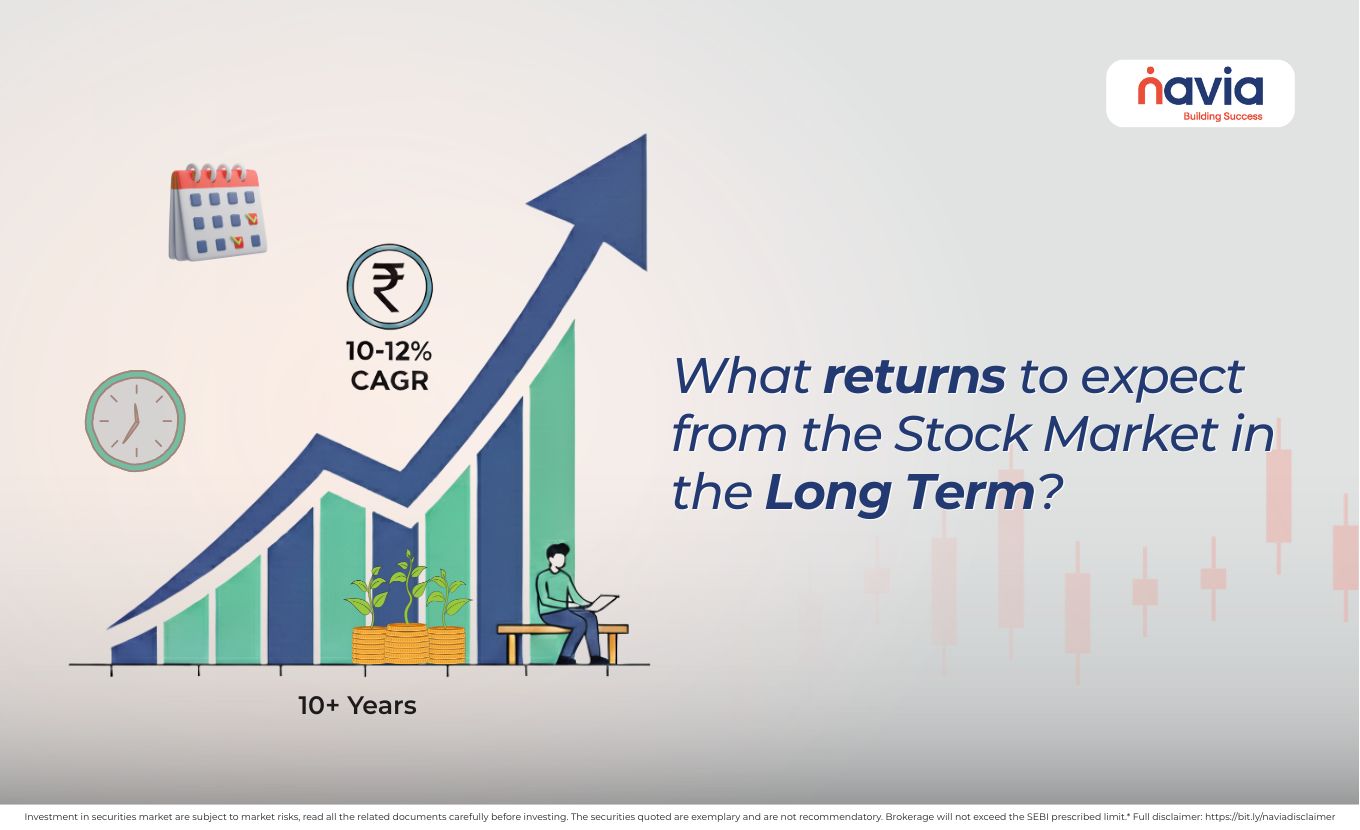
Over a long horizon of ten years or more, this guide frames Indian equities as returning roughly 10–12% CAGR, in line with the historical averages it cites. Over three to five years, outcomes vary widely with cycles, policy, and global trends; over a single year they are effectively unpredictable and sentiment-driven. Returns are driven by corporate earnings growth, economic growth, inflation and interest rates, and investor behaviour. The practical implication is that time in the market, not timing of the market, is what converts an ordinary annual return into meaningful wealth.
Historical Perspective
Over decades, stock markets across the world have rewarded investors with average annualized returns of 10–12% before inflation. In India, the Nifty 50 has delivered roughly 11–12% CAGR over the past 20 years. However, these returns have not come in a straight line—there have been bull runs, corrections, and even flat years.
Which index you track matters when you compare these numbers, since the two headline benchmarks are built differently — a distinction unpacked in Sensex vs Nifty.
The Power of Compounding
A 12% return may not sound extraordinary, but when compounded over long periods, it becomes powerful.
- ➣ ₹1 lakh invested at 12% CAGR grows to about ₹9.65 lakh in 20 years.
- ➣ Staying invested is more important than timing the market.
Compounding needs a vehicle that can survive the full holding period, which is why long-horizon portfolios are usually anchored by blue-chip stocks or by low-cost index products, whose adoption in India is traced in the growth of ETFs in India.

What Drives Long-Term Returns?
- 🔸 Corporate Earnings Growth – As companies grow profits, share prices follow.
- 🔸 Economic Growth – A rising GDP creates opportunities across sectors.
- 🔸 Inflation & Interest Rates – Reasonable inflation supports equity valuations.
- 🔸 Investor Behavior – Patience, discipline, and avoiding panic are as important as market fundamentals.
That last driver is the one investors most often underestimate. Selling winners early and clinging to losers — the disposition effect — quietly drags realised returns below the headline index figure, and no amount of theory prevents it in the moment, as knowledge does not beat emotions argues.
What Should Investors Expect?
- ➱ In the long run (10+ years), Indian equities can be expected to return 10–12% CAGR.
- ➱ In the medium term (3–5 years), returns may vary widely depending on cycles, policy, and global trends.
- ➱ In the short term (1 year or less), returns are unpredictable and often driven by sentiment.
The Takeaway
Stock markets are wealth creators—but only for those who stay invested with realistic expectations. If you aim for 10–12% CAGR over the long term, you’re aligning with historical averages. The key is not chasing quick gains, but harnessing the power of time and compounding.
Key Takeaways
- Long-horizon equity expectations in this guide sit at 10–12% CAGR, with the Nifty 50 cited at roughly 11–12% CAGR over the past 20 years.
- Those averages are never delivered in a straight line — bull runs, corrections, and flat years are part of the same number.
- Shorten the horizon and confidence collapses: three to five years is cycle-dependent, and one year or less is sentiment-driven.
- Returns come from earnings growth, economic growth, and a reasonable inflation and interest-rate backdrop — plus your own behaviour.
- Set the expectation before you invest. Most disappointment comes from importing a one-year mindset into a ten-year asset.
- Related reading: blue-chip stocks for long-term wealth, the growth of ETFs in India, Sensex vs Nifty, and the behavioural side of investing.
Did you find this article helpful?
Your feedback helps us write better content.

DISCLAIMER: Investment in securities market are subject to market risks, read all the related documents carefully before investing. The securities quoted are exemplary and are not recommendatory. Full disclaimer: https://bit.ly/naviadisclaimer.