

May 2026: A Monthly Review of Indian Equity and Sectoral Performance

May 2026 threw a significant geopolitical development at the Indian stock market, triggering a risk-off sentiment that reduced market capitalization. From a government communication that affected market sentiment through jewelry and travel stocks to a tense RBI standoff, the month left investors with raising questions about: how resilient is India’s growth story against a global uncertainty?
Nifty 50 Performance in May
May Market Roundup
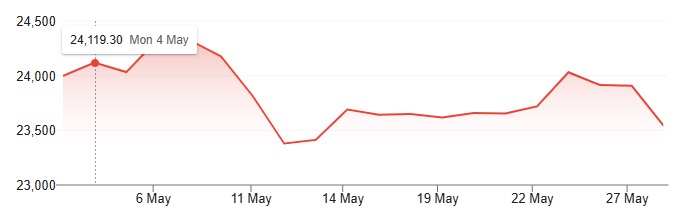
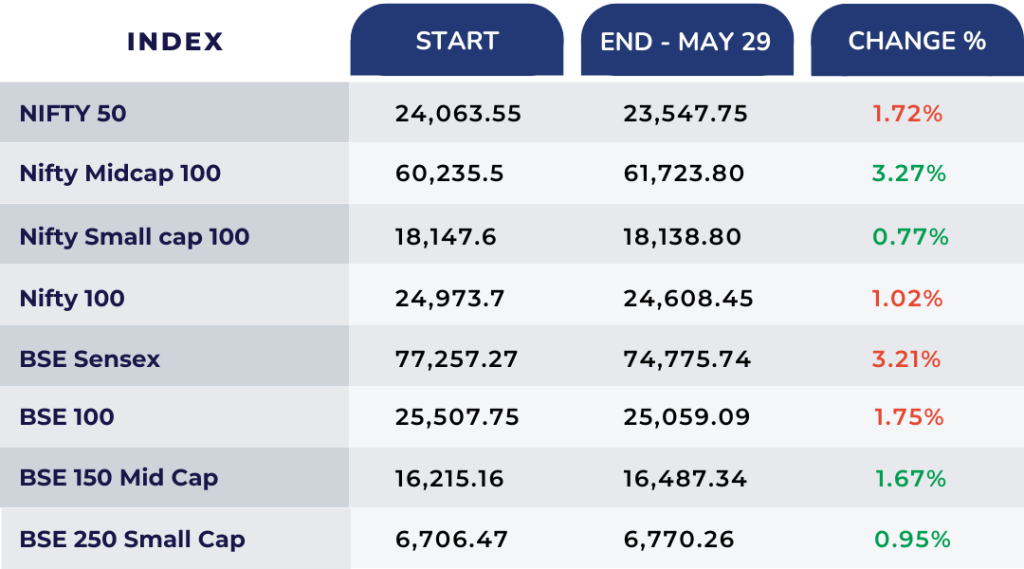
May 2026 turned into a sharp risk‑off month for the Indian stock market, dominated by escalating West Asia war fears, a surge in crude oil prices, a record‑low rupee, and sustained foreign selling. The month saw some of the steepest single‑day falls in over a year, with market capitalization declined as markets reacted to geopolitical shocks and external balance pressures.
Key Highlights:
West Asia War Fears and Crude Oil Surge:
The dominant event in May was the intensifying conflict in West Asia, particularly around Iran, the US, and the Strait of Hormuz. New US strikes in Iran in late May reignited fears of potential disruptions to commercial shipping in the Strait, a critical chokepoint for global oil flows. Brent crude oil prices spiked above $104–113 per barrel at various points during the month, with Brent briefly touching multi‑month highs as supply‑disruption fears mounted. This crude-price rise affected India’s import outlook, given its heavy reliance on oil imports. The Petroleum Ministry noted that crude oil imports in 2025‑26 stood at over $123 billion, and a sustained $100/barrel price would significantly worsen India’s trade deficit and current account balance.
Record‑Low Rupee and External Balance Stress:
The Indian rupee hit a fresh record low of 95.40 against the US dollar in early May, falling further to around 96.34 by mid‑May as oil prices soared and dollar demand remained intense. The rupee’s weakness was driven by soaring crude oil prices and wider import bill, continued foreign fund outflows, and rising global bond yields and risk‑off sentiment. Market participants noted that if global pressures persisted, the rupee market discussions considered additional pressure, with sustained pressure on the trade balance and imported inflation.
Government Appeal to Curb Imports and Gold Purchases:
In a notable policy signal, Prime Minister urged citizens to conserve foreign exchange by reducing overseas travel and discretionary gold purchases. This appeal coincided with selling pressure in jewellery stocks (Titan, Kalyan Jewellers, Senco Gold) and travel‑related stocks (InterGlobe Aviation), with Titan falling 6.1% on the day.
RBI Policy and Monetary Stance:
The RBI’s Monetary Policy Committee kept the repo rate unchanged at 6.5% for the eighth consecutive time, maintaining a neutral stance amid external pressures and inflation risks. The central bank closely monitored the impact of soaring crude oil prices and geopolitical tensions on inflation and growth, with the external sector and rupee volatility becoming key considerations in policy deliberations.
Economic Impact and Outlook:
The May selloff underscored India’s sensitivity to geopolitical shocks and oil‑price spikes, especially given its heavy dependence on crude imports and the record‑low rupee. The West Asia war risks, Strait of Hormuz tensions, and sustained crude above $100–113 created a challenging external environment for equities, the rupee, and the trade balance. However, domestic buying by DIIs, strong fiscal fundamentals, and defensive sector outperformance helped prevent a broader market correction.
Sectoral Movements
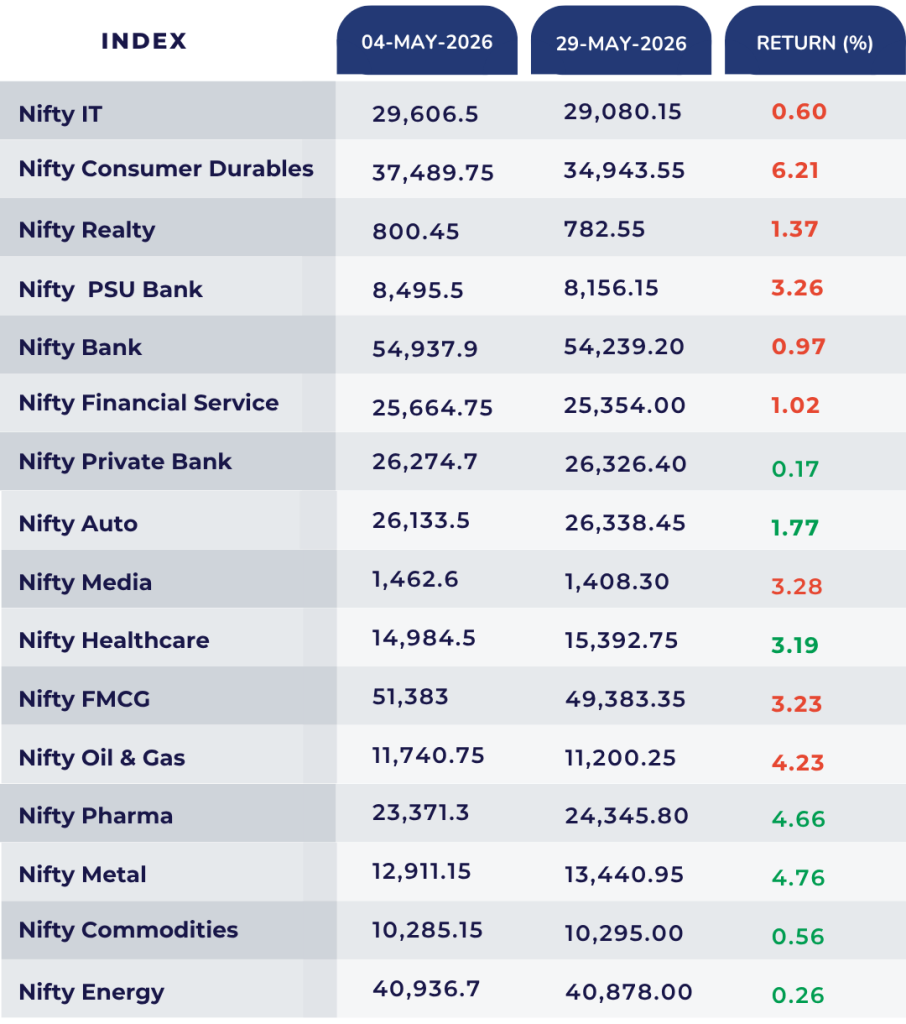
May 2026 marked a highly selective phase for the Indian equity markets, characterized by a mixed trend across key growth drivers as broad-based participation cooled. The month’s sector participation became selective, with the upward momentum led narrowly by the Metal sector at 4.76%, closely followed by strong defensive buying in Pharma (4.66%) and Healthcare (3.19%). In sharp contrast, a pronounced late-month expiry selloff and changing sectoral trends dragged down key spaces, resulting in notable pullbacks for Consumer Durables, which fell 6.21%, followed by declines in Oil & Gas (4.23%), Media (3.28%), and PSU Bank (3.26%).
Company Performance
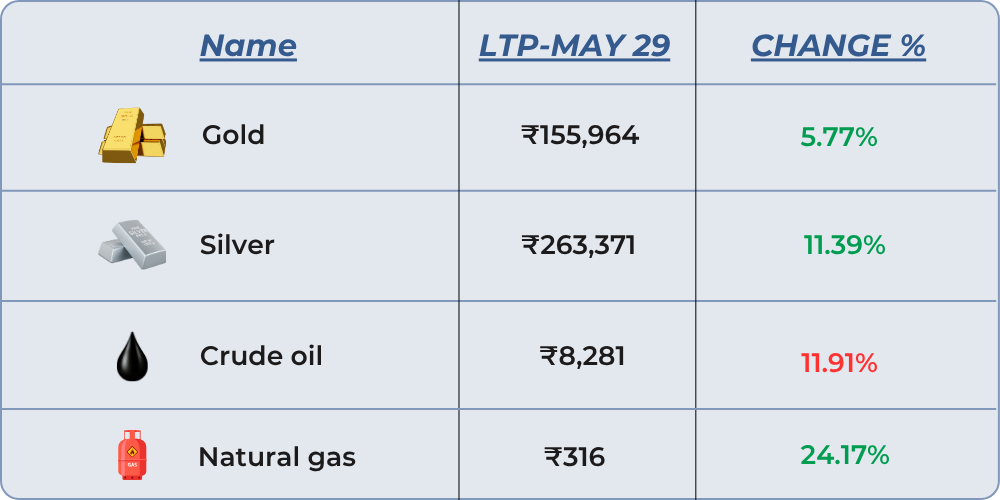
Commodities Month’s Change
SME IPO Performance – May
SME May IPO:
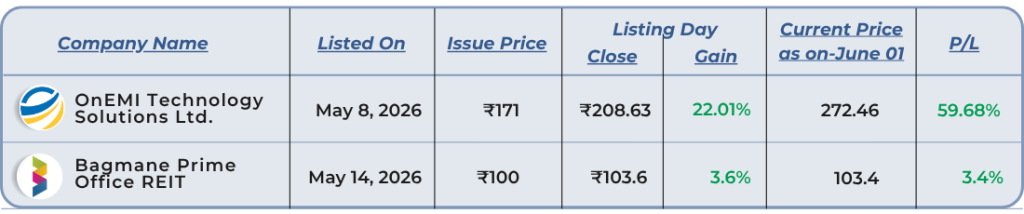
May 2026 marked a highly concentrated period for the primary market, characterized by market participation despite a selective lineup. Of the two companies that made their debut during the month, both posted listing-day gains, signaling subscription activity was observed and both recorded listing-day gains for the period’s new entrants.
Disclaimer: The IPO performances mentioned are historical examples and not investment recommendations.
Top Reads From May!
Dive into our May selection of essential reads, featuring market-related articles on sectoral market shifts, technical indicators, investment costs, and long-term market participation topics!
🔸 Exploring Bonds in the Capital Market: Navia Markets x BondVue Partnership
🔸 Investor’s Guide: Using Navia and Jarvis for Portfolio Insights
🔸 How Navia x Finspring Helps You Access Corporate FDs?
🔸 Taxation on Bonds in India: Interest, Capital Gains, and Key Aspects to Understand
🔸 Growth of ETFs in India – A Look at Market Evolution
🔸 Understanding How a Trading System Can Be Structured for Beginners
🔸 How Trade Settlement Works in the Stock Market?
🔸 Treasury Stocks Explained: Buybacks and Accounting Basics
🔸 Understanding Momentum Indicators in Technical Analysis
🔸 MTF Interest Rates: How They Affect Your Trading Returns
Interactive Zone!
Test your knowledge with our Markets Quiz! React to the options and see how your answer stacks up against others.
Ready to take a guess?

Do You Find This Interesting?
We’d Love to Hear from you-

DISCLAIMER: Investment in securities market are subject to market risks, read all the related documents carefully before investing. The securities quoted are exemplary and are not recommendatory. Full disclaimer: https://bit.ly/naviadisclaimer.