

Beyond Equities: How Corporate Bonds Can Stabilize Your Returns Before 2026
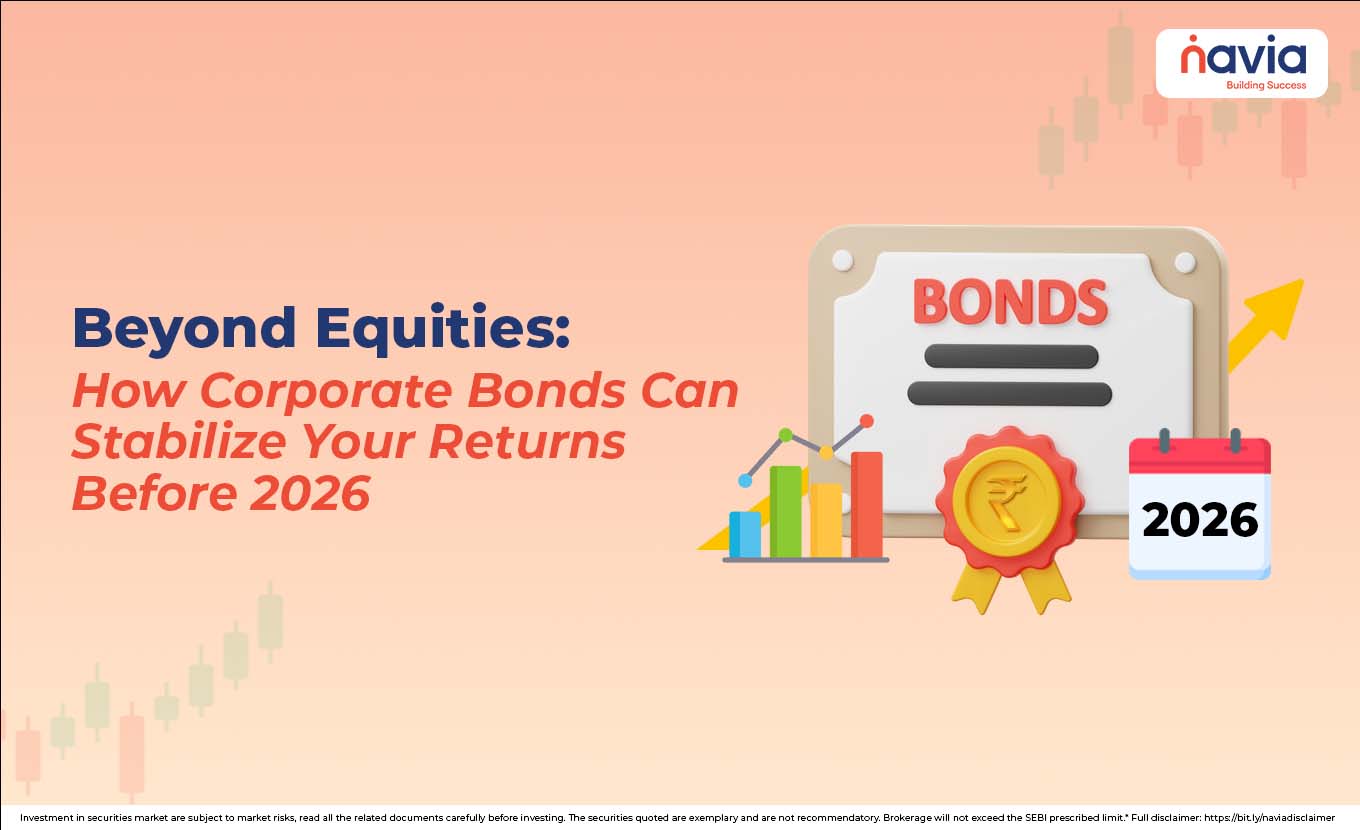
When most people think of investing, their minds jump to stocks, commodities, or mutual funds. But there is a segment that offers stability and a regular income stream, sounds new? That is called corporate bonds. For investors looking to diversify beyond risk or seeking reliable cash flow, investing in corporate bonds is the best option.
In the dynamic landscape of 2025, understanding how to effectively invest in company bonds is the key to building a robust and balanced portfolio. This guide will open the world of Indian corporate bonds for you and explaining what they are and how they work in detail. The segment is regulated by the Securities and Exchange Board of India (SEBI).
💡 Quick Answer
A corporate bond is a debt instrument issued by a company to raise capital. Buying one makes you a lender, not an owner: you receive a fixed coupon on a set schedule and the face value back at maturity. Bonds sit below equity on the risk ladder because interest payments are a legal obligation and bondholders rank ahead of shareholders if the issuer fails. The main risk is credit risk, which is why ratings from agencies such as CRISIL, ICRA and CARE matter, alongside interest-rate and inflation risk. Indian retail investors can access the market through corporate bond funds, target maturity funds, direct purchases on the exchanges, or Non-Convertible Debentures (NCDs).
What are Corporate Bonds?
A corporate bond is a debt instrument issued by a corporation to raise capital. If you invest in company bonds, you aren’t buying ownership like a stock; you are acting as a lender to the company. To understand the term in detail, you must know the differences between debt and equity. Some of the major differences given below;
| Feature | Corporate Bond (Debt) | Stock (Equity) |
|---|---|---|
| Role of investor | Lender | Owner |
| Returns | Fixed and regular interest payments | Dividends (variable) and capital appreciation |
| Risk | Lower risk | Higher risk |
| Maturity | Fixed Term, debt has a specific maturity date. | Perpetual, shares do not expire or mature. |
| Obligation to Company | Legal Obligation, the company is legally required to make interest payments and repay the principal. | No Obligation, the company is not legally obligated to pay dividends. |
| Tax Treatment (Company) | Interest paid is tax-deductible for the company. | Dividends paid are generally not tax-deductible for the company. |
Now we understand the major difference between the two terms, now we must know the mechanism of the bond. When a company issues a bond, it defines three main components, they are;
- Face Value or Pay Value: The amount the investor lends and the amount returned to maturity.
- Coupon Rate: The fixed annual interest rate the company promises to pay.
- Maturity Date: The date the bond expires, and the company repays the face value to each investor.
Through this mechanism they will enter the market; the selection of the right way is up to your own risk. So, make decisions appropriately. For a wider view of how issuance, liquidity and participation have evolved, see India’s Bond Market in 2026.
Why Invest in Corporate Bonds?
The unique blend of features makes the corporate bonds more flexible for the investors, let’s see some of them;
Predictable Income Stream
In stocks, dividends are variable and uncertain, but in corporate bonds you can get a fixed and contractually obligated interest payment (coupon) on a predetermined schedule (usually semi-annually or annually). So, this income stream is ideal for retirees or those who need a reliable cash flow.
Capital Preservation
Compared to equity, bonds offer more security. At the maturity date, the company will legally return the face value to the investors. Furthermore, in the event of bankruptcy, bondholders have a prior claim on the company’s assets before equity holders receive anything.
Diversification of Portfolio
Bonds often have a low correlation with stocks. When the stock market struggles, investors tend to flock to safer assets like bonds. That will help them stabilize their portfolio during market crashes.
Better Yields than FDs
High-quality Indian corporate bonds are typically offering yields that are 1% to 3% higher than bank Fixed Deposits (FDs). Sounds interesting, right? So, if you choose bonds, they will provide you with real returns without taking on the full risk of the equity market. Remember that the yield you keep is the post-tax yield — our guide to taxation on bonds in India explains how interest and capital gains are treated.

What are the Risk in Corporate Bonds?
We can tell that compared to stocks, corporate bonds are safer but are not risk-free. The major risk is credit risk or the chance that the issuer will default on its interest or principal payments.
To overcome or manage the risk level, investors rely on credit ratings provided by agencies like CRISIL, ICRA, and CARE. Let’s see it in detail:
| Credit Rating | Implications |
|---|---|
| AAA (Highest) | Lowest risk and strongest financial position |
| AA | Very low risk and high quality but marginally more susceptible to economic changes |
| A | Medium risk and acceptable quality but somewhat vulnerable to adverse economic conditions |
| BBB and Below | Junk bonds, and high risk of default |
Ratings are a starting point, not a guarantee, and the letter grades carry specific meanings worth learning properly — see Understanding Bond Ratings in India.
Best Ways to Invest in Corporate Bonds in India
The landscape for investing in corporate bonds has expanded significantly, offering retail investors several convenient avenues, like:
- Corporate Bond Funds (Mutual Funds): The easiest and most popular route for diversification. Bond funds pool money to invest across dozens of different bonds, instantly reducing the risk of a single default, and managed by professionals.
- Target Maturity Funds: These debt mutual funds are invested in bonds that have a maturity period. They will hold the bond until maturity that offers high predictability and is similar to a fixed deposit.
- Direct Investment via Stock Exchanges (or Bond Platforms): Individual bonds can be bought and sold on the NSE and BSE. But it needs a Demat account and proper knowledge about bond pricing and liquidity.
- Non-Convertible Debentures (NCDs): These are known as long-term debt instruments that are issued directly by the companies to the public. And they are listed on the exchange and offer fixed coupon rates.
Conclusion
Don’t think that investing in corporate bonds is not about getting rich overnight; it’s about securing your wealth and building a strong foundation for your portfolio. If you are seeking long-term financial wealth before the end of 2025, allocate a portion of your portfolio to highly rated bonds.
Whether through a diversified corporate bond mutual fund or by directly selecting a reputable NCD, bonds are the disciplined, income-generating engine that can keep your portfolio sailing smoothly, regardless of the stock market’s choppy waters.
Key Takeaways
- A corporate bond makes you a lender to the company, entitled to a fixed coupon and the face value at maturity.
- Interest is a legal obligation, and bondholders rank ahead of shareholders in the event of bankruptcy.
- The three defining terms of any issue are face value, coupon rate and maturity date.
- Credit risk is the primary risk, managed through ratings from agencies such as CRISIL, ICRA and CARE.
- Rising market interest rates push existing bond prices down, which matters if you sell before maturity.
- Retail access runs through bond funds, target maturity funds, exchange purchases or NCDs — funds being the simplest way to diversify default risk.
Did you find this article helpful?
Your feedback helps us write better content.

Frequently Asked Questions
What is a corporate bond?
A corporate bond is a debt instrument issued by a company to raise money. When you buy a corporate bond, you are essentially acting as a lender to the corporation.
Is it good to invest in corporate bonds?
Yes, it can be very good to invest in corporate bonds as part of a diversified portfolio, especially if you are seeking stable income and capital preservation.
Is corporate bond better than FD?
Bonds are generally better for higher returns, liquidity, and potential tax efficiency, while FDs are better for absolute safety (capital guarantee).
Are bonds 100% risk free?
No, bonds are not 100% risk free. All bonds carry some degree of risk, though the level varies significantly:
- Credit Risk: The primary risk for corporate bonds is that the issuer will fail to make interest or principal payments. This risk is rated by credit agencies (e.g., AAA is low risk; BBB is higher risk).
- Interest Rate Risk: If market interest rates rise, the price of existing bonds will fall, causing a loss if you sell before maturity.
- Inflation Risk: The fixed interest payments might be unable to keep pace with rising inflation, eroding the real return.
What are the 5 types of corporate bonds?
While classifications can be numerous, corporate bonds are generally categorized by their structure and features:
- Secured Bonds: Backed by specific company assets (collateral), reducing risk for the bondholder.
- Unsecured Bonds (Debentures): Not backed by specific collateral; repayment relies only on the company’s general creditworthiness.
- Callable Bonds: Give the issuer (company) the right to buy back or “call” the bond before its maturity date.
- Puttable Bonds: Give the bondholder the right to sell the bond back to the issuer before its maturity.
- Convertible Bonds: Can be exchanged by the holder for a predetermined number of the company’s common shares.
What is the maturity period of a corporate bond?
The maturity period of a corporate bond refers to the time frame until the issuer must repay the face value (principal) to the bondholder. These periods are typically categorized as:
- Short-Term: Maturities of 1 to 5 years.
- Intermediate-Term: Maturities of 5 to 12 years.
- Long-Term: Maturities of 12 years or more (up to 30 years or even longer).
The maturity period is fixed at the time the bond is issued.
DISCLAIMER: Investment in securities market are subject to market risks, read all the related documents carefully before investing. The securities quoted are exemplary and are not recommendatory. Full disclaimer: https://bit.ly/naviadisclaimer.