

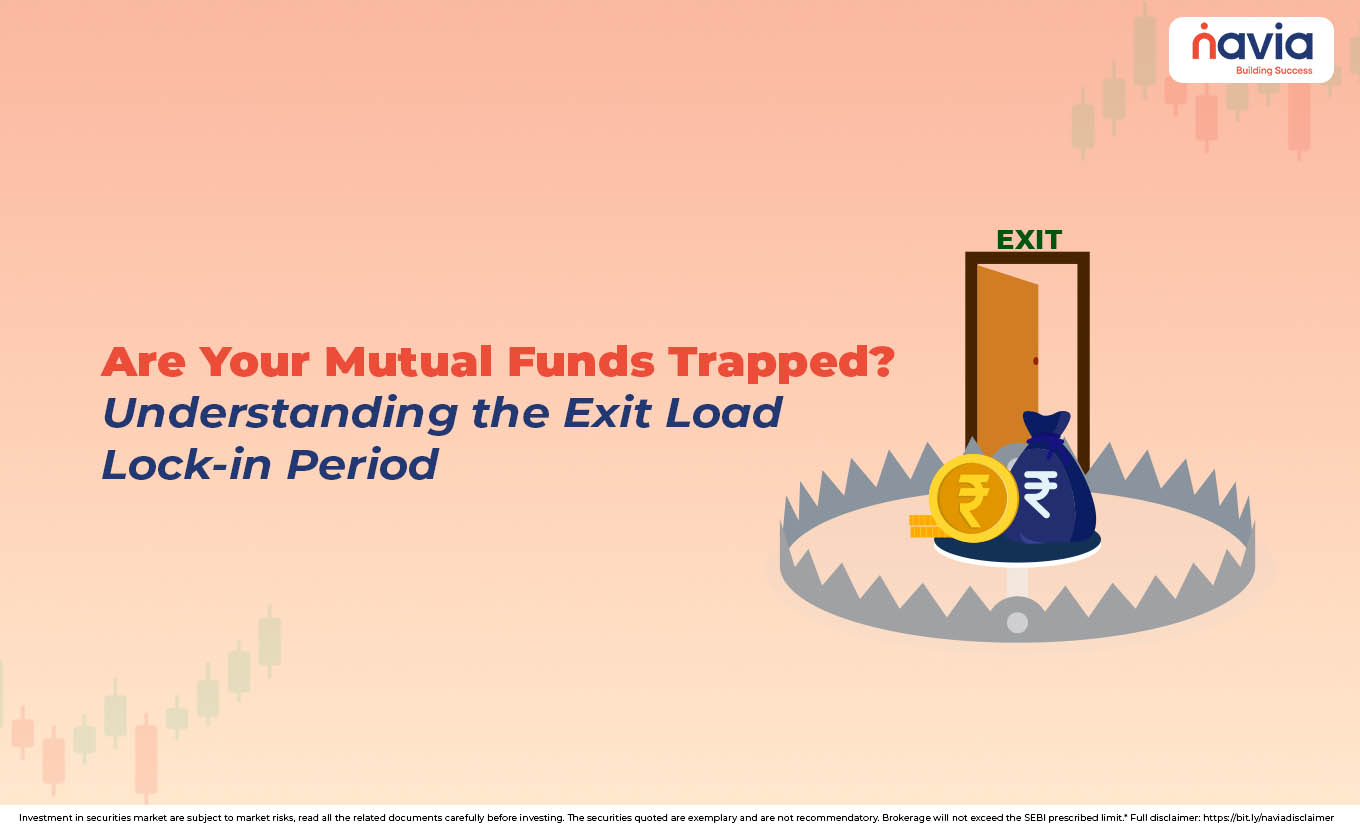
Are Your Mutual Funds Trapped? Understanding the Exit Load Lock-in Period
After you have done your research, select a top-performance scheme and watch your investment growth. But when it comes to redeeming those hard-earned units, you might face a hidden charge off your total return that is called Exit Load. Both new and experienced investors should understand what is exit load in mutual fund is crucial.
It is a mechanism that impacts your final withdrawal amount, and that can significantly alter your returns. So, if you want to avoid these unexpected fees, mastering the exit load concept is non-negotiable. This guide will demystify the exit load of mutual funds, explain the term, and show you how the exit calculation works in detail. Scheme-wise load structures are disclosed in every offer document and summarised by the Association of Mutual Funds in India (AMFI).
💡 Quick Answer
An exit load is a fee the Asset Management Company (AMC) charges when you redeem mutual fund units before a minimum holding period has passed. It is expressed as a percentage of the redemption value and is deducted from the amount you receive, so it directly reduces your realised return. Its purpose is to discourage short-term churn and protect investors who stay put. You avoid it entirely by holding past the load period, by using the free redemption limit many schemes offer, or by choosing a no-load fund. Always check the load structure in the scheme document before you invest, not when you are trying to exit.
What is Exit Load in Mutual Fund Investing?
The exit load is a fee charged by the Asset Management Company (AMC) to the investor when they sell their mutual fund units, before a specified period has elapsed since the purchase date. It’s like a penalty for early withdrawal, and some of the major purpose of the term is given below;
Discourage Short-Term Trading
We know that mutual funds are designed for long-term growth, especially equity funds. So, high-volume and short-term transactions can destabilize the fund manager’s strategy and increase administrative costs for the AMC.
Protect Long-Term Investors
By penalizing early exit, the load helps keep assets within the fund for longer, that allows the fund manager to maintain a stable portfolio and avoid forced selling of assets to meet the frequent redemption requests.
Revenue (Secondary)
The fees collected from the investors often go back into the scheme’s corpus (not the AMC’s profit) to benefit the remaining long-term investors.
In simple words, the exit load is a percentage fee that is charged on the Net Asset Value (NAV) of mutual fund units at the time of redemption. If the investor pulls out their money before a minimum holding period, typically from six months to two years.
Exit Load Calculation: A Simple Percentage
The exit load calculation is expressed as a percentage of the Net Asset Value (NAV) per unit at the time of redemption.
The standard formula is;
Redemption Value = (NAV per Unit * Units Redeemed) – Exit Load Amount
Where:
Exit Load Amount = (NAV per Unit * Units Redeemed) * Exit Load Percentage
How Does an Exit Load Work in Practice?
Just think that you invested in mutual fund scheme with the following terms:
| Parameter | Value |
|---|---|
| Initial Investment Date | January 1, 2024 |
| Exit Load Term | 1% if redeemed within 1 year |
| Investor Redemption Date | July 1, 2024 (6 months later) |
| Units Redeemed | 1,000 units |
| NAV per Unit at Redemption | ₹50.00 |
Step 1: Determine the load
Since the redemption occurred within the 1-year period, the 1% exit load applies.
Step 2: Calculate the Total Redemption Value (Before Load)
Total Value = 1,000 units * ₹50.00/ unit = ₹50,000
Step 3: Calculate the Exit Load Amount
Exit Load Amount = ₹50,000 * 1% = ₹500
Step 4: Calculate the Net Redemption Value
Net Redemption Value = ₹50,000 – ₹500 = ₹49,500
Here the investor receives ₹49,500 with ₹500 being deducted as the exit load.

Understanding the Exit Load Structure
If you are analyzing what is exit load of mutual fund schemes, pay close attention to the following details:
| Holding Period | Most critical factor. A scheme may charge 1% if redeemed within 365 days and 0% thereafter, or 0.5% if redeemed within 6 months and 0% if redeemed between 6 and 12 months. The longer you hold the units, the smaller the penalty. |
| Free Limits | Many AMCs allow investors to withdraw a small portion of their investment free of charge, even during the lock-in period. Many funds permit withdrawal of 10% to 12% of the units (or the investment amount) purchased in a specific folio within the exit load period, free of any load. |
| Load vs. No-Load Funds | You will encounter two main types of funds; Load Funds: Schemes that charge either an entry load or an exit load. No-Load Funds: Schemes that charge neither an entry load nor an exit load. These are often preferred by investors seeking maximum flexibility. |
Load structures differ sharply by scheme category. Debt and hybrid categories such as income funds and interval funds have their own redemption rules, and exchange-traded products avoid the load question entirely because they trade on the exchange — see ETF Pricing: NAV, iNAV and Fair Value Explained.
Exit Load vs. Expense Ratio: Don’t Confuse Them!
Exit load and expense ratio are the important factors so, there is a chance to become confused with these factors. Will make it clear;
- Exit Load: A one-time fee that charged upon redemption, specifically aimed at deterring early withdrawal.
- Expense Ratio: It is an annual charge that is deducted daily from the fund’s assets to cover all operating, management, and administrative costs.
The expense ratio affects your returns daily, but the exit load only affects your return if you break the stipulated holding period. Our guide to expense ratios shows how that daily drag compounds over a long holding period.
Conclusion
Understanding what is exit load isn’t about avoiding mutual funds; it’s about making an informed decision about your investment horizon. If you choose a mutual fund, you should commit to holding it for the period required to achieve the 0% load, thereby avoiding any unnecessary fee on your hard-earned profits. And the exit load calculation will help to ensure that your exit is a truly profitable one. Always read the fine print—that small percentage can make a big difference!
If you invest in instalments, the load period runs separately for each one, so it is worth reading our guide to which Systematic Investment Plan (SIP) is right for you before you set up a redemption.
Key Takeaways
- An exit load is a one-time fee charged on redemption when you sell units before the scheme’s minimum holding period.
- It is calculated as a percentage of the redemption value and deducted from what you receive, not billed separately.
- Exit load is not the same as the expense ratio — the latter is an annual charge deducted daily whether you redeem or not.
- Many schemes offer a free redemption limit within the load period, which is useful for emergency withdrawals.
- The cleanest way to avoid it is to hold past the load period or pick a no-load scheme from the outset.
- With Systematic Transfer Plans (STP) and Systematic Withdrawal Plans (SWP), each instalment carries its own load clock.
Did you find this article helpful?
Your feedback helps us write better content.

Frequently Asked Questions
What is a good exit load for a mutual fund?
A good exit load is generally 0%. Investors should aim for a scheme that is a No-Load Fund.
If a fund does charge an exit load, the following structure is usually considered acceptable, as it reflects the fund’s investment objective:
- Equity Funds: 0% if held for 1 year or more.
- Debt Funds (Liquid/Ultra Short): 0% if held for a very short period (e.g., after 7-30 days) or 0% outright.
The faster the load drops to zero, the better the structure is for the investor’s flexibility.
How to avoid exit load in mutual funds?
The most effective way to avoid exit load is to adhere to the fund’s mandate:
- Hold Past the Lock-in Period: The easiest way is to ensure you do not redeem your units until the specified load period (usually 365 days for equity funds) has expired.
- Use the Free Limit: Most schemes allow you to redeem 10% to 12% of your units purchased within the last year without incurring a load. Use this free limit for emergency withdrawals.
- Invest in No-Load Schemes: Choose funds that explicitly state a 0% exit load from the beginning.
- Use STP/SWP Strategically: When using Systematic Transfer Plans (STP) or Systematic Withdrawal Plans (SWP), ensure the redemption is scheduled to occur only after the units being redeemed have completed their load period.
Is exit load charged after 1 year?
Generally, no, the exit load is typically not charged after 1 year for most equity and hybrid mutual funds in India.
Which exit load is good?
The best exit load is 0%. A fund with 0% exit load is called a No-Load Fund. If an exit load is unavoidable because you like a particular fund, a “good” structure is one that is:
- Minimal Percentage: No more than 1%.
- Short Duration: The load applies for the shortest possible time (e.g., six months, not two years).
- Has a High Free Limit: Allows redemption of a significant percentage (e.g., 15%) without load.
Is exit load taxable?
No, the exit load itself is not taxable. The exit load is a fee that is deducted from your gross redemption amount, reducing the final amount you receive.
DISCLAIMER: Investment in securities market are subject to market risks, read all the related documents carefully before investing. The securities quoted are exemplary and are not recommendatory. Full disclaimer: https://bit.ly/naviadisclaimer.