

Navigating the Hybrid Path: A Comprehensive Guide to Interval Funds
In the vast landscape of the Indian mutual fund industry, most investors are familiar with two primary structures: Open-ended funds, which allow for entry and exit at any time, and Closed-ended funds, which lock capital until a specific maturity date. However, there exists an alternative fund structure that less commonly discussed among retail investors. This category is known as interval funds.
As the financial markets evolve, understanding what is interval funds and how they function can can support investment understanding for those looking to balance liquidity considerations with yield characteristics. This blog post explores the interval funds meaning, their operational structure, and their role within a diversified portfolio.
💡 Quick Answer
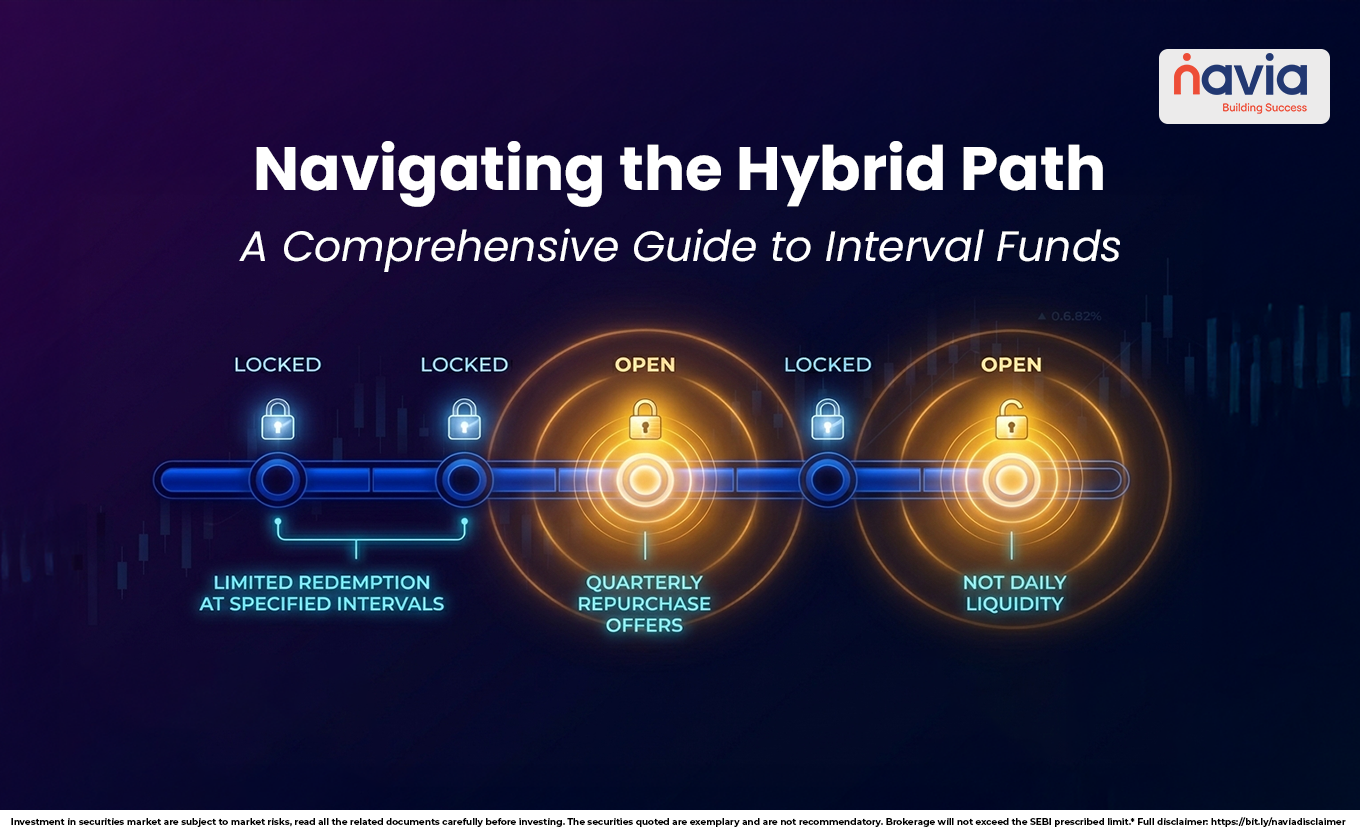
Interval funds are a hybrid mutual fund that mixes open- and closed-ended features: you can only buy back or redeem units during pre-defined windows (monthly, quarterly and so on), not daily. That lets managers hold less-liquid, potentially higher-yielding assets like corporate debt with lower NAV volatility — in exchange for limited liquidity between windows.
What are Interval Funds?
To start with the basics, interval funds are a class of mutual funds that combine the characteristics of both open-ended and closed-ended structures. Unlike standard mutual funds that trade daily, interval funds in mutual funds do not permit investors to redeem their shares on a continuous basis. Instead, the fund “opens” for buybacks or redemptions only at specific, pre-defined intervals.
The interval funds meaning is rooted in this periodic window. These windows (intervals) are determined by the fund house at the time of the fund’s launch and can occur monthly, quarterly, semi-annually, or annually. During these specific periods, the fund house offers to repurchase a certain percentage of its outstanding shares from investors at the current Net Asset Value (NAV).
How Do Interval Funds Work?
Understanding how interval mutual funds operate requires looking at their unique lifecycle.
| Non-Continuous Trading | For most of the year, the fund remains closed for redemptions. This gives the fund manager the allows allocation to relatively less liquid assets without the constant fear of sudden large-scale withdrawals (redemption pressure). |
| The Transaction Window | During the scheduled interval, the fund opens for a short duration (usually 2 to 15 days). Investors can choose to exit or purchase additional units during this time. |
| Stock Exchange Listing | According to SEBI regulations, interval funds in mutual funds are typically listed on a stock exchange. This provides a secondary market for liquidity, though trading volumes on the exchange are often low, making the official “interval” the primary exit route. |
Why Invest in Interval Funds?
Now that we have covered what are interval funds, the next logical question is: why choose them over a standard liquid or equity fund?
1. Exposure to Less Liquid Assets
Because the fund manager knows exactly when redemptions will occur, they can invest in assets that take longer to mature or are less frequently traded. These might include corporate debt, commercial papers, and other fixed-income instruments that may offer different return characteristics than the highly liquid assets found in open-ended funds.
2. Lower Volatility
Since the fund isn’t subject to the daily whims of panic-selling or mass entries, the NAV may show relatively lower fluctuations. This makes interval mutual funds an may be considered by certain investors for conservative investors who are looking for something steadier than equity but different from traditional savings instruments.
3. Disciplined Investing
The structure of interval funds inherently discourages impulsive trading. Since you cannot exit whenever the market takes a minor dip, it forces a level of investment discipline that may encourage disciplined investing behaviour.

Key Risks and Considerations
While the interval funds meaning implies a structured and stable environment, they are not without risks.
| Liquidity Constraint | This is the an important factor. If you have a financial emergency outside of the pre-defined window, investors may face difficulty to access your money. Even though they are listed on exchanges, finding a buyer at a fair price can be challenging. |
| Credit Risk | Since these funds often invest in corporate debt to generate higher yields, there is a risk that the issuing company might default on interest or principal payments. |
| Operational Risk | The periodic nature of the fund means you must be proactive. If you miss the “interval” window, you must wait until the next scheduled period, which could be months away. |
Who Should Invest?
Interval funds are not a one-size-fits-all product. They are may be suitable for:
- Investors with Clear Timelines: If you know you don’t need your capital for a specific period (e.g., a child’s college fees due in two years), investments may be aligned with a fund that has a matching interval.
- Institutional Investors: Many corporate treasuries use interval funds to park surplus cash that isn’t needed for immediate operations.
- Sophisticated Retail Investors: Investors aware of liquidity and yield trade-offs between liquidity and yield and have a secondary “emergency fund” elsewhere.
Conclusion
What are interval funds if not a hybrid structure combining different features? They offer an alternative way to gain exposure in the credit markets while providing a structured exit mechanism. While they require more planning than a standard open-ended fund, the different return characteristics and lower volatility makes them may be considered as part of diversification for a well-diversified portfolio.
Before investing, always review the Scheme Information Document (SID) to understand the specific “intervals” and the credit quality of the underlying assets. In a market where clarity is key, knowing the exact rules of your investment is important for informed decision-making. To compare interval funds with other debt options, read about income funds, low duration funds and medium duration funds, and use risk measures like the Sortino ratio to assess them.
Key Takeaways
- Interval funds blend open- and closed-ended structures, allowing redemptions only during pre-set windows.
- Windows are fixed at launch (monthly, quarterly, semi-annually or annually) and usually stay open 2–15 days.
- Reduced redemption pressure lets managers hold less-liquid, potentially higher-yielding assets like corporate debt.
- Benefits include lower NAV volatility and enforced discipline; the main trade-off is limited liquidity and credit risk.
- They suit investors with clear timelines, institutions and informed retail investors who keep an emergency fund elsewhere.
Did you find this article helpful?
Your feedback helps us write better content.

Frequently Asked Questions
What is an example of an interval fund?
An interval fund focused on venture capital might carry pre-IPO shares and late-stage startup equity, whereas one centered on credit could hold asset-backed securities, syndicated loans, or direct lending strategies.
What is an interval fund vs. mutual fund?
Unlike standard mutual funds that must maintain daily liquidity for constant withdrawals, interval funds can invest in less liquid assets like private credit or private equity. This structure allows for different return potential by removing the pressure of daily redemptions.
Can anyone buy an interval fund?
Like open-end and closed-end funds, interval funds are registered products that do not require investors to be qualified purchasers. Additionally, they may have varying minimum investment requirements than private funds.
Do interval funds have high fees?
The fees and expenses associated with interval funds are often higher than those of typical closed-end or mutual funds. This is partly attributed to the specialized management expertise required and the comparatively higher costs involved in investing in their specific underlying assets.
DISCLAIMER: Investment in securities market are subject to market risks, read all the related documents carefully before investing. The securities quoted are exemplary and are not recommendatory. Full disclaimer: https://bit.ly/naviadisclaimer.