

Minimum Deposit to Start Trading: What You Actually Need
Quick answer
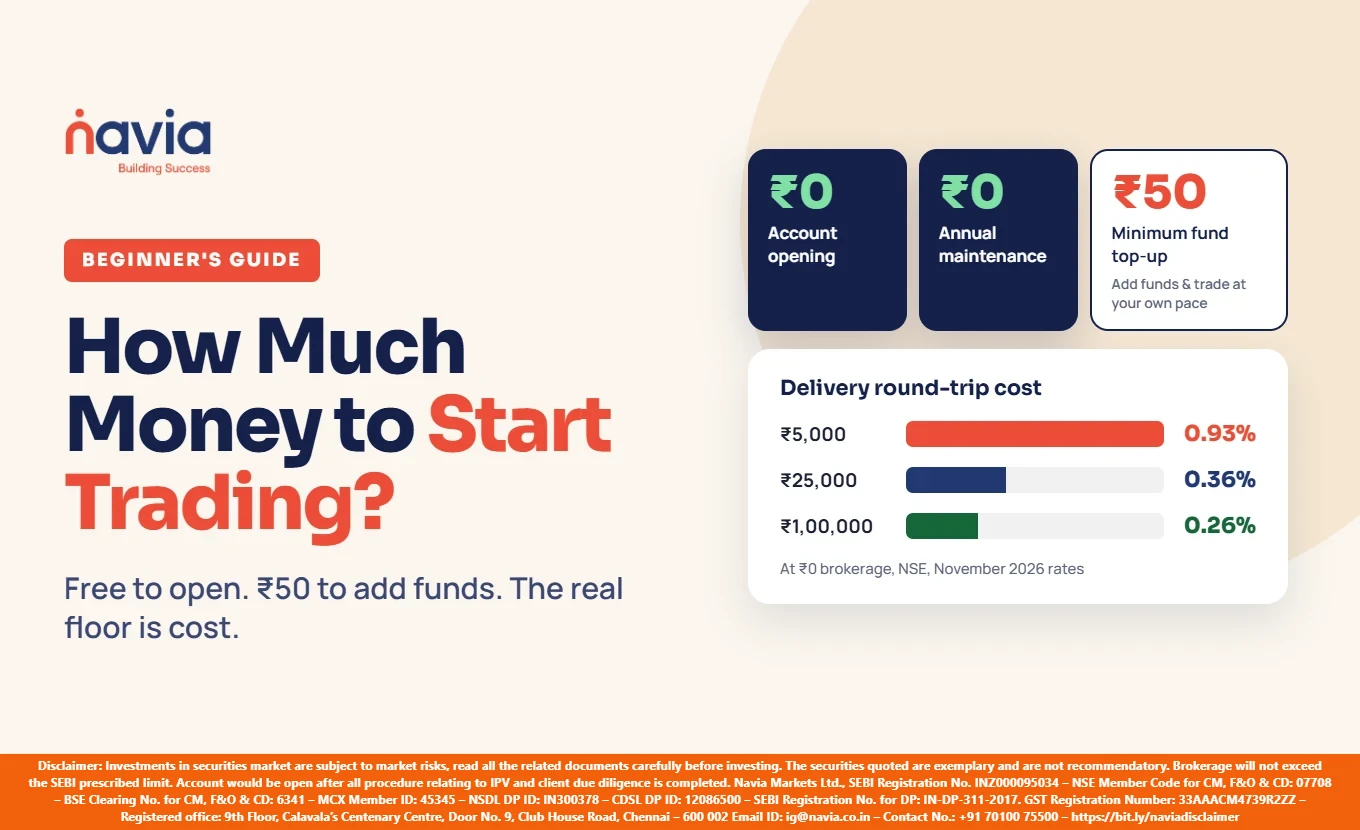
The minimum deposit is ₹50. That is the smallest top-up Navia’s add-funds screen accepts, and since account opening and annual maintenance are both ₹0, the minimum deposit on a trading app is a formality rather than a barrier. But ₹50 is a payment floor, not a trading floor — the minimum amount to start trading in India is set by what a trade costs, not by what a broker will accept.
Here is the figure nobody publishes. A ₹5,000 equity delivery round trip costs ₹46.52 at ₹0 brokerage — 0.93% of the trade, so the price must move about 1% before you are even. About 76% of that is the DP charge, which is flat. At ₹25,000 the same round trip costs 0.36%.
Key takeaways
- The minimum deposit is ₹50, the smallest top-up Navia’s add-funds screen accepts. Opening and annual maintenance are ₹0, so no rule sets a higher floor — costs do.
- A ₹5,000 equity delivery round trip costs ₹46.52 at ₹0 brokerage — 0.93% of the trade, so the price has to move about 1% before you break even.
- About 76% of that is the DP charge, a flat ₹30 plus GST per scrip sold however small the sale.
- Cost as a percentage falls fast with size: 0.93% at ₹5,000, 0.36% at ₹25,000 and 0.26% at ₹1,00,000.
- Brokerage roughly doubles the cost of a small trade. The same ₹5,000 round trip costs 1.87% at a broker charging ₹20 an order.
What does it cost to place your first trade?
More, as a share of the trade, than most people expect.
Opening the account is free and holding it is free — what a zero balance demat account covers deals with that side. The cost of buying and selling shares is a separate question, and it is the one that decides how much you actually need.
Statutory charges are identical at every broker, so brokerage is the only variable. The table is an equity delivery round trip — one buy and one sell of the same amount — at Navia’s ₹0 brokerage against a broker charging ₹20 an order. Rates in force in November 2026: securities transaction tax on delivery 0.1% each side, NSE transaction charge ₹3.07 per lakh, stamp duty on buying shares 0.015%, SEBI turnover fee ₹10 per crore, DP charge ₹30 per scrip on the sell, GST 18% where it applies.
| Trade size | At ₹0 brokerage | As % of trade | At ₹20 an order | As % of trade |
|---|---|---|---|---|
| ₹5,000 | ₹46.52 | 0.93% | ₹93.72 | 1.87% |
| ₹10,000 | ₹57.65 | 0.58% | ₹104.85 | 1.05% |
| ₹25,000 | ₹91.02 | 0.36% | ₹138.22 | 0.55% |
| ₹50,000 | ₹146.64 | 0.29% | ₹193.84 | 0.39% |
| ₹1,00,000 | ₹257.88 | 0.26% | ₹305.08 | 0.31% |
Two things fall out of it. Brokerage charges for small trades matter more than the headline suggests — 0.93% against 1.87% on the same ₹5,000 — and the percentage cost falls sharply as the trade grows, from 0.93% to 0.26%. Work out your own size before deciding what to fund.
Why does a ₹5,000 trade cost almost 1%?
Because one charge is flat, and on a small trade a flat charge is almost all of it.
Of the ₹46.52 a ₹5,000 round trip costs at ₹0 brokerage, ₹35.40 is the DP charge and its GST. That is 76% of the total. The depository participant levies it per scrip on the sell side and it does not scale, so selling ₹5,000 of a stock and selling ₹50,000 of it cost the same ₹30 plus GST.
The consequence is practical. Twenty ₹5,000 trades cost far more than four ₹25,000 trades, though the money at work is identical. If you are starting on delivery, fewer and slightly larger positions are cheaper than many tiny ones.
Can you start trading with ₹5,000?
Yes. Just know what the first 1% of the move is paying for.
Nothing prevents it, and for a first position there is a reasonable argument for a size where being wrong is affordable. The honest caveat is the break even percentage on a trade: at ₹5,000 you need roughly a 0.93% move to cover costs, at ₹25,000 about 0.36%, at ₹1,00,000 about 0.26%.
That suggests a floor rather than a target. Below about ₹10,000 a delivery trade spends more than half a percent on charges before the position does anything. A minimum investment in share market for beginners is therefore less about what you can afford to commit and more about where costs stop being the dominant term. None of this is a view on what to buy or when — it is arithmetic on charges, and it applies to every position equally.
Is there a demo account you can practise on first?
Not a legitimate one, since 2024.
SEBI’s Norms for sharing of real time price data to third parties (SEBI/HO/MRD/MRD-PoD-3/P/CIR/2024/56, 24 May 2024) restricted market infrastructure institutions and market intermediaries from sharing real-time price data with third parties, which removed the feed virtual trading apps depended on.
SEBI followed with an Advisory on unauthorized virtual trading / gaming platforms (Press Release 37/2024, 4 November 2024), cautioning investors against apps offering virtual trading, paper trading or fantasy games on listed company prices. Users of those platforms have no recourse through SCORES or the exchange and depository online dispute resolution mechanism.
Navia’s Guest Mode opens the app without KYC — watchlists, live quotes and charts, the option chain, market depth — but it does not place orders, real or simulated. What Guest Mode includes sets out the full list.
Delivery, intraday or F&O — where should you start?
Delivery, because it is the only one where you choose the size.
Delivery versus intraday charges differ in a way that matters at small sizes: an intraday position is never delivered, so no DP charge arises, but intraday adds leverage and a square-off deadline that compresses a mistake into one session.
F&O is a different matter entirely. The Nifty lot size margin runs to tens of thousands of rupees per lot, set by the clearing corporation and recomputed every session, so there is no smaller version of the position to begin with. What option selling actually blocks works through the figures. Trading in F&O involves substantial risk.
What should you check before the first order?
The cost of the specific trade, not the cost of the account.
The account side is settled: ₹0 to open, ₹0 annual maintenance, ₹50 to add funds and no minimum balance to keep. What varies is the order in front of you, and the two numbers worth knowing before you place it are what the round trip will cost and what move that implies.
Both come out of the brokerage calculator in a few seconds. Checking afterwards is how people conclude that small trading does not work, when what did not work was the size relative to a flat charge.
A note on risk
Conclusion
The question is usually asked as though a broker sets a serious threshold. Navia’s is ₹50, with ₹0 to open the account and ₹0 to maintain it, so the only thing standing between you and a first trade is the trade’s own cost.
That cost points to a shape rather than a number: delivery rather than intraday or F&O, and a position nearer ₹25,000 than ₹5,000 so one flat charge is not the trade. If ₹5,000 is what you have, it still works — you are simply paying about 0.93% for the lesson, which is a defensible price for one.
Educational content, not investment advice. Figures are illustrative; check the current margin schedule and charges before you trade.
Did you find this article helpful?
Your feedback helps us write better content.

Frequently Asked Questions
How much money do you need to start trading in India?
You can fund an account with as little as ₹50, and opening and annual maintenance at Navia are ₹0. What sets the practical floor is cost rather than any rule: below about ₹10,000 a delivery trade spends more than half a percent on charges before the position does anything.
Can I start trading with ₹5,000?
Yes, and it will cost about ₹46.52 to buy and sell ₹5,000 of a stock on delivery at ₹0 brokerage. That is 0.93% of the trade, so the price has to rise about 1% for you to break even. The same round trip at a broker charging ₹20 an order costs about ₹93.72.
What is the minimum deposit on a trading app?
At Navia it is ₹50, the smallest amount the add-funds screen accepts. There is no minimum balance to maintain, and account opening and annual maintenance are ₹0, so the real constraint is the cost of trading at small sizes rather than any deposit rule.
Why do charges hurt a small trade so much?
Most charges scale with the trade, but the DP charge does not. The DP charge is a flat ₹30 plus GST per scrip on the sell side, so at Navia it accounts for ₹35.40 of the ₹46.52 cost of a ₹5,000 round trip — about 76% — and a negligible share of a ₹1,00,000 one.
Is there a demo account I can practise on first?
Not a legitimate one. SEBI circular SEBI/HO/MRD/MRD-PoD-3/P/CIR/2024/56 of 24 May 2024 restricted the sharing of real-time price data with third parties, and Press Release 37/2024 of 4 November 2024 cautioned investors against virtual and paper trading platforms. Navia’s Guest Mode lets you see the app without KYC, but it does not place orders, real or simulated.
Should a beginner start with delivery or F&O?
Delivery, because you choose the size. Margin for a single Nifty lot runs to tens of thousands of rupees and is set by the clearing corporation, so there is no smaller version of an F&O position to learn on. Trading in F&O involves substantial risk.