

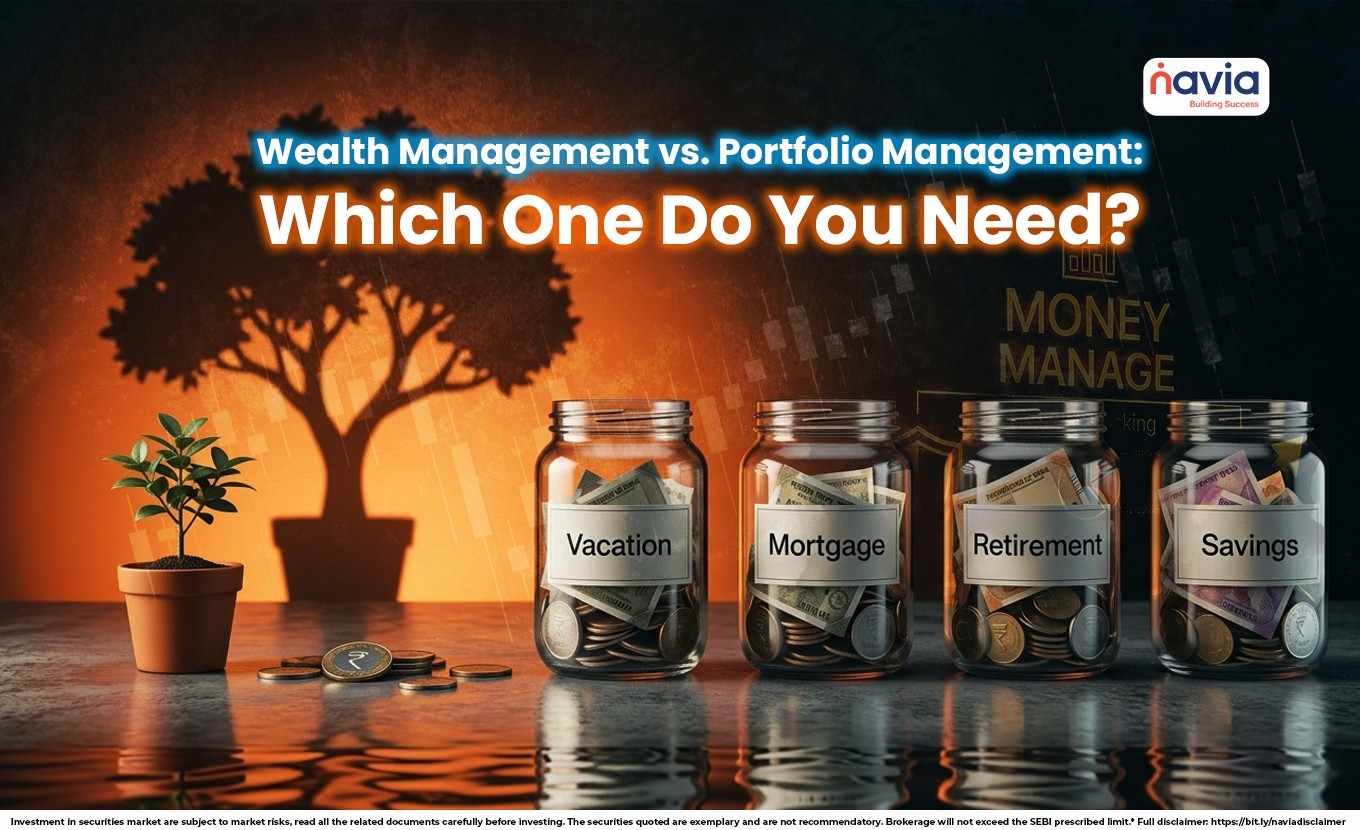
Wealth Management vs. Portfolio Management: Which One Do You Need?
Choosing the right financial service is an important decision for all investors who are looking to plan their financial goals. In the complex world of finance, two terms often appear interchangeably; they are wealth management and portfolio management. Both are aimed at managing financial assets, but they differ in their scope, depth, and the specific problems they solve.
This blog breaks down wealth management vs portfolio management in detail to help you understand the difference and align it with your long-term objectives.
💡 Quick Answer
Portfolio management is a focused service that manages your investments — stocks, bonds, and mutual funds — to balance risk and return. Wealth management is broader: it wraps investment management together with financial, tax, estate, and risk planning, usually for High-Net-Worth Individuals (HNIs). Choose portfolio management if you only need your investments handled; choose wealth management if you want your entire financial life planned around your goals.
What is Portfolio Management?
In simple words, portfolio management is the process of selecting and overseeing a group of investments. It mainly focuses on managing risk and return by managing a diverse mix of assets like stocks, bonds, and mutual funds.
The portfolio management process involves:
| Asset Allocation | Deciding how to distribute money across different asset classes. |
| Diversification | Spreading investments to reduce concentration risk. |
| Rebalancing | Periodically adjusting the portfolio to maintain the original risk profile. |
What is Wealth Management?
Portfolio management is a focused service for investment, whereas wealth management is a much broader financial advisory service. Wealth management includes investment and financial planning services; it integrates investment management with every other aspect of a High-Net-Worth Individual’s (HNI) financial life.
What are the things that a wealth manager looks at?
| Financial Planning | Retirement, cash flow, and education funding. |
| Estate Planning | Managing legacy, wills, and trust. |
| Tax Planning | Legally managing tax liabilities in accordance with applicable laws across all income streams. |
| Legal & Risk Management | Managing financial risks from market volatility and legal liabilities. |
Wealth Management vs Portfolio Management: Key Differences
Understanding the difference between portfolio management and wealth management requires looking at their scale. Just think that a portfolio manager is the captain of a ship (focused on the journey and the speed), while a wealth manager is the architect of the entire fleet and the harbor (focused on the long-term safety and legacy of the entire family).
| Feature | Portfolio Management | Wealth Management |
|---|---|---|
| Primary Objective | Aimed at managing risk-adjusted returns of a specific set of assets. | Management and planning of overall financial assets. |
| Scope of Service | Narrow: Focused strictly on stocks, bonds, and mutual funds. | Broad: Includes tax planning, estate laws, and retirement. |
| Financial Planning | Usually not included; assumes you have a plan already. | The core foundation; every investment is linked to a life goal. |
| Tax Integration | Limited to optimizing taxes on investment gains only. | Comprehensive: Income tax, inheritance tax, and business tax. |
| Target Audience | Active investors are looking for returns relative to market performance. | High-Net-Worth Individuals (HNIs) with complex needs. |
| Risk Management | Focuses on market volatility and asset-specific risks. | Focuses on life risks, including insurance and liability. |
| Fee Structure | Usually a % of Assets Under Management (AUM) + performance | Can be a mix of AUM fees, flat retainers, or hourly rates. |
Conclusion
The portfolio management vs wealth management choice isn’t about which is better, but which is needed. If you are strictly looking to manage your investments, portfolio management may be considered. However, if you are looking for a broader approach to plan overall financial assets, wealth management provides broader financial planning services. Investors exploring managed options can also compare the three types of Portfolio Management Services (PMS) — discretionary, non-discretionary, and advisory, and review the latest SEBI PMS regulatory framework before deciding.
- Portfolio management focuses narrowly on building and rebalancing a mix of assets (stocks, bonds, mutual funds) for risk-adjusted returns.
- Wealth management is a broader advisory service that also covers financial planning, tax, estate, and legal/risk management.
- Portfolio management typically suits active investors; wealth management is designed for High-Net-Worth Individuals (HNIs) with complex needs.
- Fees differ — portfolio management is usually a percentage of Assets Under Management (AUM), while wealth management may mix AUM fees, flat retainers, or hourly rates.
- The right choice depends on what you need, not which is “better” — and you can start with portfolio management and move to wealth management later.
Did you find this article helpful?
Your feedback helps us write better content.

Frequently Asked Questions
What is the difference between asset management and portfolio management?
Asset management involves a broad, customized range of financial and physical assets like property, stocks, and cash, focused on long-term management. Portfolio management is a specialized subset that focuses solely on financial securities, such as stocks and bonds, to manage returns relative to risk.
What is the main difference between portfolio management and wealth management?
Portfolio management focuses on constructing and managing an investment portfolio aligned with client objectives. In contrast, wealth management offers a more comprehensive strategy encompassing investments, insurance, tax and estate planning, and overall financial goals.
Is wealth management more expensive than portfolio management?
Wealth management typically carries higher costs than portfolio management because it encompasses a broader range of services.
Can I switch from portfolio management to wealth management later?
You can begin with portfolio management to build your investments and subsequently transition to a more comprehensive and holistic wealth management service.
DISCLAIMER: Investment in securities market are subject to market risks, read all the related documents carefully before investing. The securities quoted are exemplary and are not recommendatory. Full disclaimer: https://bit.ly/naviadisclaimer.