

How to Read a Contract Note: Everything You Need to Know
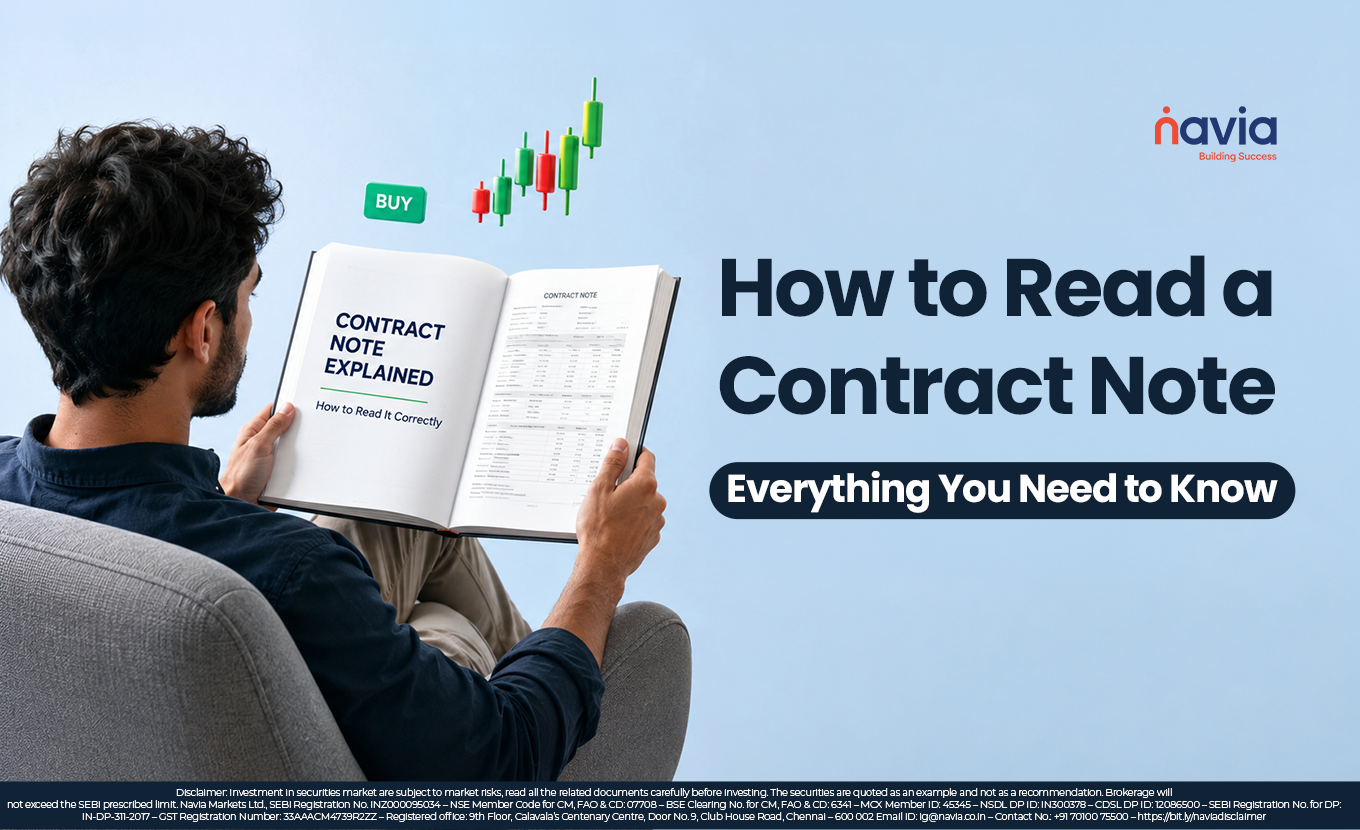
A contract note is an official document your broker issues after every trade, recording details including the security bought or sold, the execution price, quantity, and the exchange on which the trade was executed. SEBI requires registered stockbrokers to issue contract notes within the prescribed timelines, generally within 24 hours of trade execution. While many investors glance at it once and move on, a contract note serves as an important record for verifying trade details, reconciling applicable charges, supporting dispute resolution, and calculating capital gains for tax purposes. In this blog, we’ll explain everything you need to know about reading a contract note.
💡 Quick Answer
A contract note is the official, digitally signed record your broker must issue after every trade — generally within 24 hours, per SEBI rules. It lists the security, the exchange and segment, quantity and execution price, settlement details, all applicable charges, and the net amount payable or receivable. Keep it to verify trades, reconcile charges, support dispute resolution, and compute capital gains at tax time.
What Exactly Is a Contract Note?
A contract note is the official record of a stock market transaction issued by your broker after a trade is executed. Unlike a regular purchase receipt, its format and contents are prescribed under the applicable SEBI and exchange regulations. It is generally issued electronically as a digitally signed document, although physical copies may also be provided where applicable. A contract note records important details of the transaction, including the security traded, execution price, quantity, applicable charges, and settlement information. It also serves as an official record that may be used for trade reconciliation and supporting dispute resolution, subject to the applicable regulatory framework.
How Is It Different from a Trade Confirmation?
After your order is executed, your broker generally provides a trade confirmation so you know the transaction has been completed. A contract note, however, is issued within the prescribed timelines, generally within 24 hours of trade execution, and contains more detailed information, including the trade price, applicable charges, settlement details, and the net amount payable or receivable. In simple terms, a trade confirmation provides an initial notification of the executed trade, while the contract note serves as the official record of the transaction.
What Details Should You Actually Check?
Once you receive your contract note, review the following details carefully:
- 🔶 Trading member details: Your broker’s name, address, and SEBI registration number.
- 🔶 Order and trade numbers: Unique reference numbers that can be used to verify the trade, where applicable. (See the types of stock market orders.)
- 🔶 Exchange and segment: Identifies the stock exchange where your trade was executed (such as NSE or BSE) and the market segment in which it was carried out, such as the Cash Market (CM) or Futures & Options (FO).
- 🔶 Quantity and price: The quantity traded and the execution price for each trade. Under the applicable regulatory framework, contract notes include trade-level details rather than a single averaged entry.
- 🔶 Settlement details: The settlement number and settlement date. For eligible equity delivery trades, settlement is generally on a T+1 basis, subject to the applicable settlement cycle.
- 🔶 Net amount payable or receivable: The final amount after accounting for the applicable brokerage, statutory levies, and other charges.

What Charges Appear on a Contract Note?
A contract note generally includes details of the applicable charges relating to the transaction. Understanding these charges can help you reconcile the total transaction cost.
| Charge | What It Covers? |
|---|---|
| Brokerage | The fee charged by your broker for executing the trade. |
| STT | A tax levied by the Government of India on specified securities transactions. |
| GST | GST at the applicable rate (currently 18%) on brokerage and certain other applicable charges. |
| SEBI Turnover Fee | A regulatory fee charged as per the applicable SEBI-prescribed rates. |
| Stamp Duty | A duty levied on eligible buy-side transactions, as applicable. |
| Exchange Transaction Charges | Charges levied by the exchange for processing the trade. |
Review these charges along with the net amount payable or receivable to understand the total cost of the transaction.
Why Does This Document Matter for Taxes?
Because your contract note records the trade date, price, quantity, and other transaction details, it serves as one of the key records used for calculating capital gains and reconciling your trading transactions. If you hold shares through the Navia All in One App, you can use your contract note to reconcile your trade details with your Annual Information Statement (AIS) and other relevant records, where applicable, before filing your income tax return. Brokers are required to maintain contract note records in accordance with the applicable regulatory requirements. If you need details of an earlier trade, you may request a copy of the contract note from your broker, subject to the applicable record-retention requirements.
Conclusion
A contract note isn’t just another document—it’s an official record of your trade, containing details such as the execution price, applicable charges, and settlement information. Once you know which fields to review, checking your contract note takes only a few minutes and can help you verify trade details, reconcile applicable charges, support dispute resolution, and maintain records for tax purposes.
Key Takeaways
- A contract note is your broker’s official, digitally signed record of a trade, issued (per SEBI) generally within 24 hours of execution.
- Check the trading-member/SEBI details, order and trade numbers, exchange and segment, quantity and price, settlement details, and the net amount.
- It lists every charge — brokerage, STT, GST (18%), SEBI turnover fee, stamp duty, and exchange transaction charges — so you can reconcile the total cost.
- It’s a key record for capital-gains tax and for reconciling against your Annual Information Statement (AIS) before filing your return.
- Related reading in the settlement flow: block deal vs bulk deal and what happens on a short delivery.
Did you find this article helpful?
Your feedback helps us write better content.

Frequently Asked Questions
When should I receive my contract note after a trade?
SEBI requires registered stockbrokers to issue contract notes within the prescribed timelines, generally within 24 hours of trade execution. Accordingly, investors should generally receive their contract note within this timeframe.
Is a contract note the same as a trade confirmation?
No. A trade confirmation is generally sent after your order is executed to notify you that the trade has been completed. A contract note is issued within the prescribed timelines, generally within 24 hours of trade execution, and contains detailed information about the trade, including the execution price, applicable charges, settlement details, and the net amount payable or receivable.
Can I use my contract note to resolve a dispute with my broker?
Yes. A contract note serves as an official record of the transaction and may be used as supporting documentation for trade reconciliation or while resolving disputes with your broker, subject to the applicable regulatory framework.
How long do brokers need to keep contract note records?
Brokers are required to maintain contract note records in accordance with the applicable SEBI regulations and record-retention requirements. If you need a copy of an earlier contract note, you may request it from your broker, subject to the applicable record-retention policies.
Why did my recent contract note look different from older ones?
Following changes to the prescribed contract note format introduced in 2024, contract notes now include more detailed trade-level information instead of presenting certain trades as a single averaged entry, in accordance with the applicable regulatory framework.
DISCLAIMER: Investment in securities market are subject to market risks, read all the related documents carefully before investing. The securities quoted are exemplary and are not recommendatory. Full disclaimer: https://bit.ly/naviadisclaimer