

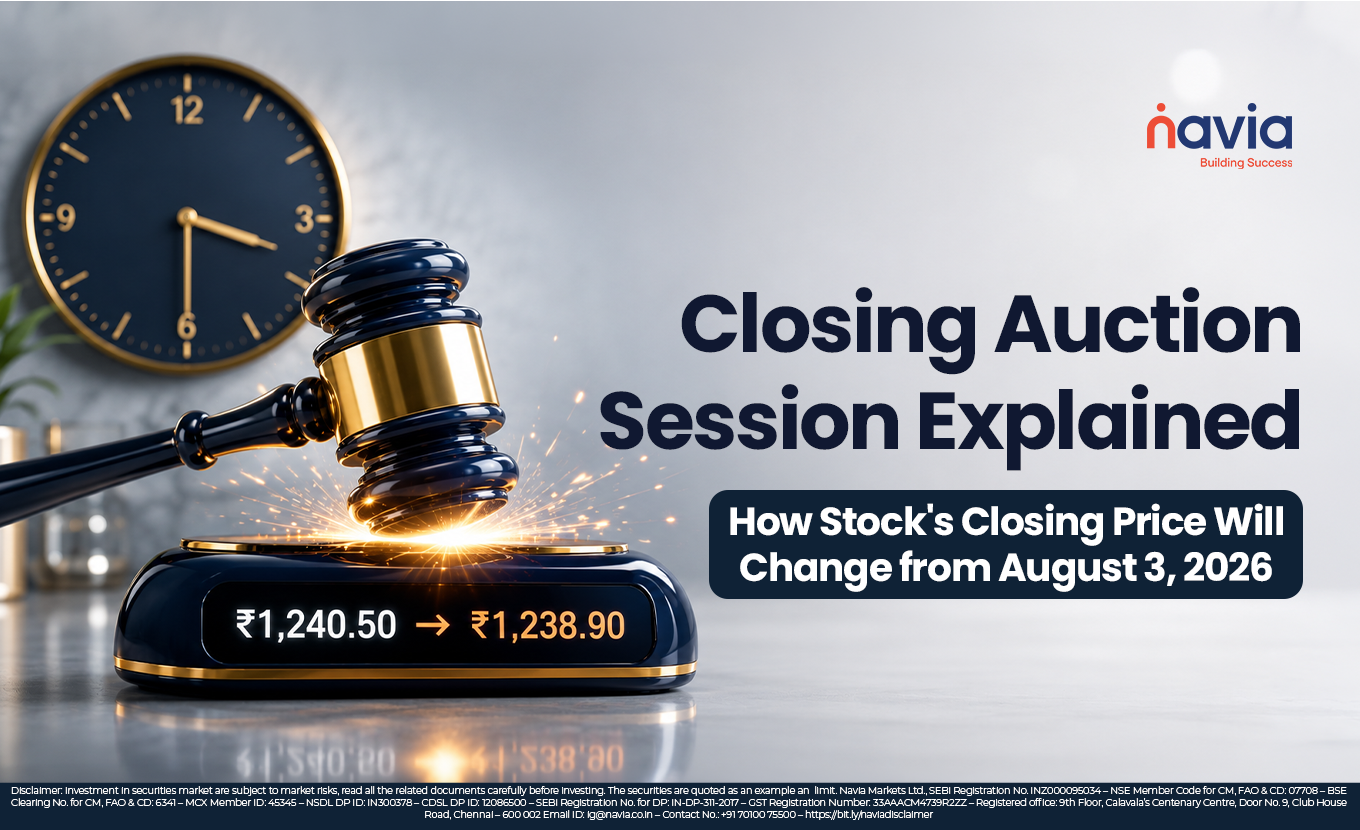
Closing Auction Session (CAS) Explained: How Stock Closing Prices Will Change from August 3, 2026
Stock exchanges determine an official closing price for each eligible security in accordance with the applicable exchange methodology. The official closing price is used across several important market processes:
💡 Quick Answer
From August 3, 2026, SEBI is changing how the official closing price of a stock is set. Instead of the VWAP of the last 30 minutes of continuous trading, stocks with F&O contracts will use a Closing Auction Session (CAS). For these stocks, normal trading stops at 3:15 pm, followed by a 15-minute auction window where all buy and sell orders are collected and matched at a single “equilibrium price” — which becomes the day’s official close. Stocks without F&O keep trading normally till 3:30 pm.
- It feeds directly into how the Sensex and Nifty are calculated (Closing Price × Number of Shares = Market Cap ÷ Base Value).
- The closing price is one of the inputs used by Asset Management Companies in valuing portfolio holdings while calculating the NAV of mutual fund schemes, where applicable.
- It is also used as an input in determining settlement prices for certain derivative contracts, in accordance with the applicable exchange methodology.
It also shows up in more everyday ways:
- Brokers rely on it to generate your P&L reports and calculate your overall portfolio value.
- The closing price may also be used as one of the inputs for valuing eligible securities pledged as collateral, subject to the applicable exchange and clearing corporation framework.
So how is the closing price actually calculated?
Here’s something that surprises a lot of investors: the closing price is not simply the Last Traded Price (LTP) of the final trade of the day.
Think about it this way — a stock trades steadily between Rs. 100 and Rs. 105 all day. Then, right at 3:29 pm, someone offloads 10 shares at Rs. 95 in a quiet, thin moment. Technically, that becomes the LTP — but it’s a poor representation of where the market actually values the stock.
To avoid this problem, exchanges currently rely on the VWAP (Volume Weighted Average Price) method:
VWAP = Sum of (Price × Volume of each trade) ÷ Total Volume
Starting August 3, 2026, SEBI has introduced a revised closing price discovery mechanism known as the Closing Auction Session (CAS), which will be used to determine the official closing price for eligible securities covered under the framework.
The closing price forms an important input in calculating the market capitalisation of constituent stocks, which is used in determining index values such as the Sensex and Nifty under the respective index methodologies.
Why is this changing?
Under the existing setup, VWAP is derived from trades executed throughout the Continuous Trading Session (CTS). According to SEBI, CAS is intended to improve price discovery by aggregating eligible buy and sell orders within a single auction window, rather than relying on trades executed throughout the continuous trading session.
The CAS framework may also facilitate the execution of larger orders. Today, institutional investors often split large orders into smaller trades to reduce market impact. By aggregating eligible buy and sell orders within a common auction window, CAS may improve the likelihood of matching larger orders at a single equilibrium price, potentially reducing market impact.
CAS also aligns the Indian market more closely with practices followed by several major global exchanges, including the NYSE and LSE, use closing auction mechanisms. Such mechanisms can help improve price discovery and may reduce tracking error for index funds and ETFs.
What does this mean for traders and investors?
For Phase I, SEBI has split the equity segment into two buckets:
- Category I: Stocks that have F&O contracts trading on both NSE and BSE
- Category II: All other stocks
CAS applies only to Category I stocks in this first phase. Here’s what changes:
- Stocks outside CAS: Regular trading continues as usual, till 3:30 pm.
- Stocks under CAS: Trading stops earlier, at 3:15 pm.
- Derivatives market: Stays open till 3:40 pm.
For CAS-covered stocks, here’s the sequence once trading halts at 3:15 pm:
| Session | What Happens? | Time |
|---|---|---|
| 1 | Reference price calculation; transition from CTS to CAS | 3:15 pm to 3.20 pm (5 mins) |
| 2 | Order entry — both limit and market orders allowed | 3:20 pm to 3.25 pm (5 mins) |
| 3 | Limit orders only; market orders locked; random close | 3:25 pm to 3.30 pm (5 mins) |
| 4 | Order matching | 3:30 pm to 3.35 pm (5 mins) |
A note for intraday (MIS) traders: auto square-off timings are also shifting from August 3, 2026:
- Equity (non-CAS and CAS stocks): 3:10 pm
- Equity derivatives: 3:25 pm
Walking through the timeline, step by step
3:00 pm – 3:15 pm
Regular continuous trading carries on as usual. In the background, the exchange is computing the VWAP for this 15-minute window — this becomes the “Reference Price” that anchors the auction session that follows.
3:15 pm – 3:20 pm
Trading in Category I stocks halts as the market transitions from CTS to CAS. The exchange finalises the reference price, and currently set at ±3% around it. No new orders are accepted during this window. Any eligible open orders carried over from the Continuous Trading Session (CTS) remain valid. However, certain order types, such as stop-loss orders, iceberg orders, and orders outside the applicable price band, are cancelled in accordance with the applicable exchange rules.
3:20 pm – 3:25 pm
Order Entry Session I opens, accepting both market and limit orders. Through this window, the exchange continuously publishes: the indicative equilibrium price, total buy/sell quantities, order imbalance, and the indicative index value.
3:25 pm – 3:30 pm
Order Entry Session II opens — limit orders only. Market orders can no longer be modified or cancelled. This session closes at a random moment between 3:28 pm and 3:30 pm, specifically to prevent last-second order flooding.
3:30 pm – 3:35 pm
The exchange stops accepting orders altogether and runs the equilibrium price algorithm, matching all orders at a single price point. This becomes the official closing price for the day.
How is the equilibrium price worked out?
This is the part that trips people up, so let’s break it down with an example.
Picture the market depth for a stock during CAS:
- A buyer willing to pay Rs. 1,010 will also happily buy at Rs. 1,005 — buyers accept any price at or below their limit.
- A seller willing to accept Rs. 1,000 will also happily sell at Rs. 1,005 — sellers accept any price at or above their limit.
Building this into a cumulative table:
| Price | Cumulative Buy Qty | Cumulative Sell Qty | Executable Volume |
|---|---|---|---|
| Rs. 1,000 | 1,500 | 200 | 200 |
| Rs. 1,002 | 1,400 | 500 | 500 |
| Rs. 1,005 | 1,200 | 900 | 900 |
| Rs. 1,008 | 800 | 1,150 | 800 |
| Rs. 1,010 | 500 | 1,300 | 500 |
The price with the highest executable volume — Rs. 1,005, at 900 shares — becomes the equilibrium price, i.e., the closing price.
If two prices end up tied on executable volume, the exchange picks whichever has the smaller buy-sell imbalance.
If it’s still a tie after that, the price closest to the reference price wins.
Did you find this useful?
Did you find this article helpful?
Your feedback helps us write better content.
Frequently Asked Questions
Will CAS apply to all stocks right away?
No. CAS is being rolled out in a phased manner. In the initial phase, it applies only to stocks in the cash segment on which derivative (F&O) contracts are available.
How is the “reference price” for CAS determined?
It’s based on the VWAP (Volume Weighted Average Price) of all trades executed in the stock between 3:00 pm and 3:15 pm.
What happens if a stock doesn’t trade between 3:00 pm and 3:15 pm?
If there’s no trade in that window, the Last Traded Price (LTP) for the day is used as the reference price. If there’s no trade at all during the day, the previous trading day’s closing price is used instead. In the case of a corporate action, the previous day’s adjusted closing price (or base price) is used.
How is the reference price calculated for stock futures?
The same logic applies:
- First preference: VWAP of the stock future’s trades between 3:00 pm and 3:15 pm.
- If no trade occurs in that window: the day’s LTP for the future.
If no trade occurs at all that day: the prevailing theoretical price, based on the cash market LTP at 3:15 pm.
What is “equilibrium price” and how is it determined during CAS?
The equilibrium price is the price at which the maximum quantity of shares can be matched between buyers and sellers during the Closing Auction Session — it becomes the stock’s official closing price. It’s arrived at by building a cumulative buy and sell order book across price points within the ±3% band and identifying the price with the highest executable volume (the lower of cumulative buy or sell quantity at that price). If two or more prices tie on executable volume, the one with the smaller imbalance quantity is chosen; if still tied, the price closest to the reference price is selected. If no equilibrium price can be determined (e.g., no matching orders), the reference price is used as the closing price instead.
What is the price band during CAS in the cash market?
Currently, ±3% from the reference price calculated for CAS.
Does the price band for stock futures also change during this period?
Yes. From 3:15 pm to 3:40 pm, the stock futures price band is aligned with the CAS price band — i.e., ±3% from the futures reference price. The existing “dynamic price band flexing” rule for the last half hour of trading does not apply during this window; instead, 2:45 pm–3:15 pm is treated as the last half hour of the Continuous Trading Session (CTS) for this purpose.
What about the options segment — does anything change there?
No. There is no change to the methodology for options price bands or LPP ranges at any point during trading hours (9:00 am to 3:40 pm), including during CAS.
What types of orders are allowed during CAS?
During the applicable CAS order-entry sessions, only limit orders and market orders are permitted, and both are used in computing the equilibrium (closing) price.
Are disclosed-quantity orders allowed during CAS?
No. Orders must be disclosed in full quantity during CAS.
Are stop-loss orders allowed during CAS?
No, stop-loss orders are not permitted in the CAS window.
How is the closing price determined for stocks not under CAS?
As per the current framework, it continues to follow the existing mechanism — i.e., the VWAP-based method.
Does the F&O segment’s closing price mechanism change?
No, closing prices for futures and options continue to be determined per the existing mechanism. The Exchange will continue providing this closing price data to Clearing Corporations for settlement price calculations.
What information will the exchange disseminate during CAS?
Through the CAS window, the Exchange will continuously publish:
- Indicative equilibrium price and indicative tradable quantity at that price
- Indicative cumulative buy and sell quantities in the order book
- Indicative imbalance quantity at the equilibrium price (considering both limit and market orders), along with an indicator of which side — buy or sell — has the greater quantity
- Indicative imbalance quantity based on market orders only, with a similar buy/sell indicator
DISCLAIMER: Investment in securities market are subject to market risks, read all the related documents carefully before investing. The securities quoted are exemplary and are not recommendatory. Full disclaimer: https://bit.ly/naviadisclaimer