

Understanding Bond Ratings in India: What AAA, AA, A and BBB Really Mean
- What Are Bond Ratings?
- Understanding Bond Rating Symbols
- Investment Grade vs Junk Grade
- What Do Plus (+) and Minus (-) Mean?
- Current Bond Yield Trends in India (2026)
- Why Lower Rated Bonds Offer Higher Yields?
- Important Risks Bond Investors Must Understand
- Important Reality Retail Investors Often Miss
- Factors Investors Commonly Consider When Evaluating Bonds
- Simple Thumb Rule in Bond Investing
- Conclusion
The Indian investment landscape has evolved rapidly over the last decade. Investors today are increasingly exploring corporate bonds, debentures, government securities and fixed income products as alongside traditional fixed deposits.One of the most important concepts every bond investor must understand is bond ratings. Ratings such as AAA, AA, A and BBB influence:
- The safety of the investment
- The interest rate offered
- The probability of default
- Liquidity in the bond market
Yet many retail investors invest in bonds purely based on high advertised returns without fully understanding what these ratings actually mean. This article explains bond ratings in simple language, how they affect yields, and the current yield levels observed in the Indian bond market.
💡 Quick Answer
Bond ratings are opinions from credit rating agencies about how likely a borrower is to repay on time. In India, agencies like CRISIL, ICRA and CARE grade bonds from AAA (highest safety, lowest yield) down through AA, A and BBB, with anything below BBB treated as speculative. As a rule, higher ratings mean lower risk and lower yield, while lower ratings offer more yield to compensate for higher default risk.
What Are Bond Ratings?
Bond ratings are opinions provided by credit rating agencies regarding the ability of a company or institution to repay its debt obligations on time. These ratings help investors assess:
- Creditworthiness
- Repayment capacity
- Financial stability
- Probability of default
In India, the credit rating agencies include:
- CRISIL
- ICRA
- CARE Ratings
- India Ratings
Globally, major agencies include:
- S&P Global Ratings
- Moody’s
- Fitch Ratings
The basic principle is simple: Higher the rating, lower the risk. Lower the rating, higher the risk.
Understanding Bond Rating Symbols
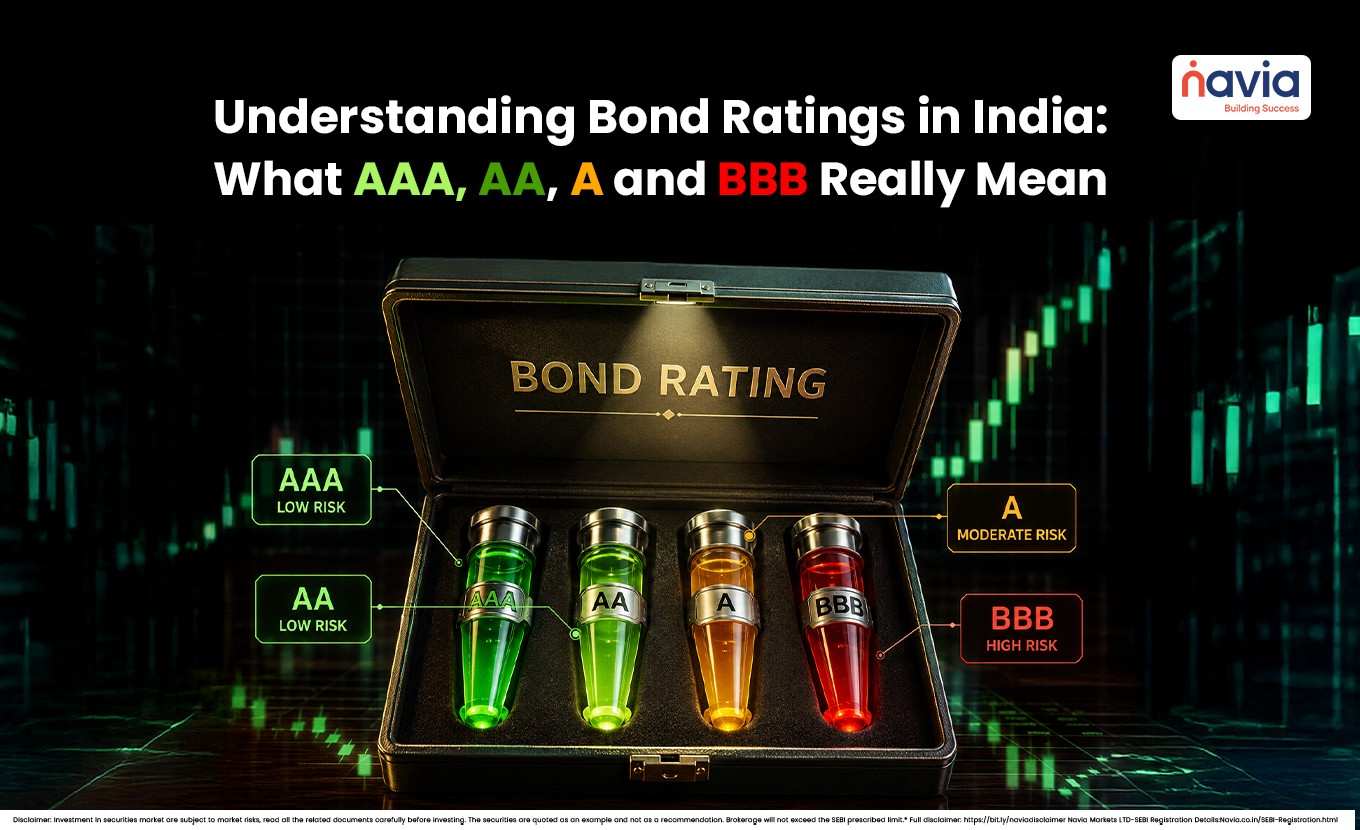
AAA Rating
AAA is the highest credit rating. It indicates:
- Extremely strong repayment capacity
- Very strong credit profile
- Historically associated with lower credit risk relative to lower-rated categories
These are usually issued by:
- Government-backed entities
- Large Public Sector Undertakings (PSUs)
- Financially strong blue-chip corporations
AAA bonds typically offer lower yields because yields are generally lower due to the stronger credit profile.
AA Rating
AA-rated bonds are generally considered to have strong credit quality but slightly riskier than AAA. These companies generally have:
- Strong cash flows
- Stable businesses
- Good debt servicing capability
AA bonds offer moderately higher returns compared to AAA bonds.
A Rating
A-rated bonds indicate:
- Moderate credit quality
- Good repayment ability
- But higher vulnerability during economic slowdown or business stress
These bonds offer higher interest rates because investors are taking moderately higher risk.
BBB Rating
BBB is one of the most important rating categories because it sits at the boundary between investment-grade and speculative debt. BBB-rated issuers generally have:
- Adequate repayment capacity
- Moderate financial strength
- Higher sensitivity to adverse economic conditions
These bonds usually offer significantly higher yields. However, BBB bonds also carry higher downgrade risk during difficult economic periods.
Investment Grade vs Junk Grade
This distinction is extremely important in debt investing.
Investment Grade Bonds
These include:
- AAA
- AA
- A
- BBB
These are considered relatively safer investments.
Speculative or Junk Bonds
These include:
- BB
- B
- CCC
- CC
- C
These carry substantially higher risk and are more vulnerable to default. Higher yields in such bonds are compensation for higher credit risk.
What Do Plus (+) and Minus (-) Mean?
Ratings often include modifiers such as:
- AA+
- AA
- AA-
- BBB+
- BBB-
These indicate relative strength within the same category. For example:
- BBB+ is stronger than BBB
- BBB- is the weakest investment-grade level
Current Bond Yield Trends in India (2026)
India’s bond market currently offers a range of yield levels across rating categories due to:
- Elevated interest rates
- Corporate borrowing demand
- Liquidity conditions
- Inflation expectations
Below are broad indicative yield ranges currently seen in the Indian market.
| Bond Category | Indicative Yield Range |
|---|---|
| AAA Rated Bonds | 7.5% – 9.0% |
| AA Rated Bonds | 8.5% – 10.5% |
| A Rated Bonds | 9.5% – 12.5% |
| BBB Rated Bonds | 12.5% – 15.0% |
| Below BBB / Junk Bonds | 13% – 16%+ |
These yields vary depending on:
- Tenure
- Liquidity
- Issuer quality
- Secured vs unsecured structure
- Market condition
Why Lower Rated Bonds Offer Higher Yields?
The additional interest earned from lower-rated bonds is known as the “credit spread.” For example:
- Government bond may offer 7%
- AAA corporate bond may offer 8%
- BBB-rated issuer may offer 14%
The extra return compensates investors for:
- Higher default probability
- Business uncertainty
- Weaker balance sheet
- Liquidity risk
Important Risks Bond Investors Must Understand
Credit Risk
The issuer may fail to repay interest or principal on time. This is the biggest risk in lower-rated bonds.
Interest Rate Risk
When interest rates rise:
- Existing bond prices usually fall
Long-duration bonds are especially sensitive.
Liquidity Risk
Some bonds may not trade actively in the secondary market. This means investors may find it difficult to exit quickly.
Downgrade Risk
A company’s rating can fall rapidly if:
- Profits weaken
- Debt rises
- Cash flows deteriorate
- Industry conditions worsen
This can significantly impact bond prices.

Important Reality Retail Investors Often Miss
Even highly rated companies globally have faced severe financial distress. Ratings are opinions based on current information and can change rapidly. Therefore, investors should not rely solely on ratings but also understand:
- Business quality
- Promoter credibility
- Debt levels
- Cash flow strength
- Industry outlook
Factors Investors Commonly Consider When Evaluating Bonds
Conservative Investors
Suitable Options:
- Government securities
- AAA PSU bonds
- Highly rated corporate bonds
Focus:
- Capital protection
- Stable income
Moderate Risk Investors
Suitable Options:
- AA-rated bonds
- Selected A-rated issuers
Focus:
- Balance between safety and return
Aggressive Yield Seekers
Suitable Options:
- BBB-rated bonds
- Structured debt opportunities
However, these require:
- Detailed credit analysis
- Diversification
- Risk tolerance
Retail investors should be especially cautious with bonds offering unusually high returns.
Simple Thumb Rule in Bond Investing
Higher yields are often associated with higher credit, liquidity, or market risks.. Unlike equities where volatility is visible daily, bond risks often remain hidden until stress periods emerge suddenly. That is why disciplined credit analysis is critical.
Conclusion
Bond ratings provide a structured framework for understanding credit quality and risk in debt investments. For most investors:
- AAA and AA bonds are generally associated with stronger credit profiles
- A-rated bonds typically carry higher yields relative to higher-rated bonds
- BBB and lower-rated bonds should be approached cautiously
India’s bond market is becoming deeper and more sophisticated, offering investors a wider range of fixed income opportunities than ever before. However, bond investing is not about chasing the highest return. It is about balancing:
- Safety
- Liquidity
- Yield
- Diversification
- Risk management
Understanding bond ratings is the first step toward making more informed fixed-income investment decisions. It also helps to understand how bond returns are taxed before you invest.
Key Takeaways
- Bond ratings are opinions on an issuer’s ability to repay, not guarantees.
- In India, CRISIL, ICRA, CARE Ratings and India Ratings are the main agencies.
- AAA is the highest grade; ratings step down through AA, A and BBB.
- BBB and above are investment grade; below BBB (BB and lower) is speculative or junk.
- Lower-rated bonds pay higher yields to compensate for higher credit, liquidity and downgrade risk.
- Ratings can change, so look beyond them at business quality, debt and cash flows.
Did you find this article helpful?
Your feedback helps us write better content.

DISCLAIMER: Investment in securities market are subject to market risks, read all the related documents carefully before investing. The securities quoted are exemplary and are not recommendatory. Full disclaimer: https://bit.ly/naviadisclaimer.