

Behavioral Finance: How Emotions Drive Market Bubbles
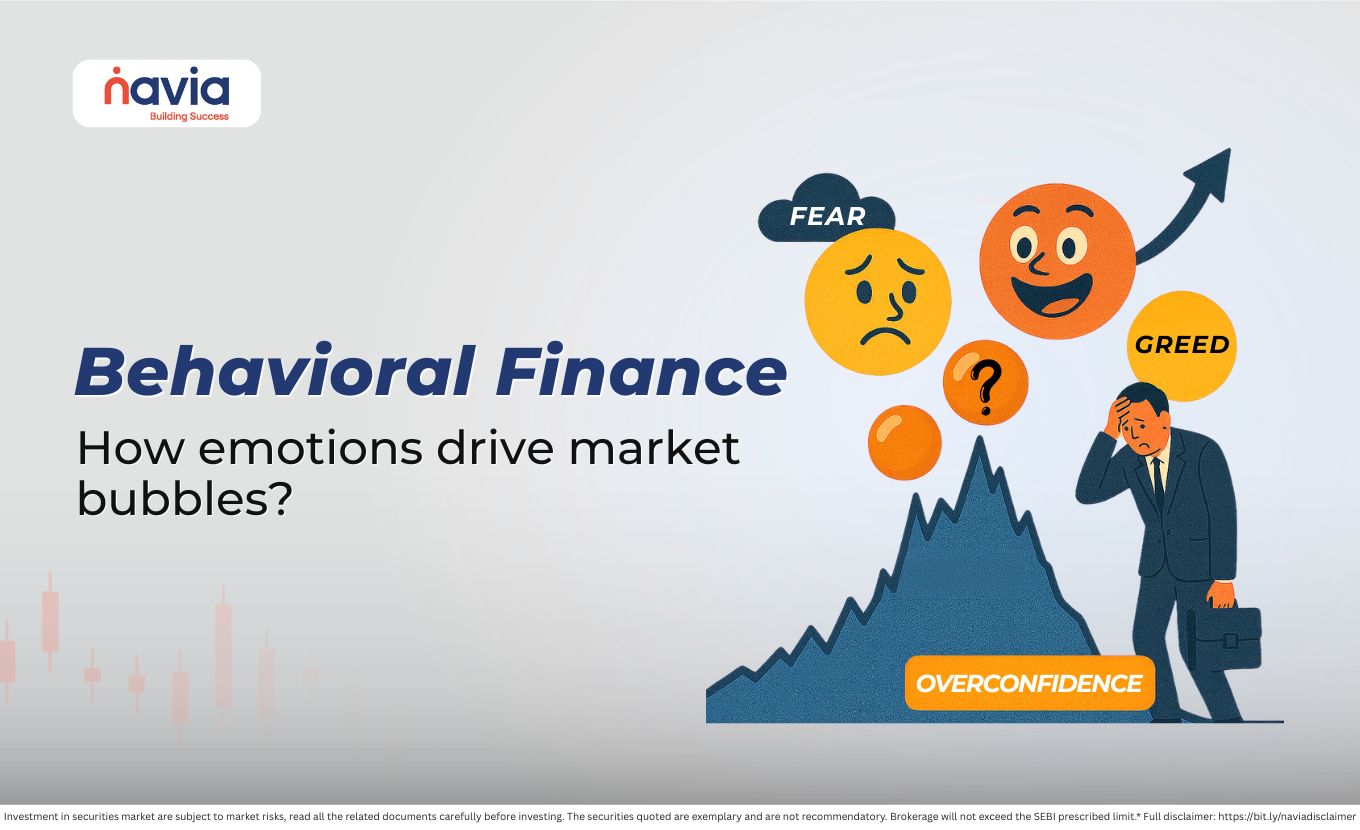
Financial markets are mostly seen as rational, governed by numbers, data and analysis, but history shows that they sometimes swing widely because of human behavior. This is where behavioral finance comes into play, that helps to understand how emotions and biases influence investment decisions like market bubbles.
In this blog, you can explore behavioral finance meaning, the connection with market bubbles, behavioral finance theory and easily understand nature of behavioral finance that are essential for all investors.
💡 Quick Answer
Behavioral finance is the study of how psychological factors — overconfidence, greed, fear — shape financial decisions. Where traditional finance assumes rational investors and efficient markets, behavioral finance starts from the observation that people are human and markets inherit that. Emotions, herd mentality, overconfidence, hyperbolic discounting, and anchoring bias are the recurring culprits, and together they explain the irrational rallies and speculative bubbles that models alone cannot. The practical response is awareness first, then a deliberate pause before deciding, professional input where bias runs deep, and research that spells out the risk you are actually taking.
What is Behavioral Finance?
Actually, what is behavioral finance meaning? In simple terms, behavioral finance is the study of how psychological factors like overconfidence, greed or fear affect financial decisions. Unlike traditional finance, behavioral finance recognizes that human emotions often drive market behavior.
The study highlights that people are not purely logical. Because they are influenced by emotional reactions and bias that lead to mistakes in investing like buying overpriced stock or panic-selling during a crash. Two of the most common are documented separately in why we fear losses more than we enjoy gains and mental shortcuts in investing.
Difference Between Traditional vs Behavioral Finance
You must know the difference between traditional and behavioral theory, because that will help to easily identify the situation. Some of the different aspects of them are given below;
| Traditional Theory | Behavioral Theory |
|---|---|
| Investment choices are made purely on mathematical models, data, and rational analysis | Decisions are shaped by fear, greed, overconfidence, and herd mentality |
| Assumes investors are rational, always seeking to maximize wealth by analyzing risk and return logically | Recognizes that investors are human, influenced by emotions, biases, and psychological factors |
| Believes in the Efficient Market Hypothesis (EMH) — prices always reflect all available information | Argues markets are not always efficient because human behavior creates inefficiencies |
| Focuses on what investors should do in theory | Focuses on what investors do in real-life situations |
| Predicts consistent, rational outcomes aligned with models | Explains irregular outcomes like sudden crashes, irrational rallies, and speculative bubbles |
Common Behavioral Biases That Affect Investor Decisions
There are so many biases that can affect an investor’s financial decision-making. According to experts, some of the most common biases given below;
| Emotions | Investors take more risky actions when they are happy, but when they are sad, that triggers bad decisions. |
| Herd Mentality | People tend to follow the crowd, and only later realise the crowd was making a mistake. |
| Overconfidence | It makes investors less cautious, and they are willing to take too much risk. |
| Hyperbolic Discounting | Investors give more importance to short-term rewards than future rewards. |
| Anchoring Bias | Make decisions to the first information they receive, cause subsequent judgments to be biased and often irrational. |
Hyperbolic discounting is the same present-over-future pull described in breaking promises to our future self, and overconfidence tips readily into the self-serving scorekeeping covered in when ego manages your portfolio.

Why Investors Need to Understand Behavioral Finance?
Understanding behavioral finance isn’t just academic-it’s practical. It will help investors to know how emotions will influence decisions and how they can avoid costly mistakes. Some of the tips are listed below;
- ➱ Avoid Herd Mentality: Don’t buy just because everyone else is buying, maybe it can lead to losses.
- ➱ Check Overconfidence: You should recognize your limits and diversify instead of betting too big.
- ➱ Overcome Loss Aversion: Investors may consider focusing on long-term fundamentals.
- ➱ Stay Rational: Always remember that no stock keeps rising forever, anything can change at any time.
The behavioral finance theory reminds all investors that markets are human systems, because if we are ready to manage our psychology, we can invest smarter. Reading the crowd with a number rather than a feeling helps — that is what the Market Mood Index and the Fear and Greed Index are for.
Tips to Avoid Common Investing Biases
Here are some tips to overcome these biases that will affect your financial decision-making process.
- 🔸 To overcome these biases, the first way is to be aware about it. If you have knowledge about it, you can easily escape from it.
- 🔸 Before making a financial decision, pause and think deeply, and don’t let your emotions take a decision.
- 🔸 Investors who struggle with biases may benefit from consulting financial professionals
- 🔸 Every time you decide, make sure to complete your research and understand the risks involved in it.
Awareness on its own is rarely enough, though. A structured, largely automated process is what actually holds under pressure — the argument in knowledge does not beat emotions, with two of the biases it defends against detailed in the disposition effect and the endowment effect.
Final Thoughts
Behavioral finance proves that emotions and biases of an investor can affect the market movements. In simple words, investors are human, and humans are not always rational. The nature of behavioral finance can help make smarter choices, focus on long-term wealth creation and also avoid herd-driven decisions.
If you apply behavioral finance theory into your investment journey, you can reduce risks and position yourself better when emotions take over the market. By applying behavioral finance insights, investors can make more rational decisions and reduce risks in volatile markets. Holding on past the point of sense is one of the costliest habits it explains, as why we cling to things that don’t work sets out.
Key Takeaways
- Behavioral finance studies how psychology — overconfidence, greed, fear — shapes real financial decisions, not idealised ones.
- Traditional theory assumes rational investors and the Efficient Market Hypothesis (EMH); behavioral theory starts from observed human behaviour instead.
- Five recurring biases: emotions, herd mentality, overconfidence, hyperbolic discounting, and anchoring bias.
- Bubbles are the visible output. Enough people making the same biased decision at the same time is what detaches price from value.
- Awareness, a deliberate pause before acting, professional input, and genuine research into the risk are the practical defences.
- Related reading: why we fear losses more than we enjoy gains, mental shortcuts in investing, breaking promises to our future self, and knowledge does not beat emotions.
Did you find this article helpful?
Your feedback helps us write better content.

Frequently Asked Questions
What role do emotions play in behavioral finance?
Emotions play a central role in behavioral finance because they often drive investors to make irrational decisions. Instead of acting purely on logic, investors influenced by emotions may misjudge risks and returns, leading to suboptimal outcomes.
How does behavioral finance affect the stock market?
Behavioral finance affects the stock market by explaining why prices often deviate from their true value. Investor biases, herd mentality, and overconfidence can cause market bubbles.
What are the limitations of behavioral finance?
The main limitation of behavioral finance is that it cannot always predict investor behavior with certainty. Emotions and biases differ among individuals, making it difficult to generalize patterns.
What are heuristics in behavioral finance?
Heuristics in behavioral finance are mental shortcuts investors use to make decisions quickly. While these shortcuts save time, they can also lead to systematic errors.
What are cognitive biases in behavioral finance?
Cognitive biases are systematic errors in thinking that affect investment decisions. Examples include confirmation bias (focusing only on information that supports existing beliefs), loss aversion (fearing losses more than valuing gains), and anchoring (relying too heavily on the first piece of information, such as a stock’s past price).
What is the difference between traditional finance and modern finance?
Traditional finance assumes investors are rational, markets are efficient, and decisions are made logically based on available information. Modern finance, particularly behavioral finance, recognizes that investors are influenced by emotions, cognitive biases, and social pressures, which often lead to irrational and unpredictable market movements.
DISCLAIMER: Investments in securities market are subject to market risks, read all the related documents carefully before investing. The securities quoted are exemplary and are not recommendatory. Full disclaimer: https://bit.ly/naviadisclaimer.