

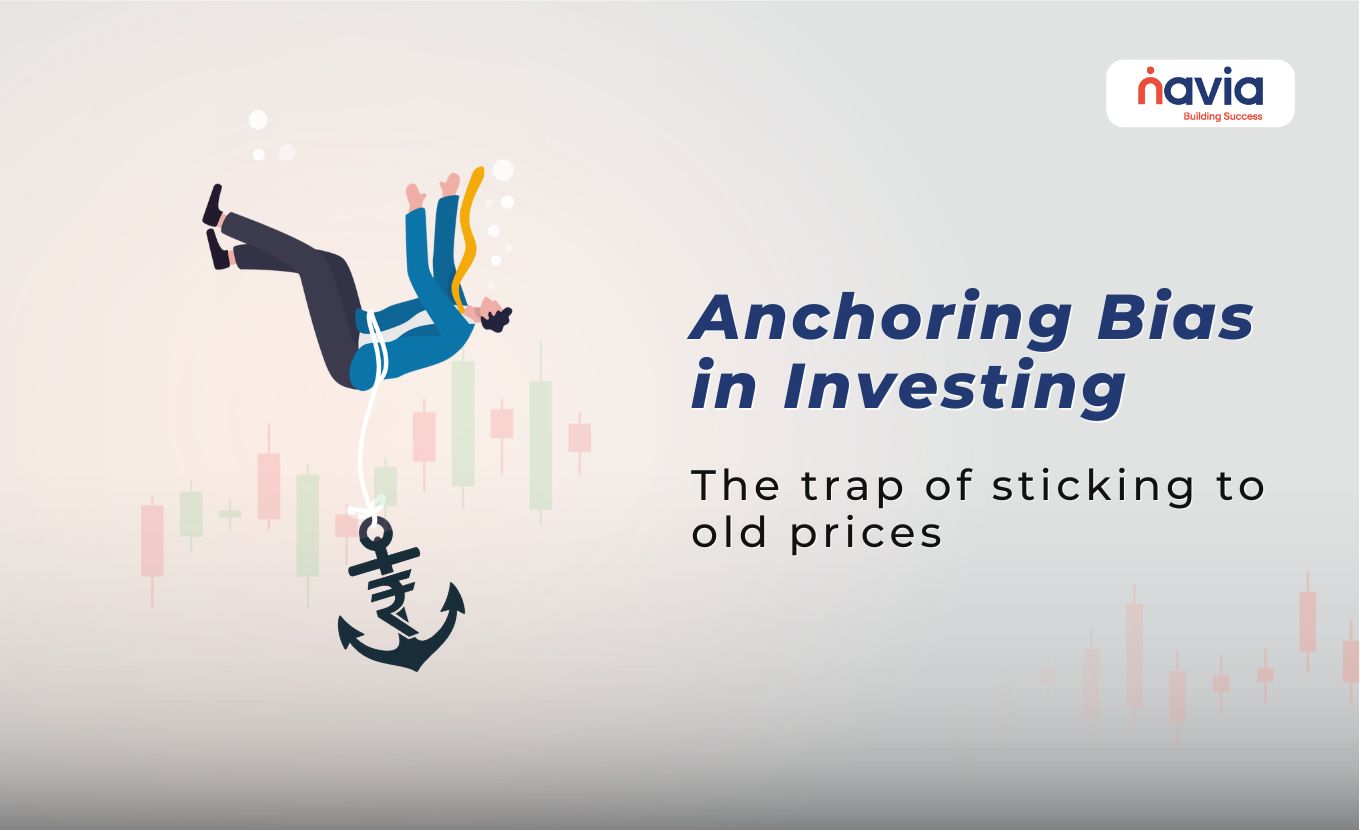
Anchoring Bias in Investing – The Trap of Sticking to Old Prices
Meet Ravi and Suresh, two friends who started investing in the stock market around the same time. Both of them recently bought shares of Alpha Ltd.
- Ravi bought the stock at ₹800 per share.
- Suresh bought it later at ₹950 per share.
A few months down the line, Alpha Ltd’s share price fell to ₹600 after weak quarterly results and negative news in the industry.
💡 Quick Answer
Anchoring bias is the habit of fixing on one number — usually your purchase price, a 52-week high or an IPO price — and judging every later decision against it, even after the facts have changed. It keeps investors holding weak stocks while they wait to “get back to even”, and it ties up money that could work harder elsewhere. The way out is to stop asking when a stock will return to your cost and start asking whether you would buy it at today’s price on today’s fundamentals.
How Ravi Reacted?
Ravi said:
“I bought it at ₹800. I’ll sell only when it goes back to my cost price. Until then, I’ll hold.”
For Ravi, the ₹800 anchor was stuck in his mind. Even though the company’s fundamentals had changed, he refused to sell below his purchase price. That refusal to book a loser while happily booking winners is the pattern we describe in the disposition effect, and it is fuelled by the fact that losses hurt more than equivalent gains please us.
How Suresh Reacted?
Suresh took a different approach. He asked himself:
“If I didn’t own this stock today, would I buy it at ₹600? Are the fundamentals strong enough?”
After analyzing, Suresh realized that Alpha Ltd’s growth prospects were weak and that better opportunities existed elsewhere. He sold his shares at ₹600 and reinvested in a stronger company. Notice that Suresh had the larger paper loss of the two, yet he was the one able to act — because he refused to let a stock he owned feel more valuable than it was, a trap covered in the endowment effect.
What is Anchoring Bias?
This story highlights anchoring bias — a behavioral finance trap where investors fixate on a specific number, usually:
- Their purchase price
- A recent high (like a 52-week peak)
- The IPO price
Even when new information suggests otherwise, the mind stays anchored to that number. Anchoring is one of several mental shortcuts that quietly steer portfolios — see mental shortcuts in investing for the wider family, and how emotions drive market bubbles for what happens when a whole market anchors at once.

Why Anchoring Bias is Dangerous?
- Ravi may hold a weak stock for too long, waiting for it to “get back” to ₹800.
- He could miss out on better opportunities while his money stays stuck.
- Anchoring prevents investors from making objective, forward-looking decisions.
The longer the wait goes on, the more the position becomes about being proved right rather than about the money — the situation described in when ego manages your portfolio.
How to Overcome Anchoring Bias?
- Reframe the Question: Instead of asking “When will it reach my cost price?” ask “Would I buy this stock at today’s price?”
- Focus on Fundamentals: Make decisions based on the company’s outlook, not past numbers.
- Set Rules in Advance: Use stop-loss or exit strategies before emotions kick in.
- Detach from IPO/Highs: Remember, past prices don’t guarantee future returns.
How that question is worded changes the answer more than most investors expect, which is the subject of the framing effect in investing. And beware the opposite failure: certainty that your original number was right is often the overconfidence trap, while a vivid recent headline can supply a fresh anchor all of its own — see the availability heuristic.
Key Takeaway
Anchoring bias can trap investors like Ravi into holding poor investments. Suresh avoided this by focusing on current data and future potential instead of being tied to old numbers.
In investing, past purchase prices should not drive decisions — what matters is whether the investment still makes sense today.
Investors are encouraged to recognize biases like anchoring, so that their decisions are guided by facts and fundamentals — not psychological anchors.
Key Takeaways
- Anchoring bias is judging a stock against a fixed reference number instead of against its current facts.
- The most common anchors are your own purchase price, a 52-week high, and the IPO price.
- Waiting to “get back to even” keeps capital locked in the weakest holdings and out of better ones.
- The market has no memory of what you paid, so your cost price carries no information about future returns.
- The reframing test — would I buy this today at this price? — strips the anchor out of the decision.
- Writing exit rules down in advance beats deciding once the position is already under water.
Did you find this article helpful?
Your feedback helps us write better content.

DISCLAIMER: Investment in securities market are subject to market risks, read all the related documents carefully before investing. The securities quoted are exemplary and are not recommendatory. Full disclaimer: https://bit.ly/naviadisclaimer.