


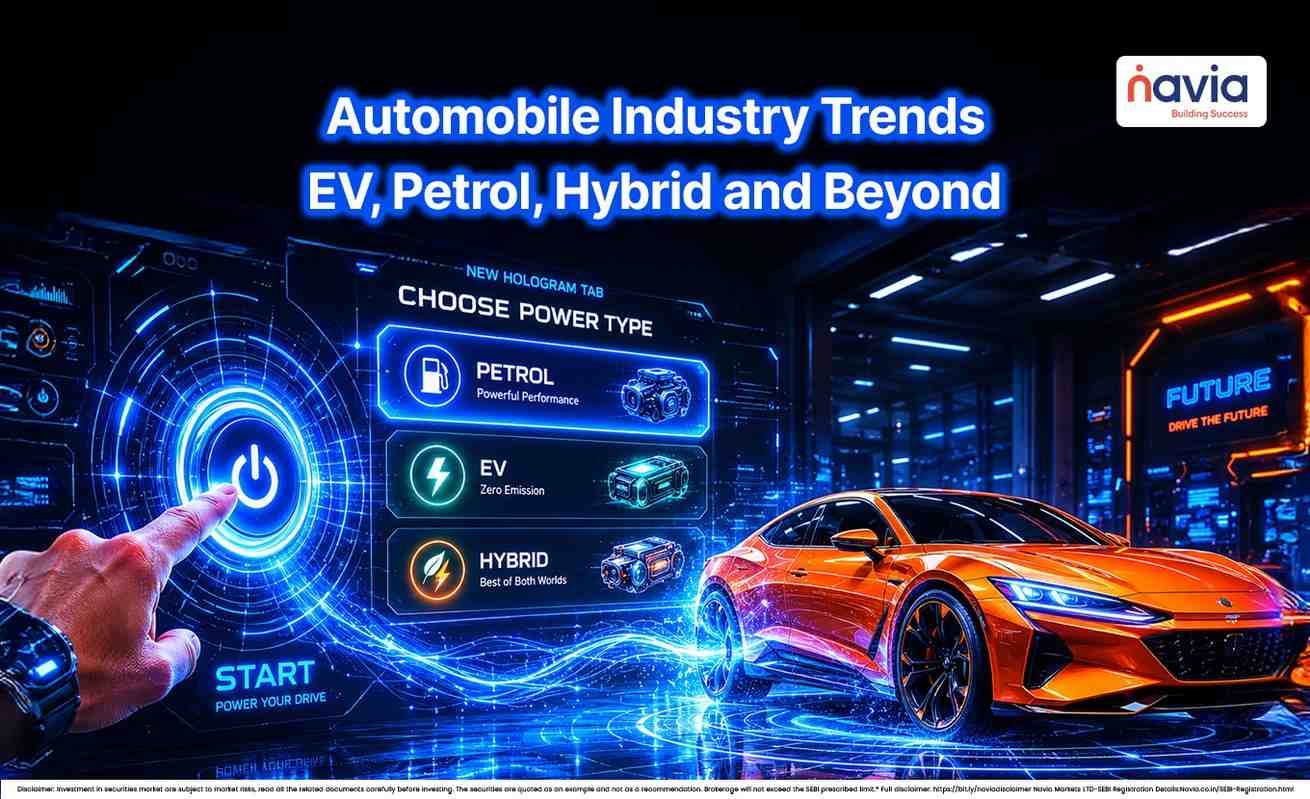
Automobile Industry Trends: EV, Petrol, Hybrid and Beyond
- The Indian Automobile Market Has Unique Realities
- The Current State of the Indian Auto Industry
- EV Sales: Rising, Stable or Falling?
- Approximate EV Share by Major Indian Passenger Vehicle Companies
- Are EVs Actually Cheaper to Own?
- Strong Hybrids: A Growing Segment
- The Petrol and Diesel Debate Is Not Over
- At What Petrol Price Does EV Economics Change Materially?
- Key Industry Participants
- EVs and Business Models
- The Charging Infrastructure Question
- What New Technologies Could Disrupt the Industry?
- Key Industry Trends to Monitor
- Possible Industry Scenarios
- Final Thought
A Turning Point for the Global Automobile Industry
The automobile industry is going through a significant period of change in its history. For more than 100 years, fossil fuel powered vehicles dominated the world. Petrol and diesel engines shaped cities, highways, supply chains, geopolitics and even economic policies.
Today, however, the industry is experiencing significant changes. Electric Vehicles (EVs) are growing rapidly. Hybrid vehicles are quietly becoming mainstream. Governments are pushing sustainability. Battery technology is improving. Fuel prices continue to remain volatile. Consumers are becoming more conscious about ownership cost rather than just purchase price.
But despite all the headlines around EVs, the multiple technologies currently coexist. The reality is far more nuanced. Especially in countries like India.
💡 Quick Answer
The Indian automobile industry is entering a multi-technology phase rather than a straight jump to electric. Electric vehicles are growing quickly in cities and fleets, strong hybrids are emerging as a convenient no-charging middle path, and petrol and diesel still serve price-sensitive and long-distance buyers. The likely winners are the companies that manage this transition intelligently across cost, infrastructure, software and consumer trust.
The Indian Automobile Market Has Unique Realities
India is not Europe. India is not China. India is not the United States. India has:
- High population density
- Price-sensitive consumers
- Uneven charging infrastructure
- Large rural and semi-urban markets
- Heavy traffic conditions
- Hot climate conditions
- Mixed electricity quality and reliability
- Long-distance intercity travel patterns
This creates a very different transition curve. Instead of a straight shift from petrol to EV, India currently exhibits characteristics of a multi-technology market. The future may include:
- Petrol vehicles
- Strong hybrids
- EVs
- CNG
- Flex fuel
- Hydrogen for commercial transport
- Alternative battery chemistries
Different technologies are currently associated with different use cases.
The Current State of the Indian Auto Industry
India remains one of the one of the larger automobile markets globally. Maruti Suzuki continues to dominate passenger vehicle sales with nearly 18 lakh units sold annually. Mahindra and Tata have recorded market-share gains in the SUV segment, while Hyundai faces increasing competitive pressure.
At the same time, EV adoption has increased over the last few years. Indian passenger EV sales crossed approximately 1.75 lakh units in 2025, representing one of the period of increased adoption for the segment. Tata Motors remains the market leader, while MG and Mahindra are growing rapidly.
However, despite strong growth, EVs still represent a relatively small percentage of India’s overall passenger vehicle market. This is a very important insight. The transition is happening. But the transition is still early.
EV Sales: Rising, Stable or Falling?
The answer is:
EV sales are rising strongly, but adoption remains uneven
The trend in India shows:
- Steady increase in EV launches
- Increased SUV EV launches
- Growing urban adoption
- Increasing fleet and commercial usage
- Rising interest among younger consumers
But there are also signs of moderation. Some early EV leaders have seen temporary slowdown in sales growth as competition increases and customers become more selective. This suggests the Indian EV market is entering a different stage of development where:
- Product quality
- Charging ecosystem
- Reliability
- Service experience
- Resale confidence
will matter more than simply being “electric.”
Approximate EV Share by Major Indian Passenger Vehicle Companies
| Company | Approx Total Annual Sales | Approx EV Sale | EV Share of Total Sales |
|---|---|---|---|
| MG Motor | ~80,000 | ~50,000 | ~60%+ |
| Mahindra | ~5.9 lakh | ~40,000 | ~7% |
| Hyundai | ~5 lakh | Low currently | <2% |
| Maruti Suzuki | ~18 lakh | Early stage | Very low currently |
| BYD India | Niche premium player | Growing steadily | Primarily EV-focused |
These numbers continue to evolve rapidly as new launches enter the market. One major development to watch is Maruti Suzuki’s entry into EVs. Historically, Maruti has waited patiently before entering new segments aggressively. When Maruti scales a category, it can potentially transform mass adoption.
Are EVs Actually Cheaper to Own?
The answer depends heavily on:
- Annual running
- Ownership duration
- Charging access
- Resale assumptions
- City vs highway usage
For high running users:
- Taxis
- City commuters
- Fleet operators
Ownership costs may differ. For moderate private users driving:
- 8,000 to 12,000 km annually
The economics become less dramatic. The potential cost differences in EV ownership come from:
- Lower energy cost
- Lower servicing cost
But higher purchase price and uncertain long-term battery depreciation often influence overall ownership cost.
Strong Hybrids: A Growing Segment
One of the most interesting developments globally is the rise of strong hybrid vehicles. Strong hybrids combine:
- Petrol engine
- Electric motor
- Regenerative braking
- Battery assistance
Without requiring external charging. In many real-world Indian conditions, strong hybrids may currently represent the one technology option currently available. Why?
Because they offer:
- 20–27 kmpl real-world mileage
- Low stress ownership
- No charging dependency
- Lower emissions than regular petrol vehicles
- Strong resale confidence
- Proven reliability
Cars like the Toyota Hyryder and Maruti Grand Vitara Strong Hybrid are increasingly becoming available vehicle options for urban professionals.
The Petrol and Diesel Debate Is Not Over
Many people assume fossil fuel vehicles will disappear quickly. That is unlikely. Petrol vehicles still offer:
- Lower upfront pricing
- Nationwide refueling convenience
- Long highway flexibility
- Easier resale market
- Simpler rural adoption
Diesel may continue surviving strongly in:
- Commercial transport
- Heavy SUVs
- Logistics
- Long-distance applications
However, diesel passenger cars will likely continue shrinking gradually because:
- Stricter emission norms
- Rising compliance costs
- Urban pollution concerns
- Changing taxation structures

At What Petrol Price Does EV Economics Change Materially?
This is one of the most important economic questions. Based on current Indian EV pricing structures, EVs become attractive when:
Petrol crosses approximately ₹140–₹160 per litre consistently
At that level:
- Fuel-cost differences increase
- EV payback period shortens sharply
- Fleet economics become impossible to ignore
- Middle-class adoption patterns may change
Currently, Indian petrol prices around ₹100–₹110 per litre create an environment where:
- Hybrids receive increased attention
- EVs make sense mainly for high running users
- Petrol still remains viable for moderate users
This is why India currently appears to be entering a hybrid-friendly phase rather than a pure EV-only phase.
Key Industry Participants
1. Tata Motors
Tata has early market participation in India’s mass-market EV space.
Strengths:
- Strong EV lineup
- Local manufacturing
- Early charging ecosystem presence
- Strong brand recall in EVs
Challenges:
- Service consistency
- Increasing competition
- Maintaining technology leadership
2. Mahindra
Mahindra has announced EV-related initiatives. Why?
- SUV dominance
- Strong product design direction
- Premium EV positioning
- Improving technology partnerships
Mahindra has disclosed EV expansion plans and globally aligned.
3. Maruti Suzuki
Maruti remains India’s most important auto company. Historically, Maruti succeeds by:
- Waiting patiently
- Scaling aggressively later
- Dominating cost structures
- Leveraging unmatched service reach
If Maruti cracks affordable EV reliability and infrastructure support, it could accelerate mass adoption faster than any competitor.
4. Toyota
Toyota may quietly become one of the significant market participants through hybrids. Toyota has:
- Decades of hybrid expertise
- Strong reliability reputation
- Efficient engines
- Excellent fuel economy
If India transitions gradually instead of abruptly, Toyota’s hybrid strategy could prove extremely intelligent.
5. BYD
BYD is perhaps the most technologically integrated EV company globally. Its strengths include:
- Battery manufacturing
- Semiconductor capabilities
- EV platforms
- Vertical integration
If geopolitical and policy conditions remain favorable, BYD could become a premium EV participant in India.
EVs and Business Models
This is a fascinating question. Initially, many automakers actually earned lower margins on EVs because:
- Battery costs were high
- Scale was low
- R&D investment was massive
But over time, EVs can profitability characteristics may differ because:
- Fewer moving parts
- Simpler manufacturing architecture
- Software-related revenue models
- Lower long-term servicing dependency
However, this creates another problem. Traditional automobile companies historically earned large profits from:
- Servicing
- Spare parts
- Engine maintenance
- Oil changes
- Transmission repairs
EVs reduce many of these revenue streams. This means the future automobile company may increasingly resemble:
A Software + Battery + Mobility Platform Company
rather than merely a mechanical engineering company.
The Charging Infrastructure Question
The future of EV adoption depends heavily on charging infrastructure. Urban India may adapt relatively quickly. But challenges remain:
- Apartment charging permissions
- Power grid capacity
- Highway fast charging density
- Charging reliability
- Charging time anxiety
This is why hybrids remain attractive during the transition phase. They remove infrastructure dependency while still improving fuel efficiency substantially.
What New Technologies Could Disrupt the Industry?
1. Solid-State Batteries
If solid-state batteries become commercially viable:
- Charging times could fall dramatically
- Safety could improve
- Energy density could increase
- Range anxiety may reduce sharply
This could influence adoption patterns.
2. Hydrogen Fuel Cells
Hydrogen may not dominate passenger vehicles in India soon. But it could become important for:
- Trucks
- Buses
- Industrial logistics
- Heavy commercial transport
3. Synthetic Fuels
Globally, research continues into low-carbon synthetic fuels that may allow combustion engines to survive longer in specialized segments.
4. AI and Software Defined Vehicles
The future automobile industry discussions increasingly include:
- Software-driven
- AI-assisted
- Subscription-enabled
- Connected to ecosystems
The future industry participants may not only be the best engine manufacturers. They may be the best software ecosystem builders.
Key Industry Trends to Monitor
Investors looking at the automobile sector should focus on:
1. Battery Ecosystem
Not just car companies. Watch:
- Battery manufacturers
- Lithium supply chains
- Charging companies
- Power electronics firms
- Semiconductor suppliers
2. Hybrid Strategy
The Indian market may reward companies that transition intelligently rather than aggressively. Hybrid technology may remain highly relevant for longer than many expected.
3. Software Capability
Future automotive profitability may increasingly come from:
- Connected services
- Software subscriptions
- Autonomous systems
- Data ecosystems
4. Manufacturing Scale
Companies with:
- Strong localization
- Supply chain control
- Cost efficiency
- Distribution reach
will continue dominating India.
5. Charging Infrastructure Players
The EV ecosystem is larger than automobile manufacturers. Charging networks, energy management systems and grid modernization companies may become major long-term beneficiaries. Investors who prefer exposure to an entire theme rather than a single company sometimes use a sector Exchange-Traded Fund (ETF) for broader participation.
Possible Industry Scenarios
The future is unlikely to be dominated by one single technology immediately. Instead, India may move through phases:
Phase 1
Petrol + Hybrid coexistence
Phase 2
Rapid urban EV adoption
Phase 3
Large-scale infrastructure maturity
Phase 4
Possible dominance of EVs or next-generation energy systems. In the near and medium term:
- Hybrids continue to be discussed as a market segment
- EVs may dominate urban high-usage segments
- Petrol will continue surviving meaningfully
- Diesel may remain important in commercial applications
The winners may not necessarily be the companies shouting the loudest about EVs. Industry outcomes may depend on factors such as:
- Manage transition intelligently
- Control costs
- Build trust
- Maintain reliability
- Create ecosystems
- Adapt to changing customer psychology
Final Thought
The future of mobility is not only about replacing engines. It is about:
- Economics
- Infrastructure
- Energy systems
- Consumer psychology
- Software
- Sustainability
- Geopolitics
- Urban design
India’s automobile future may ultimately evolve differently from the West. And that may create some of the important developments to monitor. The transition has already started. But the final winners are still far from decided.
Key Takeaways
- India’s auto market is shifting toward a mix of petrol, hybrid, electric and other technologies rather than a single dominant one.
- Electric vehicle adoption is rising fast in urban and fleet use, but remains uneven and still early overall.
- Strong hybrids are gaining ground because they improve efficiency without depending on charging infrastructure.
- Petrol and diesel still matter for affordability, highway travel, rural buyers and commercial transport.
- Charging infrastructure, battery ecosystems and software capability will shape which companies lead.
- The long-term winners are likely to be firms that manage the transition intelligently rather than those marketing electric vehicles most aggressively.
Did you find this article helpful?
Your feedback helps us write better content.

DISCLAIMER: Investment in securities market are subject to market risks, read all the related documents carefully before investing. The securities quoted are exemplary and are not recommendatory. Full disclaimer: https://bit.ly/naviadisclaimer.