

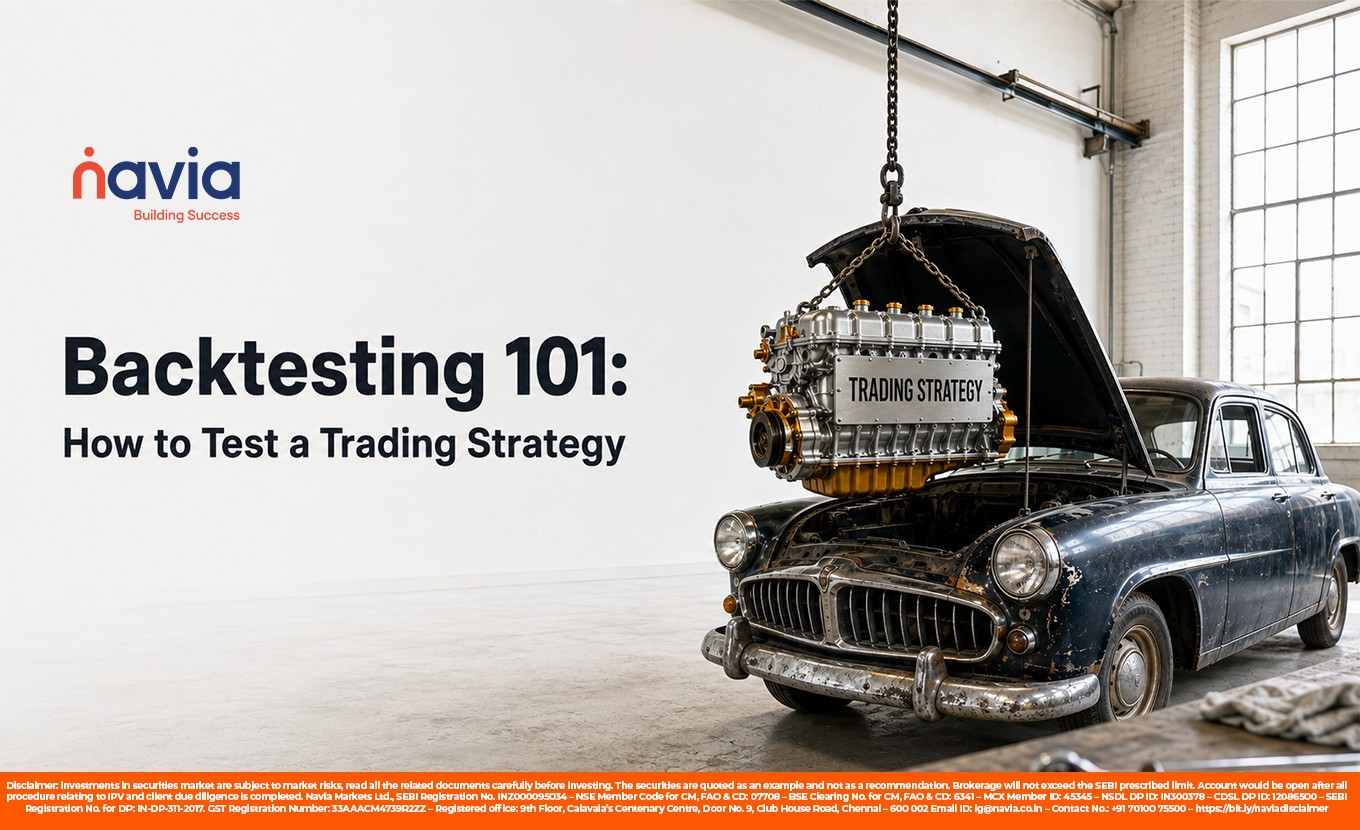
Backtesting 101: How to Test a Trading Strategy Before Going Live?
- What is backtesting?
- Why does backtesting matter?
- How to backtest a trading strategy step by step?
- Manual backtesting vs automated backtesting
- Which numbers should you check?
- What is overfitting and why is it dangerous?
- How do in-sample and out-of-sample data help?
- The final step: paper trading before going live
- Conclusion
- Frequently Asked Questions
Backtesting helps traders study how a trading strategy would have behaved using historical market data. It can provide insights into a strategy’s past performance under different market conditions. This guide explains backtesting in simple terms. You will learn how to backtest, review key metrics, and understand common limitations.
💡 Quick Answer
Backtesting runs a set of trading rules through past market data to study how a strategy would have behaved. It does not involve placing live trades or using actual capital. Historical results may not reflect future performance, and a backtest cannot predict how a strategy will behave in live markets.
What is backtesting?
Backtesting is the process of taking a set of trading rules and running them through past market data. By reviewing the results, traders can study how the strategy responded to different market situations during the selected period.
A trading strategy backtest does not involve placing live trades or using actual capital. Instead, it helps traders review historical results and understand a strategy’s behaviour.
However, historical results may not reflect future market performance.
Why does backtesting matter?
Backtesting helps traders examine a trading strategy using historical data before considering its use in live markets.
A strategy that appears reasonable in theory may show different results across past market conditions. Therefore, a backtest can help traders review how predefined rules behaved over a selected period.
It can also highlight factors such as drawdowns, winning and losing periods, and overall historical performance. These observations may support further analysis and risk management.
However, a backtest cannot predict future performance. Historical results may differ from results in live market conditions.
How to backtest a trading strategy step by step?
A structured process can make backtesting easier to understand. Here are four basic steps.
- First, define clear entry and exit rules, position size, and risk parameters. Clear rules can support a more consistent backtest.
- Next, select suitable historical data that covers different market conditions. The chosen period can affect the results.
- Then, run the backtest manually or with suitable software. Apply the same predefined rules throughout the testing process.
- Finally, review the results before making further changes to the trading strategy. Consider the strategy’s historical behaviour, limitations, and relevant performance metrics.
You can study market charts and explore trading tools on the Navia All in One App.
Manual backtesting vs automated backtesting
There are two common approaches to backtesting: manual and automated.
Manual backtesting involves reviewing historical charts and recording observations in a spreadsheet or journal. This approach can help traders examine how their predefined rules apply to individual market situations.
Automated backtesting uses software to apply predefined rules across a selected set of historical data. It can process larger datasets more efficiently than manual testing.
The choice between manual and automated backtesting depends on the strategy, available data, and the trader’s testing requirements.
However, neither method can guarantee future performance. Historical results may differ from outcomes in live market conditions.
Which numbers should you check?
A backtest involves more than reviewing overall profit or loss. Traders can examine several metrics together.
Win rate shows the percentage of trades that ended with a profit. However, this metric alone does not describe overall strategy performance.
Profit factor compares gross profits with gross losses. It can provide one view of the historical relationship between gains and losses.
Maximum drawdown measures the largest decline from a previous portfolio peak during the tested period. Traders may use it to understand historical downside.
Finally, review the number of trades included in the backtest. A larger dataset may provide a broader historical sample, although it cannot predict future results.
Consider these metrics together rather than relying on a single number. Historical backtesting results may differ from live market outcomes.
What is overfitting and why is it dangerous?
Overfitting can occur when a trading strategy becomes too closely tailored to past historical data. Excessive adjustments may make a backtest appear stronger within the selected period.
However, those results may partly reflect past market conditions or random price movements. The strategy may then behave differently in new or live market conditions.
To reduce the risk of overfitting, traders can keep their rules clear and avoid unnecessary adjustments. Testing across different market conditions may also provide a broader perspective.
However, no testing method can eliminate uncertainty or guarantee future performance.
How do in-sample and out-of-sample data help?
Traders can divide historical data into two separate periods for backtesting.
In-sample data helps develop and refine a trading strategy. Out-of-sample data then evaluates the strategy using a separate dataset.
Comparing results across both periods can provide additional context about the strategy’s historical behaviour. Significant differences may also indicate possible overfitting.
This approach can help traders assess how closely a strategy depends on the data used during development. However, consistent historical results cannot guarantee future performance.
The final step: paper trading before going live
A backtest can provide historical insights, but it does not show how a trading strategy may perform in live markets.
Therefore, some traders use forward testing, also known as paper trading, after completing a backtest. This approach applies predefined rules to current market conditions without placing actual trades.
Paper trading can help traders observe how a strategy behaves under changing market conditions. However, simulated results may differ from actual trading outcomes because of factors such as execution, costs, and market liquidity.
A trader may review both backtesting and paper trading results before considering live trading. However, past and simulated results cannot guarantee future performance.
Conclusion
Backtesting helps traders examine how a trading strategy behaved using historical data. It can support the study of predefined entry and exit rules across past market conditions.
When reviewing a backtest, traders may consider metrics such as win rate, profit factor, and maximum drawdown together. They can also remain aware of overfitting, especially when strategies undergo repeated adjustments.
Some traders also use paper trading to observe a strategy under current market conditions. However, historical and simulated results may differ from live trading outcomes.
No backtest can guarantee future performance or profits. Therefore, traders should consider appropriate risk management before making trading decisions.
Key Takeaways
- Backtesting runs a set of trading rules through past market data and does not involve placing live trades or using actual capital. However, historical results may not reflect future market performance.
- Clear entry and exit rules, position size and risk parameters can support a more consistent backtest, and the historical period chosen can affect the results.
- Manual backtesting records observations from historical charts, while automated backtesting applies predefined rules across larger datasets. Neither method can guarantee future performance.
- Metrics such as win rate, profit factor and maximum drawdown are worth reviewing together rather than relying on a single number, as historical results may differ from live market outcomes.
- Overfitting can occur when a strategy becomes too closely tailored to past data, and no testing method can eliminate uncertainty or guarantee future performance.
- Paper trading applies predefined rules to current market conditions without placing actual trades, although simulated results may differ from actual trading outcomes.
DID YOU FIND THIS INTERESTING?
We’d love to hear from you –

Frequently Asked Questions
What is backtesting in simple words?
Backtesting involves evaluating a trading strategy against historical market data. It allows traders to see how the strategy’s predefined rules would have behaved across past market conditions.
How much historical data is needed for backtesting?
The required amount of historical data depends on the strategy and market. A broader dataset may cover different market conditions and provide more observations.
What is a good profit factor?
There is no universally suitable profit factor. Traders should review it alongside drawdown, trade count, costs, and other relevant performance metrics.
What is overfitting?
Overfitting occurs when a strategy becomes too closely tailored to past data. This can make a backtest appear stronger than future results.
Is backtesting the same as paper trading?
No. Backtesting uses historical market data. Paper trading, or forward testing, applies a trading strategy to current market conditions without actual trades.
Does a good backtest guarantee profit?
No. Backtesting reflects historical results only. Past results cannot guarantee future performance or profits.
Can beginners do backtesting?
Yes. Beginners can start with manual backtesting using charts and spreadsheets. Automated tools may also support more complex testing requirements.
DISCLAIMER: Investment in securities market are subject to market risks, read all the related documents carefully before investing. The securities quoted are exemplary and are not recommendatory. Full disclaimer: https://bit.ly/naviadisclaimer.