

How India VIX Affects Options Trading ?— Simple Guide for Traders
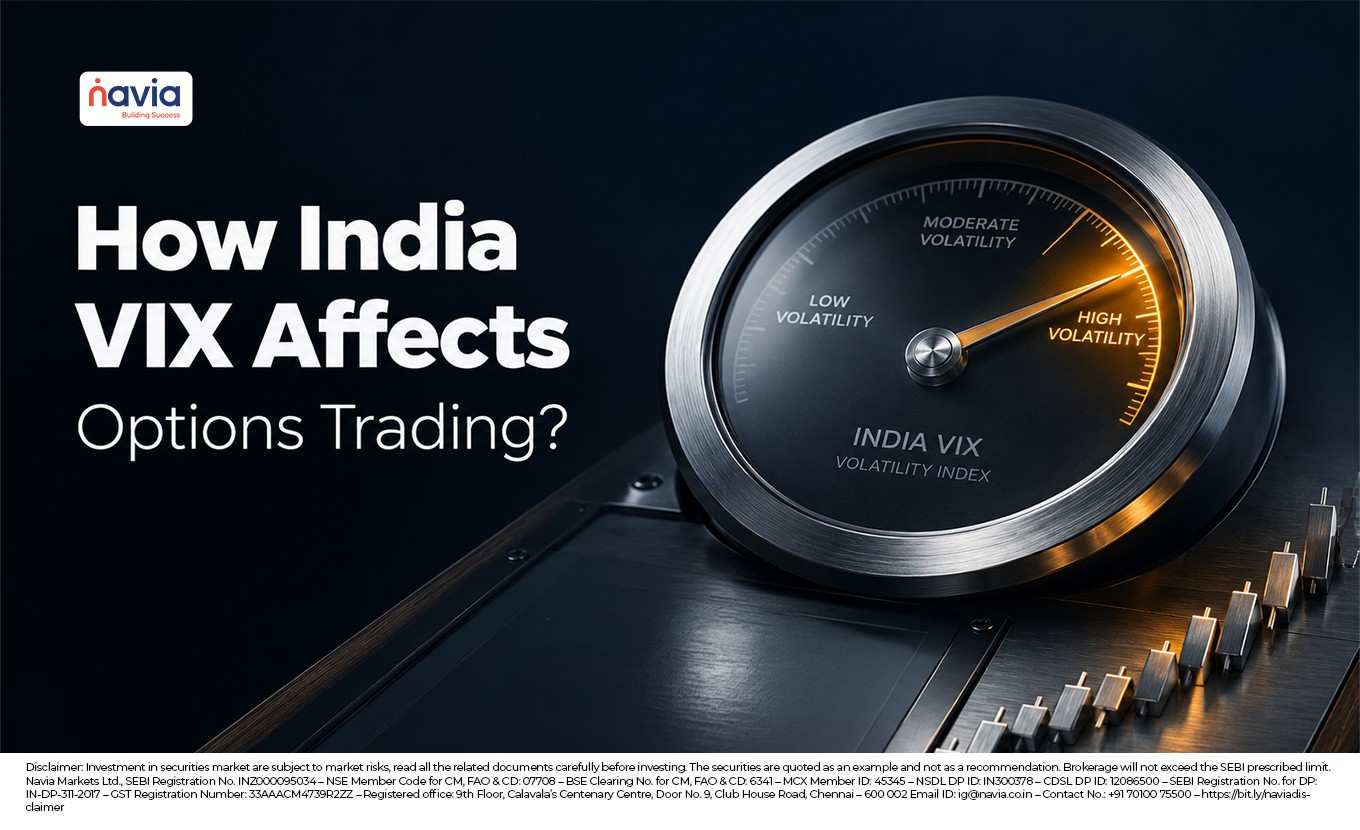
India VIX is often called the fear index because it reflects expected market volatility. How India VIX affects options trading depends on changes in market expectations. Higher India VIX levels are generally associated with higher option premiums, while lower India VIX levels are generally associated with lower option premiums. Changes in volatility can also influence theta decay, which affects the time value of options. Understanding India VIX can provide additional context when analyzing options trading.
💡 Quick Answer
India VIX is the NSE’s volatility index, reflecting the market’s expected volatility over the next 30 calendar days. Higher readings are generally associated with higher option premiums and slower theta decay; lower readings with cheaper premiums and faster time-value loss. It signals expected magnitude, not market direction.
What is India VIX exactly?
India VIX is a real-time volatility index published by the National Stock Exchange (NSE). It measures the market’s expected volatility over the next 30 calendar days.
You can think of it as a measure of expected market volatility. Higher India VIX values generally indicate higher expected volatility, while lower values indicate relatively lower expected volatility. The index is calculated using Nifty options prices, including bid and ask quotes for near-month and next-month Nifty call and put contracts.
The NSE calculates India VIX using a methodology based on the CBOE Volatility Index (VIX). The value is expressed as an annualized percentage. For example, an India VIX reading of 20 reflects the market’s expected annualized volatility, which can be converted into an implied expected movement over shorter periods using standard market conventions.
Launched in 2008, India VIX is commonly referred to as the “fear index.” It reflects the expected magnitude of market movements and does not indicate the direction of the market.
Why does India VIX move?
India VIX responds to changes in market uncertainty. During major events such as the Union Budget, India VIX may rise as market participants anticipate higher volatility. Factors that can influence India VIX levels include:
- Economic data
- RBI policy announcements
- Corporate earnings
- Global commodity prices
- US Federal Reserve decisions
- Geopolitical developments
India VIX and the Nifty Index have often shown an inverse relationship during periods of market stress. When the Nifty declines sharply, India VIX has historically tended to rise. Likewise, when the Nifty moves steadily with lower expected volatility, India VIX has often remained lower. However, this may not be true for all market situations.
How does India VIX change option premiums?
This is the core of how India VIX affects options trading. Option premiums are influenced by several factors, including India VIX and expected volatility.
High India VIX means higher option premiums
When expected volatility increases, option premiums generally rise because the market expects larger price movements. As a result, option prices tend to be higher.
Low India VIX means lower option premiums
When expected volatility declines, option premiums generally become lower. In such conditions, time decay continues to reduce an option’s time value as expiry approaches, even if the underlying index shows limited price movement.
| India VIX Level | Typical Range | What It May Indicate? | Potential Effect on Option Premiums |
|---|---|---|---|
| Below 15 | Relatively low | Lower expected market volatility | Option premiums are generally lower; theta decay may have a greater impact on option buyers. |
| 15–25 | Moderate | Moderate expected volatility | Option premiums are generally in a moderate range. |
| 26–35 | Relatively high | Higher expected market volatility | Option premiums are generally higher. |
| Above 35 | Elevated | Significantly higher expected market volatility | Option premiums are generally at higher levels. |
Table illustrative only. Actual premium prices vary by strike, expiry and Nifty level.

Theta Decay and Options Trading
Theta decay refers to the reduction in an option’s time value as it approaches expiry. It is measured using theta, one of the options Greeks.
As time passes, the time value of an option premium generally decreases, even if the Nifty Index shows little or no price movement. This gradual reduction in time value is known as theta decay.
- Higher India VIX levels are generally associated with higher expected volatility, which may slow the rate of theta decay.
- Lower India VIX levels are generally associated with lower expected volatility, where the time value of options may decline more quickly.
- As expiry approaches, the impact of theta decay typically becomes more significant, and this effect is often more noticeable in shorter-duration options, including weekly index options.
Reading India VIX Levels for Options Traders
A simple framework can help interpret India VIX alongside options trading activity:
- India VIX below 12: Expected volatility is relatively low. Option premiums are generally lower, while theta decay may have a greater impact on option buyers.
- India VIX 12–18: Expected volatility is within a moderate range. Option premiums are generally balanced relative to market expectations.
- India VIX 18–25: Expected volatility is higher. As a result, option premiums generally increase compared with lower India VIX levels.
- India VIX above 25: Expected volatility is elevated. Option premiums are generally higher, reflecting increased expectations of market price movements.
Many market participants review India VIX alongside the Nifty 50 to better understand changes in expected volatility. For example, if the Nifty 50 declines while India VIX rises significantly, it may indicate an increase in expected market volatility. However, India VIX should be considered along with other market indicators rather than used as a standalone signal.
Three Mistakes Beginners Make with Volatility
- A common mistake is buying Nifty options without considering India VIX or expected volatility. Lower volatility levels may result in lower option premiums, while time value continues to decline as expiry approaches.
- Another mistake is assuming option premiums remain unchanged. In practice, option premiums can change as volatility, the underlying price, time to expiry, and other market factors change. A decline in India VIX may affect the value of an option, depending on market conditions.
- A third mistake is overlooking theta decay when holding positions close to expiry. As expiry approaches, theta decay generally increases, reducing the time value of Nifty options more rapidly.
Mandatory Disclosure: According to SEBI’s FY25 study, a significant proportion of individual traders in the equity derivatives segment incurred net losses. Options trading involves substantial risk and may not be suitable for all investors. Before trading options, investors should understand the product, associated risks, and applicable risk management practices.
Conclusion
Understanding how India VIX affects options trading can help investors interpret changes in volatility, option premiums, and time decay. Reviewing India VIX alongside other market indicators may provide additional context when analysing options trade opportunities. You can access Nifty options and other market features through the Navia All in One App. As with any market activity, options trading involves risk and should be undertaken only after understanding the product and its associated risks.
Key Takeaways
- India VIX is a real-time volatility index published by the NSE, measuring the market’s expected volatility over the next 30 calendar days.
- It is calculated from Nifty options prices using a methodology based on the CBOE Volatility Index, and is expressed as an annualized percentage.
- Higher India VIX levels are generally associated with higher option premiums; lower levels with lower premiums.
- Volatility also affects theta decay: higher expected volatility may slow it, while lower expected volatility can let time value decline more quickly.
- India VIX and the Nifty have often shown an inverse relationship during market stress, though this does not hold in all situations.
- India VIX reflects expected magnitude, not direction, so it should be read alongside other indicators rather than used as a standalone signal.
Did you find this article helpful?
Your feedback helps us write better content.

FREQUENTLY ASKED QUESTIONS
What does India VIX below 15 mean for options traders?
An India VIX reading below 15 generally indicates relatively lower expected market volatility. In such conditions, option premiums are often lower, while theta decay may have a greater impact on option buyers as expiry approaches.
How fast does theta decay accelerate before expiry?
The impact of theta decay generally becomes more significant as options approach expiry. As a result, time value typically declines at a faster rate during the final days before expiry, although the rate may vary depending on market conditions.
Can I use India VIX as a trading signal by itself?
No. India VIX reflects expected market volatility, not market direction. It is best used alongside price action, trading volume, and other market indicators rather than as a standalone trading signal.
What’s the difference between India VIX and implied volatility?
India VIX is a market-wide volatility index derived from option prices on the Nifty Index. Implied volatility (IV) represents the market’s expected volatility for an individual stock, index, or option based on its market price.
Do weekly Nifty options decay faster than monthly ones?
In general, Nifty options with shorter time to expiry experience a faster rate of theta decay than those with longer maturities. As expiry approaches, time decay typically becomes more pronounced.
Should I always sell options when India VIX is high?
Not necessarily. Higher volatility is generally associated with higher option prices, but it may also indicate increased market uncertainty. Any decision involving India VIX should consider market conditions, risk tolerance, and an appropriate risk management approach.
DISCLAIMER: Investment in securities market are subject to market risks, read all the related documents carefully before investing. The securities quoted are exemplary and are not recommendatory. Full disclaimer: https://bit.ly/naviadisclaimer.