

Zero Brokerage in India: What It Means, What You Still Pay, and How to Start
Zero brokerage is the first thing most traders search for when picking a broker, but the phrase means different things on different platforms. Some brokers waive brokerage only on delivery. Others charge a subscription for it. And even when brokerage is genuinely ₹0, the trade itself is not free, because statutory charges still apply. This guide explains what zero brokerage actually means, what it costs in practice, and how to get started.
What does zero brokerage mean?
Brokerage is the fee a broker charges per order for executing trades on your behalf. Zero brokerage removes that per-order fee entirely, so a ₹1 lakh trade and a ₹10 lakh trade both cost ₹0 in commission. The model became viable because technology-first discount brokers cut operating costs and recover revenue from other services instead of trade commissions. What zero brokerage does not remove are the statutory charges every Indian broker must collect. Those go to the government, SEBI and the exchanges, not the broker.
Are all zero brokerage brokers the same? The 3 models in India
| Model | How it works | What to check |
|---|---|---|
| Zero on delivery only | ₹0 on equity delivery; intraday and F&O charged per order (typically up to ₹20 per order at flat-fee brokers) | Your intraday and F&O trades still cost brokerage |
| Zero for a fee | ₹0 per trade, but after a one-time joining fee or a monthly or annual subscription | Total cost = subscription ÷ trades placed |
| Zero across all segments | ₹0 per order on delivery, intraday, F&O and commodities, with no subscription | Confirm the duration of the offer, and check AMC and DP charges |
Navia follows the third model: ₹0 brokerage for life on every segment, with free account opening and no AMC, for trades you place yourself on the Navia All in One App. When comparing brokers, check which model the zero actually belongs to, because the word is used for all three. For a deeper look at what Navia itself charges, see Navia brokerage charges: ₹0 and what else you pay.
If brokerage is ₹0, what do you still pay?
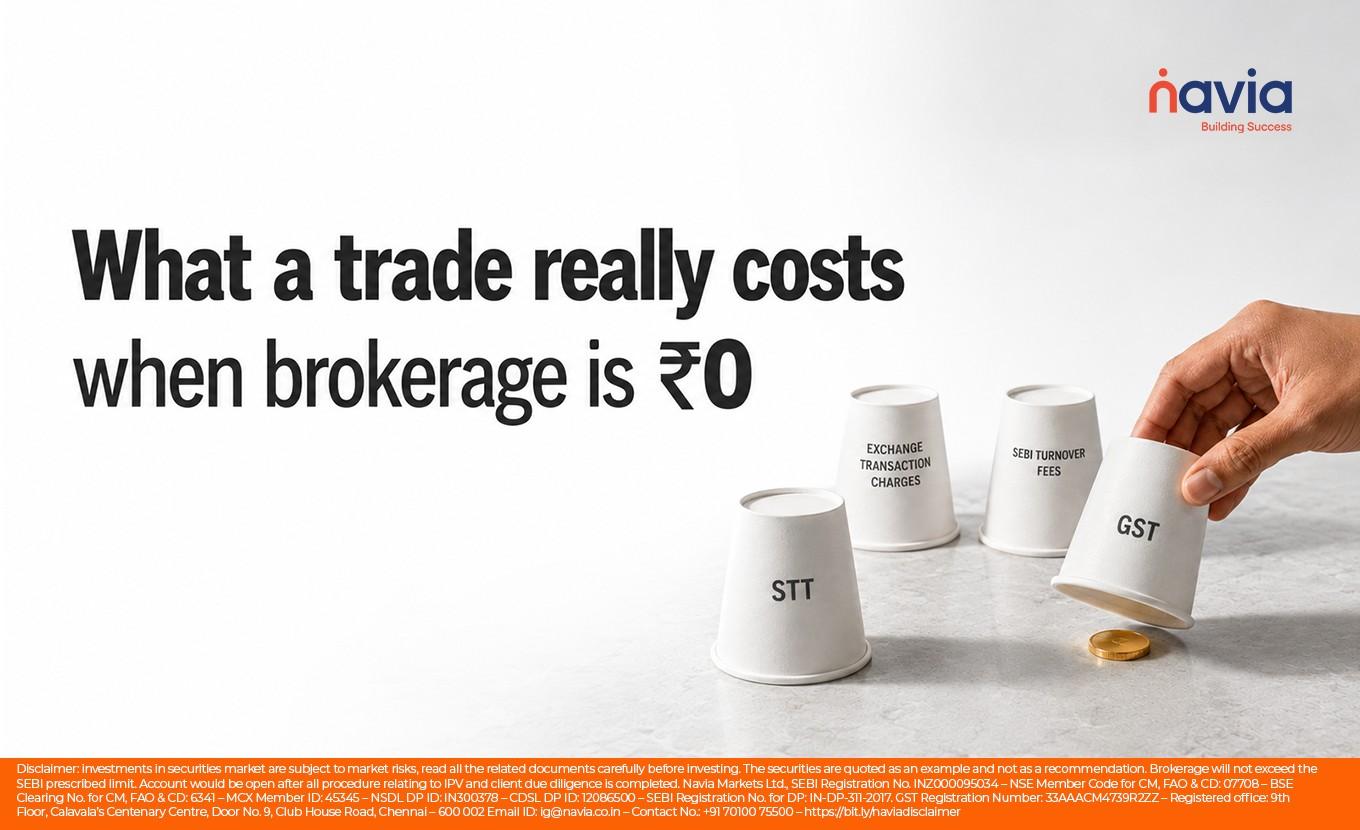
Every trade carries government and regulatory charges. These include Securities Transaction Tax (STT), which is usually the largest, exchange transaction charges from NSE, BSE or MCX, GST at 18% on the fee-based charges, a SEBI turnover fee of ₹10 per crore, and stamp duty on the buy side. On equity delivery, STT is 0.1% on both buy and sell. On intraday and F&O it applies only on the sell side. There is also a DP charge when you sell shares from demat, which at Navia is 0.03% of value with a minimum of ₹30 and a maximum of ₹300.
→ Check the exact cost of any trade in Navia’s brokerage calculator
A worked example: a ₹1 lakh trade at a zero brokerage broker
Say you buy 100 shares at ₹1,000 and later sell them at ₹1,000 at Navia. Brokerage is ₹0, STT comes to about ₹200, stamp duty about ₹15, exchange charges and GST a few rupees, the SEBI fee a few paise, and a ₹30 DP charge applies on the sell. The whole trade costs roughly ₹250. At a broker charging ₹20 per order, the same trade costs about ₹290, and for an active trader placing 25 orders a day, brokerage alone can cross ₹10,000 a month. That saving in brokerage, rather than any change in statutory charges, is what a zero brokerage account gives you. The figures above are approximate and vary with live rates, and the securities and values are illustrative only. For the derivatives version of this math, see the 5 charges you still pay on zero brokerage F&O.

How do zero brokerage brokers make money?
Legitimately, through disclosed sources other than trade commissions. Navia, for example, earns revenue through interest on Margin Trade Funding (MTF), interest on client float, dedicated relationship manager (RM) services, and technology and API partnerships. This is what lets Navia offer lifetime zero brokerage to self-directed clients, while RM-serviced clients pay applicable brokerage as per their plan. A SEBI-registered broker is required to publish its complete tariff, so the published charge list is the reliable place to compare brokers, rather than the headline claim. Navia’s tariff is on its pricing page. The advantages of a zero brokerage trading account hold when the pricing is fully transparent.
How do you start trading at zero brokerage?
Open a free demat and trading account on the Navia All in One App. Provide your PAN, bank details and Aadhaar-linked mobile number, then e-Sign with an Aadhaar OTP. KRA-compliant accounts are typically activated within 24 hours. There is no account-opening charge and no AMC, for life. You can also explore the app in Guest Mode before opening an account.
A note on cost and risk
Zero brokerage lowers your cost of trading. It does not lower market risk. Prices can move against you regardless of what a trade costs to place, so size your positions sensibly and read all scheme and risk documents before investing.
Conclusion
Zero brokerage means the broker’s commission is ₹0. Your real cost is the statutory charges, which are identical at every broker, and STT is usually the largest of them. The model matters too: check whether the ₹0 covers all segments, for how long, and whether a subscription applies. Navia offers ₹0 brokerage for life across every segment, with no AMC and no account-opening fee, for self-directed trades. Open your free account on the Navia All in One App. Navia Markets is registered with SEBI (Reg. No. INZ000095034).
DID YOU FIND THIS INTERESTING?
We’d love to hear from you –