

What is Bid-Ask Spread? Meaning, Trading Impact, and Why it Matters
- What is Bid and Ask?
- Why the Spread Exists — and What Moves It
- Spread Width Across Indian F and O Instruments — Where You Are Safe and Where You Are Not
- Market Orders vs Limit Orders — How You Interact with the Spread
- How to Read Liquidity Before Placing an Order?
- Why Spread Matters to Retail Investors?
- Conclusion
- Frequently Asked Questions
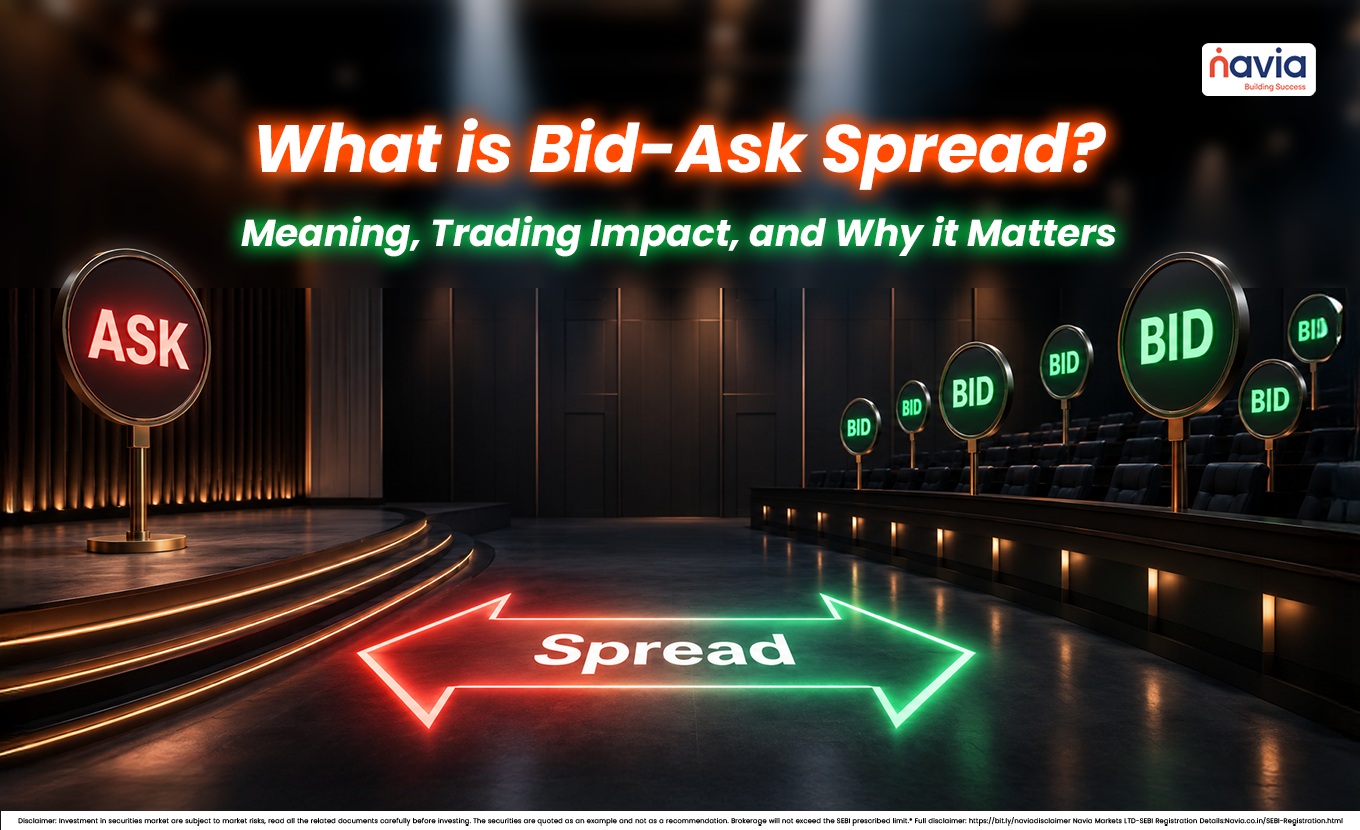
What is bid ask spread is one of the most basic questions in market trading, yet it explains a lot about price, liquidity, and transaction cost. In simple terms, the bid ask spread is the difference between the highest price a buyer is willing to pay and the lowest price a seller is willing to accept.
If you want to understand bid & ask meaning, think of it as the meeting point between buyers and sellers in the market. The spread becomes especially relevant because it can influence trade execution prices — and how they compare with the last traded price — when you buy or sell.
💡 Quick Answer
The bid-ask spread is the gap between the highest price a buyer will pay (the bid) and the lowest price a seller will accept (the ask). It is not a broker fee — it is the cost of trading immediately, and it widens when volatility is high or liquidity is low. Using limit orders instead of market orders, and trading liquid instruments, helps you pay less of the spread.
What is Bid and Ask?
Every tradeable instrument has two prices simultaneously — a bid price and an ask price. The spread is the gap between them. It is not a fee charged by your broker. It is the natural cost of immediacy — the price you pay for being able to trade right now.
Bid-Ask Spread = Ask Price – Bid Price [always positive; paid by the order-taker]
Five Components of a Market Quote
| Component | What It Is | Who Sets It | In Today’s Market (Jun 16) |
|---|---|---|---|
| Bid Price | Highest price a buyer is willing to pay RIGHT NOW | Buyers (institutions, retail, algos) | Nifty ATM Call: e.g. Rs. 148 |
| Ask Price | Lowest price a seller is willing to accept RIGHT NOW | Sellers (option writers, market makers) | Nifty ATM Call: e.g. Rs. 150 |
| Bid-Ask Spread | The gap between bid and ask — your immediate transaction cost | Set by market forces; tightens with liquidity | Rs. 2 on Nifty ATM (VIX ~13.6 today) |
| Mid-Price | Midpoint of bid and ask — the ‘fair value’ reference | Calculated; not tradeable directly | Rs. 149 — useful for limit order placement |
| Last Traded Price (LTP) | Most recent actual execution price | Exchange (after a buyer and seller matched) | May differ from bid/ask in fast markets |
Why the Spread Exists — and What Moves It
In Indian Futures and Options (F&O) markets, market makers and algorithmic traders continuously quote both bid and ask prices. They profit from the spread — buying at the bid and selling at the ask repeatedly. In return, they provide liquidity: someone is always there to take the other side of your trade.
What Makes Spreads Widen or Tighten
- Volatility (VIX): Higher uncertainty = market makers demand more compensation = wider spreads. When VIX hit 28.91 on March 30, 2026, Bank Nifty ATM spreads ballooned to Rs. 80–150.
- Volume and Open Interest: More participants = tighter competition = narrower spreads. Nifty ATM options trade 4+ million contracts daily — hence spreads under 0.15%.
- Time to expiry: As options approach expiry, OTM options lose premium rapidly. The spread as a % of premium widens dramatically in the final hour.
- Market depth (order book): Thin order books mean your order ‘walks’ through price levels. A 10-lot order in a contract with only 3 lots at each level averages worse than the quoted spread.
- Event proximity: Pre-RBI, pre-Budget, pre-earnings — spreads widen as market makers protect themselves from informed flow.
Spread Width Across Indian F&O Instruments — Where You Are Safe and Where You Are Not
Not all F&O instruments carry the same spread risk. The table below maps typical spreads across the key instruments Indian traders use — so you know exactly what you are stepping into before you place an order.
| Instrument | Typical Bid-Ask Spread | Spread as % of Premium | Liquidity Level | Trader Implication |
|---|---|---|---|---|
| Nifty 50 ATM Call (weekly) | Rs. 0.50 – 1.50 | 0.03 – 0.10% | EXCEPTIONAL | Tightest in Indian F&O.; Market orders generally safe. |
| BankNifty ATM Call (weekly) | Rs. 1.00 – 2.00 | 0.05 – 0.15% | VERY HIGH | High daily turnover (>Rs.10 lakh cr). Slight spread vs Nifty. |
| Nifty 1% OTM Call | Rs. 2 – 8 | 0.15 – 0.80% | MODERATE | Spreads widen fast. Limit orders strongly preferred. |
| Nifty Far OTM Call (>3%) | Rs. 5 – 20 | 1 – 5%+ | LOW | Avoid market orders. Spread can be > option premium. |
| Large-cap stock option (liquid) | Rs. 3 – 15 | 0.5 – 2% | MODERATE | Trade only near ATM. Far OTM spreads are punishing. |
| Mid-cap stock option | Rs. 15 – 60 | 3 – 10%+ | LOW | Wide spreads destroy profitability. Avoid frequent trading. |
| Nifty 50 Futures | Rs. 0.05 – 0.25 | <0.01% | EXCEPTIONAL | Most liquid instrument in Indian derivatives. Near-zero spread. |
Market Orders vs Limit Orders — How You Interact with the Spread
How you place an order determines whether you pay the full spread, half the spread, or potentially earn part of it. This single decision is one of the highest-leverage execution choices a retail trader makes.
| Aspect | Market Order | Limit Order at Ask/Bid | Limit at Mid-Price |
|---|---|---|---|
| Execution guarantee | Yes – fills immediately | Yes, if liquid | Not guaranteed in fast markets |
| Spread cost paid | Full spread (buy at ask, sell at bid) | Full spread | Half spread (if filled) |
| Best use case | Emergency exits; highly liquid index | Standard entries/exits | Passive trading in range-bound market |
| Risk in low liquidity | HIGH — fills at worse levels | Moderate — may not fill | HIGH non-fill risk |
| Risk on event days | VERY HIGH — fills Rs.20–80 wide | Controlled | Often missed entirely |
| Today (Jun 16, expiry) | Avoid for OTM after 2:30 PM | Preferred for all strikes | Works in morning session only |
How to Read Liquidity Before Placing an Order?
Before any trade, a 30-second check of these six indicators tells you whether the bid-ask spread is safe to cross, or whether you need to change your approach.
| Indicator | Where to Find It | What It Tells You | Good vs Bad Signal |
|---|---|---|---|
| Bid-Ask Spread | Option chain — any broker platform | Tighter = more liquid = lower transaction cost | < 0.5% of premium = GOOD; > 2% = AVOID |
| Open Interest (OI) | Option chain OI column | Higher OI = more participants = better liquidity | OI > 50,000 lots = liquid; < 5,000 = thin |
| Volume (today’s) | Option chain volume column | Active trading = tighter spreads intraday | Volume > 10,000 lots today = reliable fills |
| Market Depth (L2) | Order book / market depth screen | Shows available bids/asks at each price level | Depth > 5 lots at each level = good; 1 lot = risky |
| Last Traded Price vs Mid | Compare LTP to (Bid+Ask)/2 | Large gap = market is moving fast; stale quotes | LTP within Rs. 1 of mid = healthy; Rs. 5+ = caution |
Why Spread Matters to Retail Investors?
Retail investors often focus on price movement, but the spread can quietly affect their overall investment outcome. A stock with a wider spread may involve higher transaction costs, especially if traded frequently.
That is why the bid and ask price explained concept is so useful for beginners. It helps them understand that trading cost is not only brokerage; it also includes the spread.
Conclusion
The bid ask spread is a simple idea with a big impact: it shows the gap between what buyers pay and what sellers accept. If you understand bid & ask meaning, you can better evaluate market liquidity and trading cost.
For anyone learning what is bid ask spread, the key takeaway is that this spread affects execution quality, especially in bid ask trading and in markets with lower liquidity. Knowing the ask rate and bid rate helps market participants better understand order execution and liquidity and improve awareness of how trades are executed when orders are filled.
Key Takeaways
- The bid-ask spread is the difference between the best bid and best ask — the cost of immediate execution.
- It is set by market forces, not charged by your broker, and tightens as liquidity rises.
- Spreads widen with volatility, near expiry, in thin order books and around major events.
- Liquid instruments like Nifty options and futures have very tight spreads; illiquid ones do not.
- Market orders pay the full spread; limit orders can pay less but may not fill.
- Checking spread, open interest, volume and depth before ordering protects execution quality.
Did you find this article helpful?
Your feedback helps us write better content.
Frequently Asked Questions
What is bid ask spread?
It is the difference between the highest bid price and the lowest ask price in the market.
What is bid and ask meaning?
Bid is the price buyers are willing to pay and ask is the price sellers are willing to accept.
What is ask & bid price?
They are the two quoted prices used to show buyer demand and seller supply.
What is bid ask trading?
It is trading with attention to the bid price, ask price, and spreading to better understand quoted prices and market liquidity.
Why does the spread matter?
Because it affects liquidity, transaction cost, and the price at which your trade is executed.
DISCLAIMER: Investment in securities market are subject to market risks, read all the related documents carefully before investing. The securities quoted are exemplary and are not recommendatory. Full disclaimer: https://bit.ly/naviadisclaimer.