

Unlock Profit: Mastering the Break-Even Point for Business Success
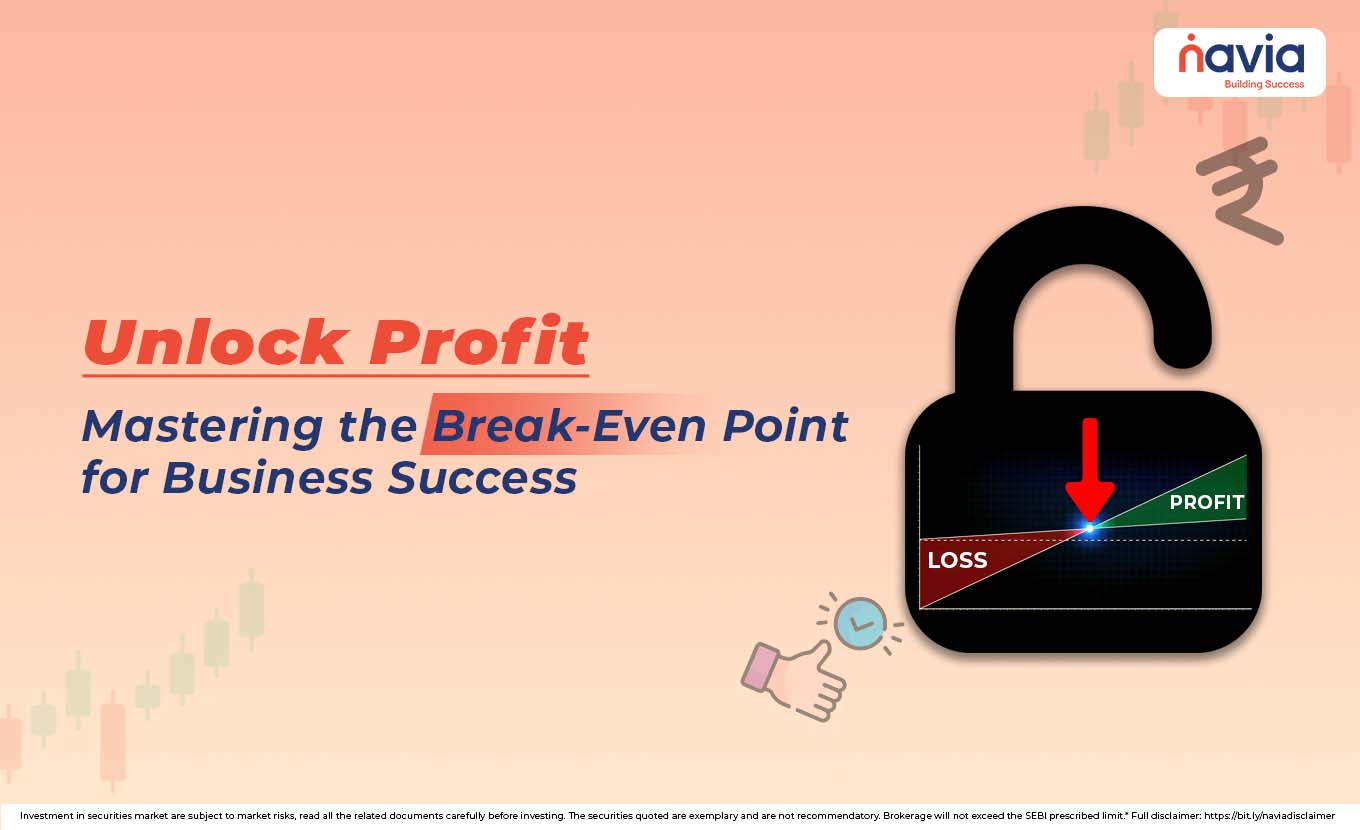
From a local coffee shop to a multinational corporation, every business focuses on a single and crucial financial goal; to make a profit. But every single rupee of profit must first answer a foundational question: How much do we need to sell just to cover our costs? The answer lies in mastering the break-even point.
Understanding the breakeven point is non-negotiable for entrepreneurs and savvy investors. The metric will separate optimism from reality, and act as a critical line between losing money and earning it. If you want to know what is breakeven point and how to use it, this blog will offer a definitive look at the concept.
💡 Quick Answer
The break-even point (BEP) is the sales volume at which total revenue exactly equals total costs — zero profit and zero loss. To find it in units, first work out the Contribution Margin per unit (selling price per unit minus variable cost per unit), then divide Total Fixed Costs by that margin. Every unit sold beyond the break-even point contributes directly to profit.
What is Break-even Point?
The break-even point is the level of sales volume at which a business’s total revenue equals its total costs. At this point, the business is neither making a profit nor incurring a loss. If you want to know what is a breakeven analysis the answer is that it is a study performed by management and financial analysts to determine every point.
Why Do We Need Break-Even Points?
The importance of the breakeven point mean cannot be overstated, it provides;
| Factors | Definition |
|---|---|
| Financial Viability | The BEP establishes the minimum sales level needed to cover all costs (zero profit/loss). |
| Strategic Pricing | It helps determine the necessary contribution margin to cover costs, guiding effective product pricing. |
| Risk Management | It calculates the Margin of Safety—how much sales can drop before the company starts losing money. |
| Profit Planning | It can be adapted to calculate the sales volume required to hit a specific target profit. |
Two Pillars of Break-Even Analysis
Before break-even point calculation formula, you should categorize your business costs into two groups: Fixed and Variable.
Fixed Costs (FC)
There are some costs that do not change the volume of goods or services produced. For example, rent for the office, monthly salaries, property taxes, etc.
Variable Costs (VC)
These costs will fluctuate directly with the volume of production or sales. For example, packaging costs, sales commissions, direct labor wages (per unit produced), etc.

Calculating the Break-even Point in Units
The most common way to calculate the break-even point is to determine the number of units a company must sell to cover all its costs. Before applying the breakeven point formula, you must calculate the Contribution Margin (CM), which represents the revenue remaining after deducting variable costs.
Contribution Margin Per Unit = Selling Price per Unit – Variable Cost per Unit
Let’s see the break-even point calculation formula in units
Break-Even Point (Units) = Total Fixed Costs ÷ Contribution Margin per Unit
Now we can calculate the break-even point for a company who sells mobile phone cases.
- Selling Price Per Unit: ₹500
- Variable Cost per Unit: ₹200
- Total Fixed Costs (Monthly): ₹9,00,000
First calculate Contribution Margin:
CM per Unit = ₹500 – ₹200 = ₹300
Apply the Breakeven Point Formula:
Break-Even Point (Units) = ₹9,00,000 ÷ ₹300 = 3,000 units
Result: The company must sell 3,000 mobile phone cases per month to cover all their fixed and variable costs. If they sell units above 3,000 will generate a profit.
Break-even sits alongside the other core fundamentals an investor checks before committing capital. If you are building that toolkit, start with these 7 must-know stock market ratios, then look at how the current ratio measures short-term liquidity and how Earnings Per Share (EPS) measures profitability per share.
Conclusion: Driving Smarter Business Decisions
Understanding what are break even points, a fundamental for better financial management. And the breakeven point calculation formula will provide a clear and quantitative target that management can use to:
- 🔸 Make or Buy Decisions: Compare the fixed and variable costs associated with manufacturing a component in-house versus buying it from a supplier.
- 🔸 Target Setting: Determine minimum sales goals for the sales team.
- 🔸 Risk Assessment: Quickly model the impact of cost increases (e.g., rising raw material prices) on profitability.
We can say that breakeven point is a truth-teller in business finance, because it strips away complicated projections and boils down success to a single target. But regular monitoring is necessary to ensure they are operating safely, efficiently, and on the path to consistent profit.
To take the same cost-and-profit thinking further into company analysis, see how DuPont analysis breaks return on equity into its drivers, how a SWOT analysis works for investors, and why the Sortino ratio is a sharper risk measure than raw returns.
Key Takeaways
- The break-even point is the sales level where total revenue equals total costs — zero profit, zero loss.
- Split every cost into Fixed Costs (unchanged by volume) and Variable Costs (move with volume) before you calculate anything.
- Contribution Margin per unit = selling price per unit minus variable cost per unit. It is the amount each sale contributes toward fixed costs.
- Break-Even Point (units) = Total Fixed Costs divided by Contribution Margin per unit.
- BEP feeds directly into pricing strategy, sales targets, make-or-buy decisions, and the Margin of Safety.
- Related reading: 7 must-know stock market ratios, DuPont analysis, why a great company is not always a great investment.
Did you find this article helpful?
Your feedback helps us write better content.

Frequently Asked Questions
What is the break-even point formula?
The most common formula for the Break-Even Point (BEP), calculated in units sold, is:
BEP (Units) = Total Fixed Costs ÷ Contribution Margin per Unit
What is called a breakeven point?
The Break-Even Point is the level of sales volume (in units or revenue) at which a company’s total revenue exactly equals its total costs. At this point, the business achieves zero profit and zero loss. It’s the moment when a company recovers all its expenses.
What are the three methods to calculate break-even?
The three main methods used to calculate and analyze the break-even point are:
➜ The Formula Method: Using the mathematical equations (as shown above) to find the BEP in units or revenue.
➜ The Contribution Margin Method: This focuses on the Contribution Margin Ratio (Contribution Margin divided by Sales) to calculate the BEP in terms of required sales revenue.
➜ The Graphical Method: Plotting the Total Revenue line, the Total Fixed Cost line, and the Total Cost line on a chart. The point where the Total Revenue line intersects with the Total Cost line is the break-even point.
Why is it called a break-even point?
It is called the break-even point because it is the point where a business’s financial ledger “breaks even,” meaning the income and expenses are equal. The company breaks out of the loss-making territory and evens out its financial position.
What’s the difference between break-even and profit?
The difference is fundamental:
➱ Break-Even: The state where Total Revenue = Total Costs, resulting in Zero Profit. It is the minimum required level of activity to survive.
➱ Profit: The state where Total Revenue > Total Costs. Every sale made after the break-even point contributes to the profit.
What is the purpose of BEP?
The main purpose of the Break-Even Point (BEP) analysis is to provide a critical understanding of a company’s financial structure and operational risk. Its core purposes are:
➢ Risk Assessment: To determine the Margin of Safety (how much sales can drop before losses begin).
➢ Decision Making: To aid in setting pricing strategies, justifying capital investments, and making “make-or-buy” decisions.
➢ Target Setting: To establish the minimum, non-negotiable sales goal for the business or for a new product.
DISCLAIMER: Investment in securities market are subject to market risks, read all the related documents carefully before investing. The securities quoted are exemplary and are not recommendatory. Full disclaimer: https://bit.ly/naviadisclaimer.