

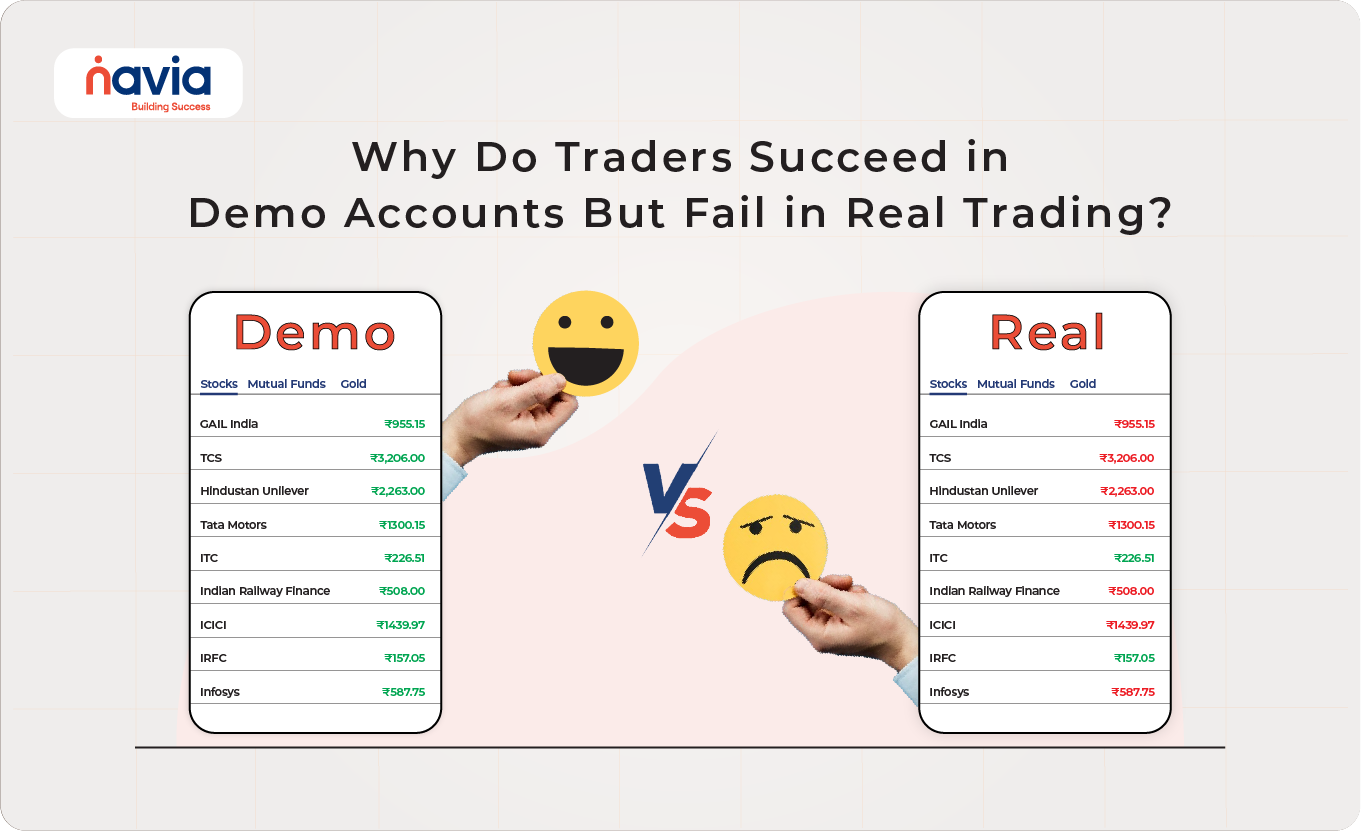
Why Do Traders Succeed in Demo Accounts But Fail in Real Trading?
- 1. Lack of Discipline
- Solution:
- 2. Overconfidence After Demo Success
- Solution:
- 3. Emotional Challenges
- Solution:
- 4. Lack of Experience with Real Market Conditions
- Solution:
- 5. Inconsistency in Execution
- Solution:
- 6. Unrealistic Expectations
- Solution:
- 7. Fear of Losses and the Freeze Effect
- Solution:
- Conclusion: Bridging the Gap Between Demo and Real Trading
- Frequently Asked Questions
Many traders often find themselves performing exceptionally well in demo accounts, only to struggle once they switch to live trading. This is a common experience, and there are several reasons why this happens. Understanding these reasons can help you make a smoother transition from demo trading to real trading, and avoid the pitfalls that many traders face.
Let’s take a look at the key reasons why traders succeed in demo accounts but often fail in real trading—and how you can avoid these mistakes.
💡 Quick Answer
Demo accounts remove the one variable that decides real trading: your own money. Without it there is no fear, no greed and no cost, so discipline is easy and results look good. This article gives seven reasons the gap opens up in live markets, and a practical fix for each one.
1. Lack of Discipline
When you’re trading in a demo account, there’s no real money at risk, so the pressure is minimal. This often makes traders more relaxed and disciplined in their approach. They follow their trading plan, manage risk appropriately, and stick to their strategy because there’s nothing to lose.
However, in real trading, things change dramatically. The moment you put your own money on the line, emotions like fear and greed can take over. Suddenly, sticking to a plan or following risk management rules becomes more challenging.
Solution:
- Stick to Your Plan: No matter the emotions, trust your strategy. If it works in the demo, it can work in the real world—just stay disciplined.
- Practice Risk Management: Always stick to the risk levels you practiced in the demo. Don’t let the fear of losing money make you take uncalculated risks.
2. Overconfidence After Demo Success
Success in a demo account can sometimes give traders a false sense of security. Since they’re trading with virtual money, the stakes are low, and traders may become overconfident in their skills. This overconfidence can lead to reckless decision-making when they move to real accounts.
In a demo account, there are no real consequences. But in real trading, overconfidence can result in significant losses.
Solution:
- Stay Humble: Understand that demo trading is a learning tool, not a measure of your real-world trading ability.
- Start Small: When transitioning to live trading, start with small positions and gradually scale up as you gain confidence in your strategy.
3. Emotional Challenges
In demo trading, emotions like fear and greed are usually not factors. After all, it’s not real money on the line. However, in live trading, emotions can easily cloud your judgment. The fear of losing your hard-earned money or the greed of wanting more can lead to impulsive decisions, which can sabotage your strategy.
Solution:
- Control Emotions: Practice emotional discipline. Remember that a calm, rational mindset is critical to successful trading.
- Take Breaks: If you feel overwhelmed, step away from the market to clear your mind. It’s better to miss a trade than to make a poor decision.
4. Lack of Experience with Real Market Conditions
Such accounts allow traders to practice in simulated environments, but these environments may not always reflect real-world conditions. Real trading comes with unexpected market shifts, slippage (when you can’t buy or sell at the exact price you want), and sudden volatility. Additionally, demo accounts may not simulate the psychological stress of losing real money, which can affect decision-making.
Solution:
- Get Real-World Experience: Start small in live trading to gradually get used to real-world market conditions.
- Stay Informed: Keep an eye on market news and trends that might affect your trades. Being well-prepared can help you navigate unpredictable situations.
5. Inconsistency in Execution
Consistency is key to trading success, but it’s often easier to maintain consistency in a demo account. In live trading, the pressure to perform can cause traders to deviate from their strategy, leading to inconsistent results. What worked well in a demo setting might get abandoned in real trading due to the emotional pressures of potential losses or market uncertainty.
Solution:
- Keep a Trading Journal: Document every trade you make, both in demo and live accounts. This will help you spot inconsistencies and improve your decision-making process.
- Stick to Your Strategy: Remind yourself why you created your strategy in the first place. Consistent execution is the backbone of profitable trading.
6. Unrealistic Expectations
Demo accounts often make it easy to imagine that trading is more straightforward than it really is. For one, demo accounts don’t include trading costs like spreads, commissions, or slippage, which can significantly affect your profitability in live trading. Additionally, demo trading does not simulate the psychological impact of real financial loss.
When traders transition to live accounts, they may find themselves surprised by the costs and risks that weren’t present in the demo environment.
Solution:
- Set Realistic Expectations: Understand that real trading is not a shortcut to riches. It requires patience, discipline, and the ability to handle both wins and losses.
- Factor in Trading Costs: Before making trades, calculate the actual costs involved, including commissions and spreads, to have a realistic view of potential profits.
7. Fear of Losses and the “Freeze” Effect
When it’s virtual money, traders tend to take calculated risks without hesitation. But in real trading, the fear of losing actual money can cause traders to hesitate or freeze in decision-making moments. Instead of executing a trade based on analysis, they may second-guess themselves and miss out on opportunities.
Solution:
- Embrace Risk: Understand that losses are part of trading. Rather than fearing them, learn to manage them by setting stop losses and only risking a small percentage of your capital per trade.
- Focus on the Long Term: Don’t obsess over each individual trade. Focus on long-term results and improvement.

Conclusion: Bridging the Gap Between Demo and Real Trading
The transition from demo trading to real trading is a crucial one, and it’s where many traders stumble. The psychological shift from trading with virtual money to trading with real money can’t be underestimated. Real trading introduces factors like emotion, cost, and market volatility that simply can’t be replicated in a demo account.
To succeed, traders need to:
- Stay disciplined and follow their strategy.
- Manage emotions and avoid overconfidence.
- Gain real-world experience gradually, starting with small positions.
- Understand that trading is a marathon, not a sprint.
By recognizing these challenges and preparing for them, you can increase your chances of success in real-world trading. Demo trading is a great learning tool, but real success comes from applying those lessons with discipline and emotional control in live markets.
Key Takeaways
- Demo trading carries no real money, so the emotional pressure that breaks discipline in live markets is simply absent.
- Success on a demo account can create a false sense of security and lead to reckless decisions when real capital is at stake.
- Demo environments do not reproduce slippage, sudden volatility or the psychological stress of a real loss.
- Demo accounts usually exclude trading costs such as spreads, commissions and slippage, so they overstate profitability.
- The fear of losing real money can cause traders to hesitate or freeze and miss opportunities they would have taken on a demo.
- The article’s remedies are consistent: start small, keep a trading journal, stick to the plan, factor in costs and focus on long-term results rather than individual trades.
Did you find this article helpful?
Your feedback helps us write better content.
Frequently Asked Questions
Why do traders succeed in demo accounts but fail in real trading?
Because the demo removes real risk. With no money on the line the pressure is minimal, so traders follow their plan and manage risk properly. Once real money is at stake, emotions like fear and greed take over and sticking to the plan becomes much harder.
Does a demo account reflect real market conditions?
Not fully. The article notes that simulated environments may not reflect real-world conditions such as unexpected market shifts, slippage, and sudden volatility, and they do not simulate the psychological stress of losing real money.
Why do demo results overstate profitability?
Demo accounts generally do not include trading costs such as spreads, commissions or slippage, all of which affect profitability in live trading. The article advises calculating the actual costs involved before making trades.
How should you move from a demo account to live trading?
Start small. The article recommends opening small positions and scaling up gradually as you gain confidence in your strategy, so you get used to real market conditions without risking too much.
What is the freeze effect in trading?
It is hesitation caused by the fear of losing real money. Instead of executing a trade based on their analysis, traders second-guess themselves and miss opportunities. The article suggests accepting that losses are part of trading and managing them with stop losses and small position sizes.
How do you stay consistent when trading live?
Keep a trading journal documenting every trade in both demo and live accounts so you can spot inconsistencies, and remind yourself why you built the strategy in the first place. The article calls consistent execution the backbone of profitable trading.
DISCLAIMER: Investments in the securities market are subject to market risks, read all the related documents carefully before investing. The securities quoted are exemplary and are not recommendatory. Brokerage will not exceed the SEBI prescribed limit. Full disclaimer: https://bit.ly/naviadisclaimer