

Understanding SEBI’s New Rules for Index Derivatives: What’s Changing for Traders?

- Key Changes in SEBI’s Derivatives Regulations
- 1. Increase in Contract Size
- 2. Revised Lot Sizes
- 3. Limiting Weekly Expiry Contracts
- 4. Increased Tail Risk Coverage on Expiry Day
- 5. Upfront Collection of Options Premium
- 6. Intraday Monitoring of Position Limits
- Summary of Key Changes
- Impact on Traders and Examples
- 1. Reduced Leverage for Option Buyers
- 2. Higher Margins on Expiry Days
- 3. Adjusted Contract Sizes
- 4. Reduced Speculative Trading on Expiry
- How to Adapt to These Changes
- Conclusion
- Frequently Asked Questions
We had on 28th August 2024 published a Blog titled “SEBI’s Consultation Paper on Index Derivatives Framework” which talked about the proposed measures SEBI is considering to restrict retail trading in Options
On October 1, 2024, SEBI released a circular that changes a few things for index derivatives. Here’s a breakdown of all the changes and their impact. Starting November 20, 2024, SEBI will introduce several important changes for derivative traders in an effort to increase investor protection and improve market stability. If you’re a trader dealing with index derivatives like Nifty, Sensex, BankNifty, FinNifty, Bankex, MidcpNifty, NiftyNXT50 these changes will directly impact how you trade options and futures. In this blog, we’ll explain these updates in simple terms, use examples, and provide a summary in tabular form for easy understanding.
The rules described in this article were announced by SEBI with effect from the dates stated. Please check the current framework on sebi.gov.in before trading.
Quick Answer: SEBI’s circular of 1 October 2024 introduced six measures for equity index derivatives. Contract value rises to ₹15–20 lakh, weekly expiry is limited to one index per exchange, an extra 2% margin applies to short options on expiry day, option premium must be paid upfront, and position limits are monitored intraday.
Key Changes in SEBI’s Derivatives Regulations
Based on SEBI’s recent circular, the upcoming changes focus on margin requirements, contract sizes, expiry day trading, and more. Here’s what will change:
1. Increase in Contract Size
The contract value for Index F&O contracts will increase from the current range of Rs. 5 lakhs to Rs. 10 lakhs to a new range of Rs. 15 lakhs to Rs. 20 lakhs. To align with this change, the NSE and BSE will revise the lot sizes for all new index F&O contracts introduced on the effective date 21/11/24.
2. Revised Lot Sizes
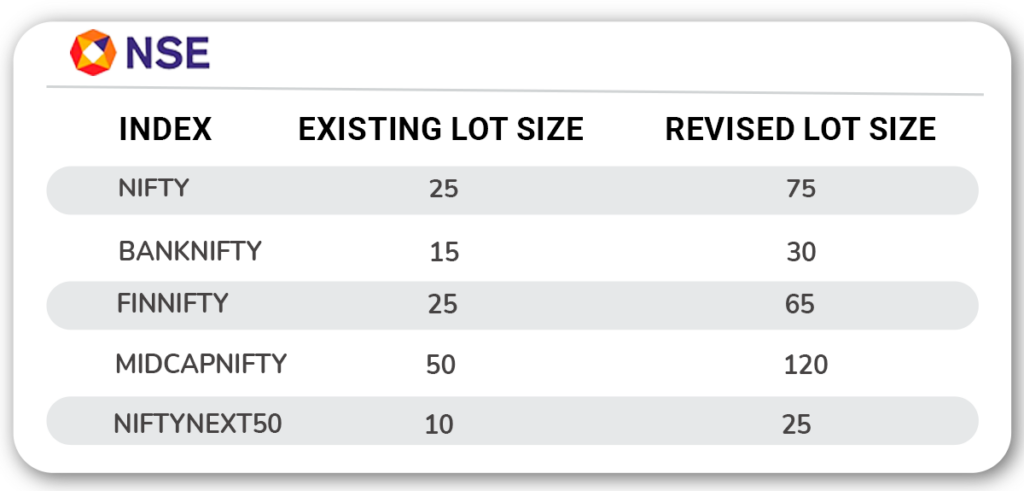
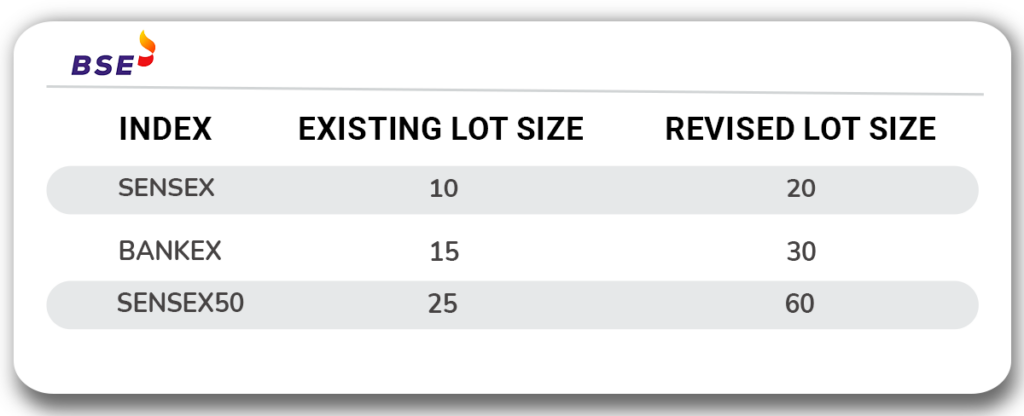
The National Stock Exchange (NSE) and the Bombay Stock Exchange (BSE) will revise the lot sizes for all new index F&O contracts as in below from February 2025 contract expiry for Monthly contract and from January 2025 1st week for Weekly contracts.
NSE Indices:
BSE Indices:
3. Limiting Weekly Expiry Contracts
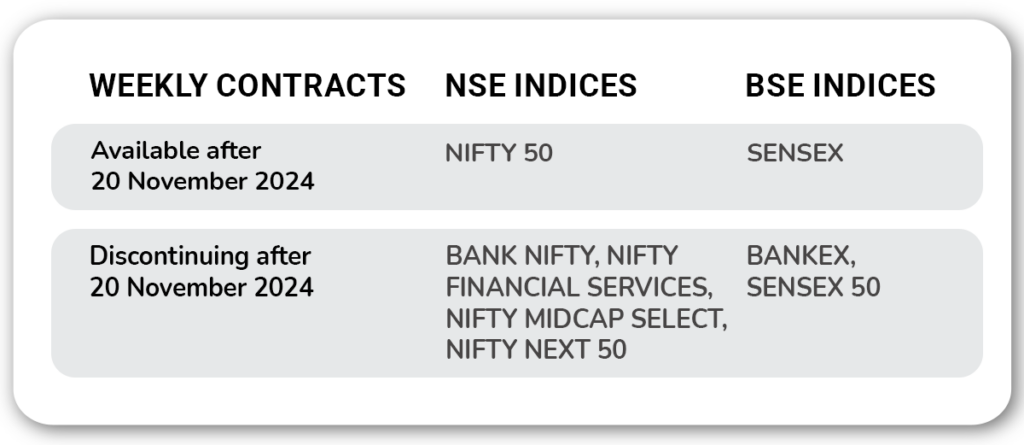
As per the new rules, SEBI will restrict weekly expiry contracts to one benchmark index per exchange. This aims to reduce speculative trading and volatility on expiry days.
| Monthly Expiry Schedule for Index Options and Futures | ||||
| Monday | Tuesday | Wednesday | Thursday | Friday |
| SENSEX50, BANKEX | Nifty50, FINNIFTY, BANKNIFTY,MIDCAPNIFTY, NIFTYNEXT50 | |||
| Individual Securities | ||||
| Weekly Expiry Schedule for Index Options | ||||
| Monday | Tuesday | Wednesday | Thursday | Friday |
| Sensex | Nifty50 | |||
4. Increased Tail Risk Coverage on Expiry Day
To cover the risk of volatile price movements on expiry day, SEBI will require traders holding short positions to maintain an additional 2% Extreme Loss Margin (ELM) on expiry day. This new rule will be effective from November 20, 2024.
Example Calculation:
For a short position in a Nifty 25,000 call option:
- Strike Price: 25,000
- Lot Size: 25
2% Margin: Strike Price × Lot Size × 2% (25,000 * 25 * 2%) = 12,500
If the margin requirement for this position is Rs. 1 lakh, an additional margin of Rs. 12,500 will be required on the expiry day.
5. Upfront Collection of Options Premium
From February 1, 2025, traders will need to pay the full options premium upfront for buying options. Previously, traders could leverage smaller upfront margins to take larger positions, especially intraday. Now, traders must pay the entire premium at the time of the trade, reducing the excessive leverage some traders used.
6. Intraday Monitoring of Position Limits
From April 1, 2025, exchanges will begin to monitor position limits intraday rather than just at the end of the day. This means your positions will be checked at least four times daily to ensure they do not exceed permissible limits.
Example: If the limit for Nifty options is 1,000 contracts, the exchange will check your positions multiple times during the day. If your positions exceed this limit, you’ll need to bring them back within the limit or face penalties
Summary of Key Changes
| Measure | Effective Date | Impact on Traders |
|---|---|---|
| Revised Contract Size for Index Derivatives | November 20, 2024 | Contract value increased to at least ₹15 lakhs from February 2025 expiry onwards for monthly and from January 2025 1st week onwards for weekly contracts |
| Limiting Weekly Expiry Contracts | November 20, 2024 | Only 1 Index for weekly expiry from NSE and BSE. NIFTY weekly will expiry every Thursday and Sensex weekly will expire every Friday |
| Increased Tail Risk Coverage on Expiry Day | November 20, 2024 | Additional 2% margin required for short options on expiry day. |
| Upfront Collection of Options Premium | February 1, 2025 | Full premium required at the time of trade. |
| Removal of Calendar Spread on Expiry Day | February 1, 2025 | No margin benefit for spreads involving expiring contracts. |
| Intraday Monitoring of Position Limits | April 1, 2025 | Position limits will be monitored throughout the trading day. |
Impact on Traders and Examples
1. Reduced Leverage for Option Buyers
With the requirement to pay full premium upfront, traders will need more capital to take positions. This move limits excessive leverage and ensures better risk management.
2. Higher Margins on Expiry Days
On expiry days, traders will need to maintain higher margins as the calendar spread benefit is removed and additional tail risk coverage is introduced. This will require careful capital management to avoid margin calls.
3. Adjusted Contract Sizes
With Nifty trading at 25,000 and the contract size increasing to ₹15 lakhs, the number of contracts in each lot will increase to 60 (from lower levels), making it more capital-intensive for small traders to trade index derivatives.
4. Reduced Speculative Trading on Expiry
By offering only one weekly expiry index per exchange, SEBI aims to reduce speculation. With BSE choosing the Sensex (82,000) for weekly expiries, traders will need to adjust their strategies and focus on one index at a time.
How to Adapt to These Changes
To stay ahead of these new rules, traders should:
- Plan ahead for expiry days, ensuring sufficient capital to cover increased margins.
- Monitor position limits throughout the trading day to avoid penalties.
- Adjust to the new contract sizes by trading more strategically or reducing position sizes.
- Focus on Nifty weekly options on NSE and Sensex weekly options on BSE for expiration trades.
Conclusion
SEBI’s new regulations aim to make the index derivatives market safer and more stable by addressing excessive leverage, tightening margins, and reducing speculative volatility on expiry days. Traders will need to be more strategic in managing their positions, ensuring they have enough capital to meet the new margin requirements, and carefully selecting the right contracts.

With the changes coming into effect from November 20, 2024, now is the time to start adjusting your strategies and preparing for the new trading landscape.
By staying informed and adapting to these new rules, traders can continue to participate effectively in the derivatives market while navigating the tighter regulations.
Key Takeaways
- The measures come from a SEBI circular dated 1 October 2024, and the article states effective dates of 20 November 2024, 1 February 2025 and 1 April 2025 for different items.
- Index F&O contract value moves from a range of ₹5–10 lakh to a range of ₹15–20 lakh, with NSE and BSE revising lot sizes from the February 2025 monthly expiry and the first week of January 2025 for weekly contracts.
- Weekly expiry contracts are limited to one benchmark index per exchange — Nifty 50 on NSE and Sensex on BSE.
- Short positions on expiry day attract an additional 2% Extreme Loss Margin; on a Nifty 25,000 call with a lot size of 25 that is 25,000 × 25 × 2% = ₹12,500 of extra margin.
- Full option premium must be collected upfront from 1 February 2025, and exchanges monitor position limits at least four times a day from 1 April 2025.
- This article was written before those effective dates and describes the measures as forthcoming; check the SEBI circular for the position in force today.
Did you find this article helpful?
Your feedback helps us write better content.

Frequently Asked Questions
What did SEBI change for index derivatives in its October 2024 circular?
The circular, released on 1 October 2024, covers six measures: an increase in contract size, revised lot sizes, limiting weekly expiry contracts to one index per exchange, an additional 2% tail risk margin on expiry day, upfront collection of option premium, and intraday monitoring of position limits.
What is the new contract size for index derivatives?
The contract value for index F&O contracts increases from the earlier range of ₹5 lakhs to ₹10 lakhs to a new range of ₹15 lakhs to ₹20 lakhs. NSE and BSE revise lot sizes for all new index F&O contracts from the February 2025 expiry for monthly contracts and the first week of January 2025 for weekly contracts.
Which indices still have weekly expiry?
Weekly expiry contracts are restricted to one benchmark index per exchange. The article states that Nifty weekly contracts expire every Thursday on NSE and Sensex weekly contracts expire every Friday on BSE.
How much extra margin applies to short options on expiry day?
An additional 2% Extreme Loss Margin is required on expiry day for traders holding short positions. The article’s example uses a short Nifty 25,000 call with a lot size of 25: 25,000 × 25 × 2% = ₹12,500, so a position with a ₹1 lakh margin requirement needs ₹12,500 more on expiry day.
What does upfront collection of option premium mean for buyers?
From 1 February 2025 traders must pay the entire option premium at the time of the trade. Previously smaller upfront margins could be used to take larger positions, especially intraday, so the change reduces the leverage available to option buyers and means more capital is needed per position.
Are these index derivatives rules in force now?
The article was published before the dates it cites and describes the measures as forthcoming. Its own stated effective dates are 20 November 2024, 1 February 2025 and 1 April 2025, all of which have passed. Refer to the linked SEBI circular for the position in force today.
DISCLAIMER: Investments in the securities market are subject to market risks, read all the related documents carefully before investing. The securities quoted are exemplary and are not recommendatory. Brokerage will not exceed the SEBI prescribed limit. Full disclaimer: https://bit.ly/naviadisclaimer