

Sahi vs Navia: Which Trading App Wins in 2026?
This comparison is based on information available on the official websites and published tariff schedules of Sahi and Navia Markets Limited as on August 22, 2026. Charges, features and offers are subject to change without notice. Readers should independently verify the latest information directly from each broker before making any decision.
💡 Quick Answer
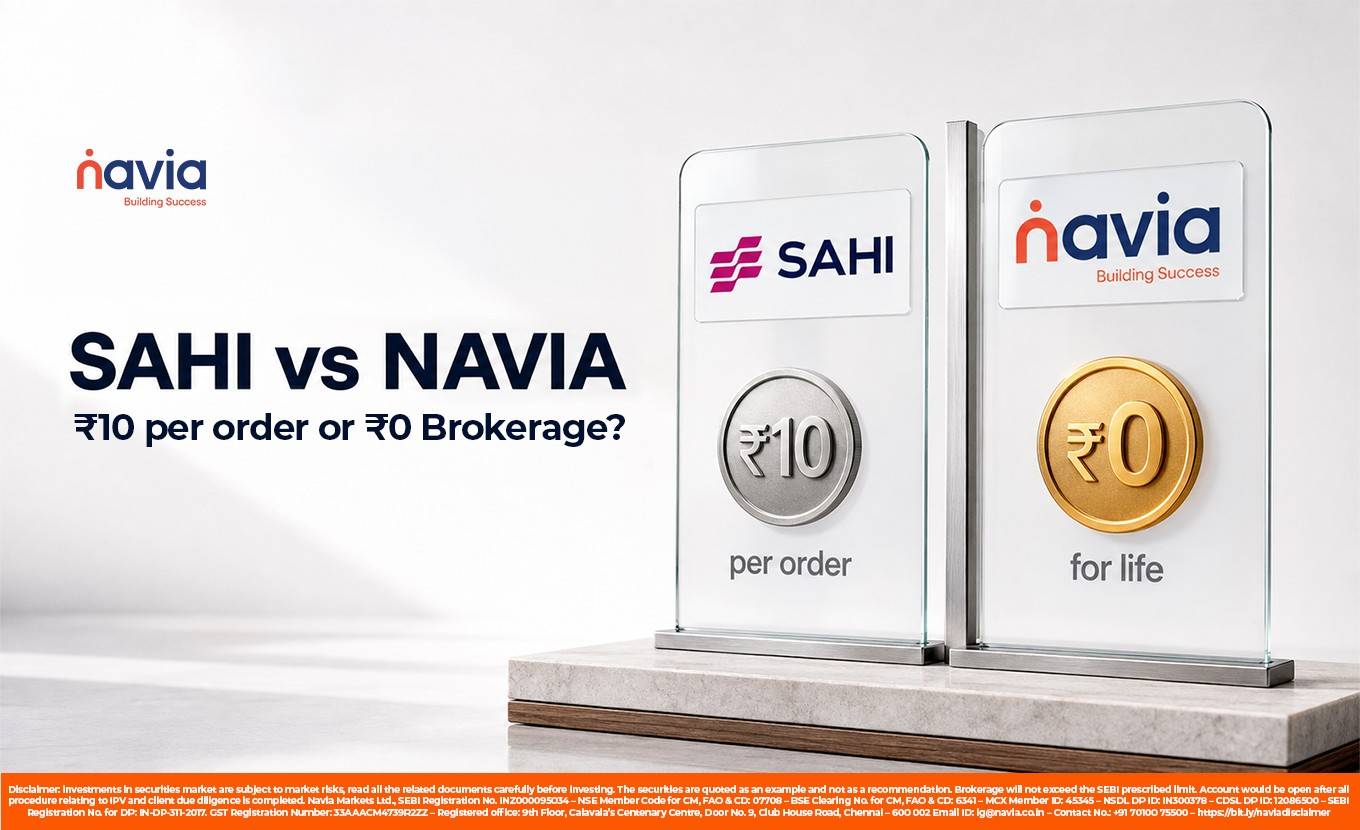
Sahi and Navia are both SEBI-registered brokers with free account opening and no AMC, built for different priorities. Sahi charges a flat ₹10 per executed order, free for the first 30 days, and is designed for active traders and option scalpers. Navia charges ₹0 brokerage for life across every segment, with a more than 40-year track record.
Both Sahi and Navia are modern, low-cost brokers, but the right one for you depends on what and how you trade. This comparison lays out the facts on brokerage, charges, segments, trading tools, safety and the kind of trader each is built for, so you can decide with clear information.
Sahi and Navia at a glance
Information compiled from official websites as on August 22, 2026. Charges and features are subject to change.
| Factor | Sahi | Navia |
|---|---|---|
| Brokerage | Flat ₹10 per order; free for 30 days | ₹0 for life, all segments |
| Account opening | Free | Free |
| AMC | ₹0 | ₹0 |
| Segments | Equity, F&O, ETFs, IPOs | Equity, F&O, commodities, currency, mutual funds, ETFs, IPOs |
| Depository | CDSL | NSDL and CDSL |
| Established | 2023 | 1983 |
| Built for | Active traders and option scalpers | Traders and investors, all segments |
Source: Official websites of Sahi and Navia Markets Ltd. as on August 22, 2026. Verify current information before making any decision.
Brokerage and charges
This is the clearest difference. Sahi charges a flat ₹10 per executed order across segments, with the first 30 days free, so a single futures trade bought and sold costs ₹20 in brokerage. Navia charges ₹0 brokerage for life, so the same trade costs nothing in brokerage. On a ₹1,00,000 equity delivery trade bought and sold, Sahi’s total charges come to about ₹267, of which ₹20 is brokerage. On Navia the brokerage is ₹0, so you pay only the statutory charges and a small DP charge, saving that ₹20. The statutory charges — STT, exchange transaction charges, GST, the SEBI turnover fee and stamp duty — are identical on both because they are set by regulators. Over many trades, the difference between zero brokerage and low brokerage adds up. You can see every charge that applies on Navia’s pricing page.
Note: The ₹267 total charges figure above is illustrative only, based on published tariff schedules as on August 22, 2026. Actual charges vary by trade value, applicable statutory levies and segment. Readers should verify current charges using a brokerage calculator before making any decision.
Segments and account types
Navia covers more ground. You can trade equity, F&O, commodities and currency, and invest in direct mutual funds, ETFs and IPOs, all from one account, and Navia also offers NRI accounts. Sahi focuses on equity, F&O, ETFs and IPOs, and does not currently offer mutual funds, currency or commodities. If you want everything in one place, Navia is broader. If you only trade equity and F&O, Sahi covers what you need.
Trading tools and platform
Both are strong on tools, with different emphases. Sahi is built around speed, with an in-house charting engine, trade from charts, a single-screen scalper mode, AI-powered scanners and an options strategy builder, all without a separate charge. Navia brings its Insta Options suite, with a live option chain showing open interest and implied volatility, a strategy builder with payoff charts and one-tap square off, alongside Insta Funds for instant withdrawals, basket orders, margin trading and a guest mode to try the app first. For pure scalping speed Sahi is purpose-built, while Navia pairs strong options tools with wider segment access.
Safety and track record
Both brokers are registered with SEBI and are members of the NSE and BSE, so both meet the same regulatory bar. The difference is history. Navia has operated since 1983, giving it a more than 40-year track record, and it uses both NSDL and CDSL as depositories. Sahi launched in 2023, so it is new, modern and fast moving, but with a shorter track record, and it uses CDSL. Neither is unsafe. It comes down to whether you value a long record or a newer, trader-first platform.

Which should you choose?
Choose Sahi if you are an active intraday or F&O trader or an option scalper who wants a fast, chart-first platform with a flat ₹10 per order fee, and you do not need mutual funds, currency or commodities. Choose Navia if you want true ₹0 brokerage for life across every segment, including commodities, currency and mutual funds, a dual depository and a longer track record, whether you trade actively or invest for the long term.
A note on risk
Whichever platform you choose, the tools support your trading but do not remove its risk, especially in F&O. SEBI’s studies have found that most individual traders in the equity derivatives segment make net losses, so use sound risk management and trade only with money you can afford to lose.
Conclusion
Sahi and Navia are both capable, low-cost, SEBI-registered brokers, built for different traders. Sahi is a modern, chart-first platform tuned for active F&O trading and scalping at a flat ₹10 per order. Navia offers true ₹0 brokerage for life across the widest range of segments, backed by a 40-year track record. If paying no brokerage at all and trading across every segment matter most to you, you can open a free account on the Navia All-in-One App. Navia Markets is registered with SEBI (Reg. No. INZ000095034).
Key Takeaways
- Both are SEBI-registered brokers with free account opening and no AMC, and both are members of the NSE and BSE. The difference is what each one is built for.
- Sahi charges a flat ₹10 per executed order, free for the first 30 days. Navia charges ₹0 brokerage for life across every segment.
- The statutory charges — STT, exchange transaction charges, GST, the SEBI turnover fee and stamp duty — are identical on both, because regulators set them and no broker can waive them.
- Navia covers more segments: equity, F&O, commodities, currency, mutual funds, ETFs and IPOs, plus NRI accounts. Sahi covers equity, F&O, ETFs and IPOs.
- On tools, Sahi is purpose-built for scalping speed with in-house charts, a single-screen scalper mode, AI scanners and an options strategy builder, so it suits pure scalpers. Navia pairs its Insta Options suite with wider segment access.
- On track record, Navia has operated since 1983, a more than 40-year history, and uses both NSDL and CDSL. Sahi launched in 2023 and uses CDSL.
Did you find this article helpful?
Your feedback helps us write better content.

Frequently Asked Questions
Is Sahi or Navia cheaper?
On brokerage, Navia is cheaper: it charges ₹0 for life, while Sahi charges a flat ₹10 per executed order after a 30-day free period. On a ₹1,00,000 delivery trade, Sahi’s brokerage is about ₹20 and Navia’s is ₹0. The statutory charges are the same on both.
Is Sahi or Navia better for F&O trading?
Both offer strong F&O tools. Sahi is built for fast option scalping with a chart-first, single-screen design. Navia offers ₹0 brokerage on F&O for life plus its Insta Options suite. Sahi suits pure scalpers, while Navia suits those who also want zero brokerage and more segments.
Does Navia charge a flat fee like Sahi’s ₹10?
No. Navia charges ₹0 brokerage for life across all segments, with no per-order fee. Sahi charges a flat ₹10 per executed order after the first 30 days. Both charge the same statutory charges set by regulators.
Which broker offers more segments, Sahi or Navia?
Navia. It covers equity, F&O, commodities, currency, mutual funds, ETFs and IPOs, and offers NRI accounts. Sahi covers equity, F&O, ETFs and IPOs, and does not currently offer mutual funds, currency or commodities.
Are Sahi and Navia safe?
Both are registered with SEBI and are members of the NSE and BSE, so both meet the same regulatory standards. Navia has operated since 1983 and uses NSDL and CDSL, while Sahi launched in 2023 and uses CDSL.
Can I try Navia before opening an account?
Yes. Navia offers a guest mode, shown as Try Now, that lets you explore the platform before you open and fund an account.
The tools and features described above are intended to assist users with market analysis and order execution. They should not be construed as investment advice, trading recommendations, or an assurance of profits or returns.
This comparison is based on information available on the official websites and published tariff schedules of Sahi and Navia Markets Limited as on August 22, 2026. Brokerage plans, charges, products, features and offers may change from time to time without notice. Readers should independently verify the latest information directly from the respective brokers before making any financial decision. This article is provided solely for informational and educational purposes and does not constitute investment advice, a recommendation to open an account with any broker, or a solicitation of any kind. Investment in securities market are subject to market risks, read all the related documents carefully before investing. The securities quoted are exemplary and are not recommendatory. Brokerage will not exceed the SEBI prescribed limit. Nothing in this comparison is intended to, or should be construed as, discrediting any SEBI-registered intermediary or making an unfair comparison within the meaning of Rule 5.2 of the NSE Code of Advertisement (NSE Circular NSE/COMP/55482). All information is sourced from publicly available tariff schedules and official websites of the respective brokers as on the date of publication and is presented on a factual basis only. Full disclaimer: https://bit.ly/naviadisclaimer