

Mother’s Day Moment: What Really Matters in Investing

A Mother’s Day Lunch That Turned Unexpected
Mother’s Day in Pune was quiet but warm. At a long dining table, four generations of women had gathered in one house. No speeches, no decorations, just food, laughter, and small stories.
But the younger ones had planned a surprise. Instead of gifts, they placed envelopes in front of their mothers. Inside each was a printed sheet showing their investments from the past few years. Soon, the room filled with confusion.
One mother said, “This fund shows profit, but it doesn’t feel like much.” Another added, “This one shows less return, but I feel more comfortable holding it.” A third asked, “Which one should I understand better?” The room grew noisy.
At the corner sat Mrs. Deshpande, the eldest in the family, a retired mathematics teacher who had quietly managed her savings for decades. She watched everyone patiently, then tapped her spoon gently on the table.
“Let me show you something,” she said. The room fell silent.

The Curve That Tells the Real Story
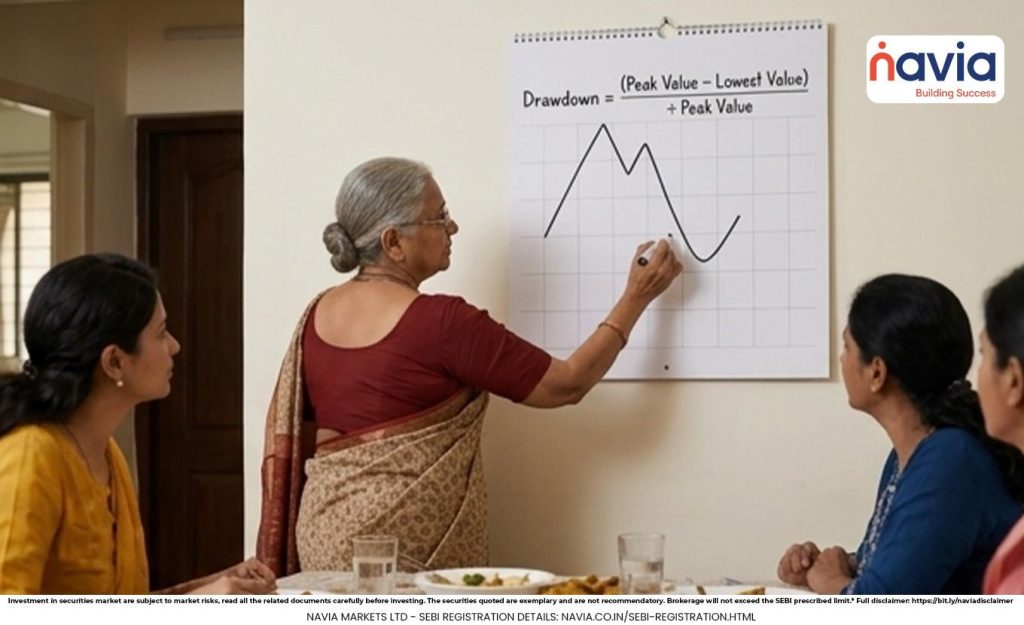
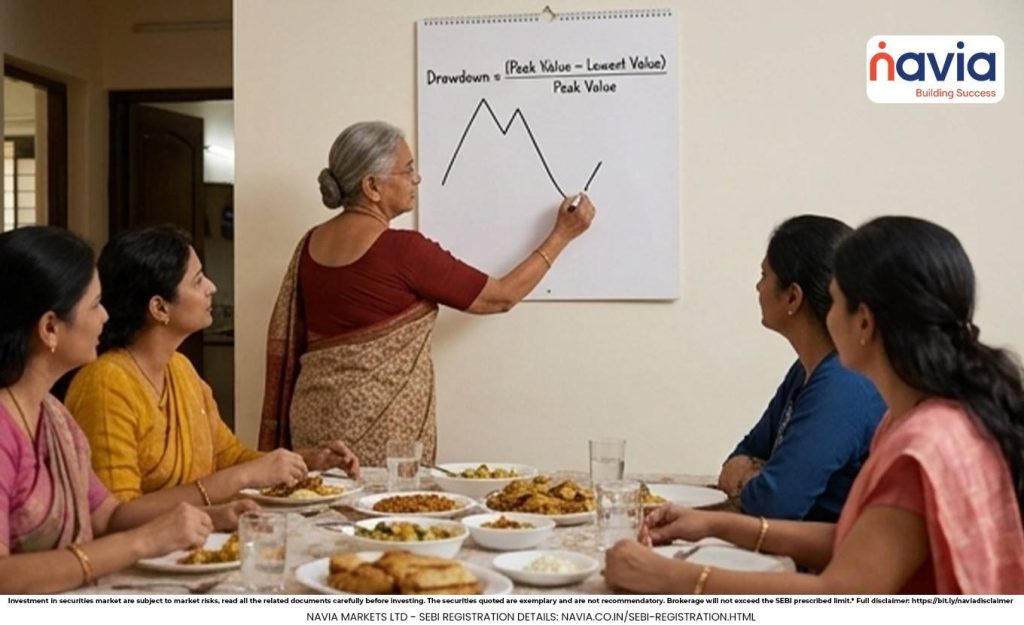
Instead of explaining directly, she stood up and walked to the wall where a calendar hung. She flipped it and used the blank back side to draw.
“This is called a Drawdown Curve,” she said. She drew a line going up, then suddenly dipping down.
“Returns alone don’t tell the full story. What also matters is how much your investment falls before it rises again.”
A younger woman asked, “So losses matter more than gains?”
Mrs. Deshpande smiled. “Losses test your patience. Gains test your discipline.”
She wrote slowly:
Drawdown = (Peak Value – Lowest Value) ÷ Peak Value
“This tells you how much your investment dropped from its highest point. I will WhatsApp the direct link to calculate: https://www.omnicalculator.com/finance/maximum-drawdown”
The Hidden Risk Most People Ignore
She continued, keeping her tone simple.
“Let’s say your investment grows from ₹1,00,000 to ₹1,50,000. Then it falls to ₹1,20,000.”
She looked at everyone. “Your profit still looks good. But your drawdown is ₹30,000 from the peak.”
She calculated. “Drawdown = (1,50,000 – 1,20,000) ÷ 1,50,000 = 20%”
The room became quiet. She added, “Now imagine another investment that grows slower but doesn’t fall sharply. Which one might you hold more comfortably?”
One mother said softly, “The one that doesn’t fall much.”
Mrs. Deshpande nodded.
“This is why many people track something called Maximum Drawdown. It shows the deepest fall an investment has seen.”
“Many people focus on high returns but overlook drawdowns. But deeper drawdowns can make people exit at uncomfortable times.”
A Different Meaning of Motherhood Care
The food had gone cold, but no one noticed.
One daughter said, “So the best investment is not the one with highest return?”
Mrs. Deshpande smiled. “It depends on what suits you. Often, it’s the one you can stay with.”
“Motherhood teaches the same thing. Stability matters more than speed.”
Another woman asked, “How do we track this properly?”
Mrs. Deshpande replied, “Keep your analysis simple. Look at returns and drawdowns together. Platforms like the Navia All In One App can help track things clearly.”
The room slowly filled with smiles again.
The envelopes were no longer confusing. They were meaningful.
Because on Mother’s Day, they did not just talk about money.
They understood something deeper. Care is not about how fast things grow. It is about how safely they move through ups and downs.
And in that moment, every mother at that table felt understood.
Do You Find This Interesting?
We’d Love to Hear from you

DISCLAIMER: This story is a fictional illustration created for educational purposes. Investment in securities market are subject to market risks, read all the related documents carefully before investing. The securities quoted are exemplary and are not recommendatory. Brokerage will not exceed the SEBI prescribed limit. Full disclaimer: https://bit.ly/naviadisclaimer