

Implied Volatility vs Realised Volatility: Understanding the Key Differences
- What is Realised Volatility?
- What is Implied Volatility?
- Comparison: Implied Volatility vs. Realised Volatility
- Realised vs Implied Volatility: Who Has the Edge?
- Conclusion
- Frequently Asked Questions
In stock market movement is the only constant, whether a stock climbs steadily or crashes overnight; traders use a specific metric to measure these fluctuations: that is volatility. For those trading futures and options, understanding the nuances of implied volatility vs realised volatility isn’t just a theoretical exercise. Its plays an important role in understanding option pricing and market expectations.
In this guide, you can explore the core differences between these two concepts and how they influence options pricing and trading decisions.
What is Realised Volatility?
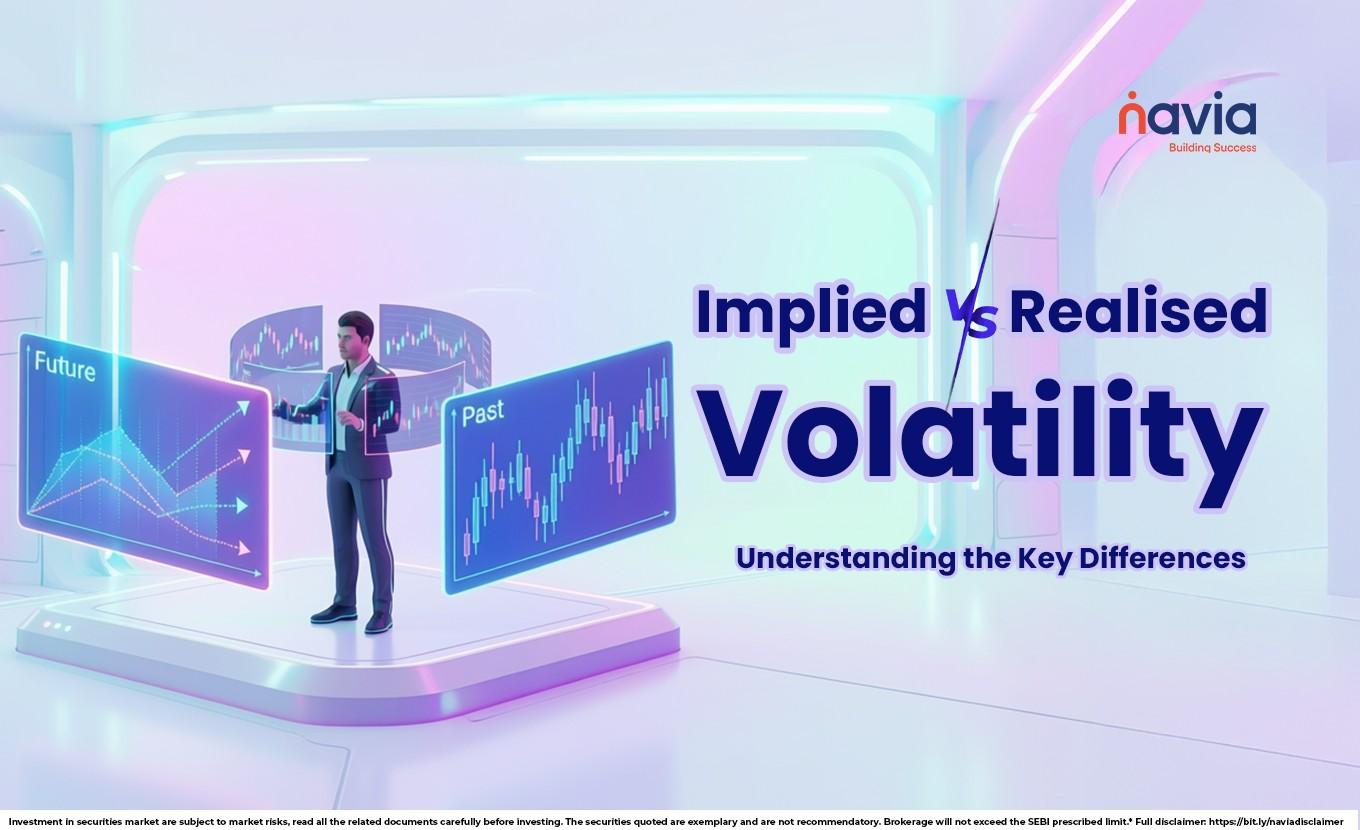
Realised Volatility, also known as Historical Volatility, measures the actual movement an asset has already experienced over a specific period. Every asset moves, some will move fast, and some will move slow. RV is a statistical measure derived from historical price movements.
Just see an example, if the Nifty 50 has swung violently over the last 30 days, its realised volatility will be high. Conversely, if the index has been trading in a narrow, stagnant range, the RV will be low.
The reason is it is computed directly from past prices; realised volatility is backward-looking. It represents past price movement based on historical data.
What is Implied Volatility?
If realised volatility is the rearview mirror, then implied volatility (IV) reflects market expectations of future price movements. It means, is the market’s expectation of how much an underlying asset will move in the future. Unlike RV, IV is derived from the current market price of an option.
IV reflects market expectations of potential price fluctuations, because it’s a forward-looking metric. If the investors expect a major event like, earnings report, budget announcement or geopolitical crisis, they bid up the price to protect themselves.
But how can we calculate it? Remember that you won’t find IV by looking at the stock price chart; it involved using an option pricing model such as the black-Scholes model. By plugging in the current option price, the stock price, time to expiry and interest rates, the model solves the volatility level required to justify that option’s price.

Comparison: Implied Volatility vs. Realised Volatility
| Feature | Implied Volatility (IV) | Realised Volatility (RV) |
|---|---|---|
| Perspective | Forward-looking: It reflects market expectations of potential future movements. | Backward-looking: It measures past movement. |
| Source of Data | Derived from current Option Prices. | Derived from Historical Stock Prices. |
| Nature | Subjective; reflects market sentiment and fear. | Objective; based on actual price fluctuations. |
| Calculation | Uses models like Black-Scholes. | Uses statistical Standard Deviation. |
| Primary Driver | Driven by demand/supply of options and events. | Driven by actual buying/selling of the stock. |
| Use Case | Used to price options and evaluate option pricing relative to historical volatility. | Used to assess historical risk and backtest models. |
| Predictive Power | Indicates market-implied expectations of price variability. | Reflects the actual volatility that was achieved. |
Realised vs Implied Volatility: Who Has the Edge?
After understanding the difference between realised vs implied volatility, it can help market participants understand different volatility conditions.
When IV > RV (The Seller’s Edge)
When implied volatility is higher than the actual movement, the market is overestimating future risk.
Strategy: It is ideal for option writers (sellers), they can deploy strategies like Short Straddles, Iron Condors or Covered Calls to collect it.
When RV > IV (The Buyer’s Edge)
When realised volatility exceeds implied volatility, the market has underpriced the move, so the options were relatively inexpensive but the stock moved explosively.
Strategy: It favors option buyers, so the traders can use Long Straddles, Strangles or Directional Buying to benefit from significant price movement relative to option pricing.
Conclusion
There are many beginners focus primarily on price direction when trading options, that focus only on the Delta (the stock price move). However, many market participants view options as instruments influenced by volatility.
The battle of implied volatility vs realised volatility is the heart of the options market. So, by identifying when the market is overpaying for fear (high IV) or underestimating a coming storm (low IV), you can focus on analysing volatility alongside price direction.
Do You Find This Interesting?
We’d Love to Hear from you-

Frequently Asked Questions
Is historical volatility the same as implied volatility?
While realised volatility serves as a rearview mirror by documenting the actual price swings an asset has already undergone, implied volatility acts as a forecasting tool, deriving market expectations for future turbulence directly from the premiums of options.
What does 20% implied volatility mean?
In the world of derivatives, implied volatility (IV) serves as a forecast of a stock’s potential movement over a 12-month period, presented as a percentage. For instance, an IV of 20% signals a market consensus that the underlying asset could fluctuate within a 20% range-either upward or downward-by year-end. By applying the principles of standard deviation, traders can mathematically “de-annualize” this figure to estimate expected price swings for shorter timeframes, such as a single day or a week.
What is the difference between IV and HV?
When an asset has experienced an erratic price action lately, it is reflected in a spiked Historical Volatility (HV) reading. Conversely, a high Implied Volatility (IV) indicates that the market is currently bracing for a major shock, fueled by anxiety or the expectation of a high-impact catalyst. While RV helps you quantify the risk that has already materialized, IV allows you to gauge how much “fear” is currently being priced into option premiums.
Is higher implied volatility better?
Elevated Implied Volatility (IV) acts as a catalyst for enhanced higher option premium. Because the market perceives greater future risk, buyers are willing to pay a “fear tax,” which allows option writers to receive relatively higher option premiums.
Conversely, a depressed IV environment leads to lower option premiums. As market uncertainty fades, the demand for protection drops, causing option prices to shrivel and reducing the available yield for income-focused strategies.
How do I calculate implied volatility?
To determine implied volatility, one must reverse-engineer the Black-Scholes model by inputting the current market premium to isolate the specific volatility variable. While this “back-solving” method is standard, the financial world utilizes several distinct methodologies and algorithms to derive these forward-looking estimates.
DISCLAIMER: Investment in securities market are subject to market risks, read all the related documents carefully before investing. The securities quoted are exemplary and are not recommendatory. Full disclaimer: https://bit.ly/naviadisclaimer.