

Mastering the Invisible Force: A Guide to Implied Volatility in Options Trading
- What is Implied Volatility?
- Relationship Between Volatility and Implied Volatility
- How Implied Volatility Impacts Option Premiums?
- What Drives IV Movements?
- Conclusion
- Frequently Asked Questions
In the high-stakes arena of the derivatives market, price movement is only half of the story. Global markets react to shifting economic policies and corporate earnings; traders are increasingly looking beyond simple charts to understand a critical metric that is implied volatility.
If you have ever seen an option price drop even when the stock moved in your favor, there you encountered the silent impact of the volatility. So, understanding what is implied volatility is important for traders seeking a more systematic understanding of option pricing.
What is Implied Volatility?
In simple words, implied volatility or IV represents the market’s expectation of the future price movement of an underlying asset. It means that it tells you the magnitude of the expected move but not the direction. Let’s see the difference between high and low IV;
🔸 High IV: The market expects significant price swings
🔸 Low IV: The market expects the price to remain relatively stable
Unlike historical volatility, that looks at past data, implied volatility options traders use this for forward-looking. It is derived from the current market price of the option and reflects the uncertainty or risk premium baked into the contract.
Relationship Between Volatility and Implied Volatility
It is important to distinguish between volatility and implied volatility. Here you can find a simple definition of both.
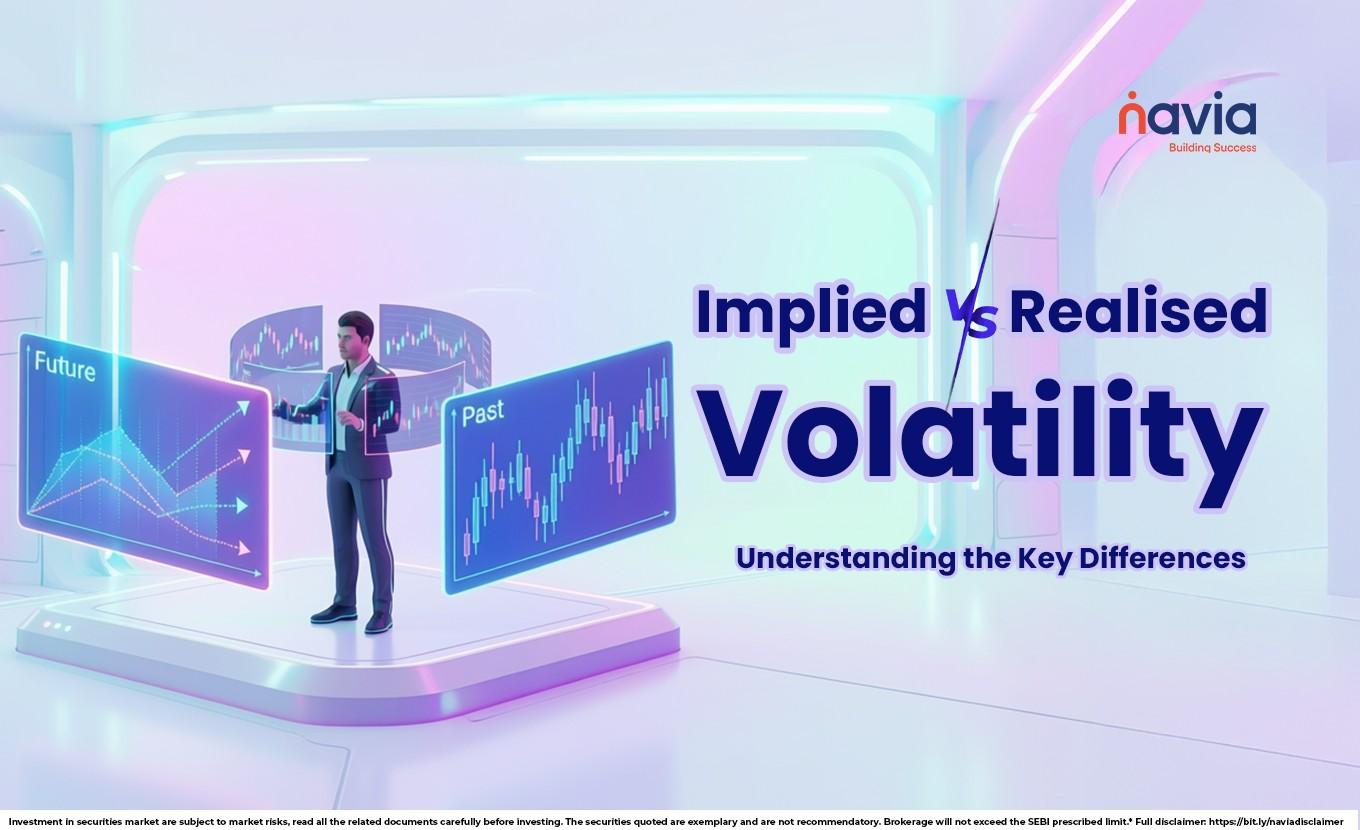
🟠 Historical Volatility (HV): It measures how much the stock moved in the past; it is like a backward-looking metric.
🟠 Implied Volatility (IV): It reflects what the market implies the stock will do in the future.
Most professional traders constantly monitor implied volatility chart to compare IV against HV.
✅ If IV > HV, option premiums may be elevated relative to past volatility
✅ If IV < HV, options are relatively cheap
By observing these patterns, market participants may evaluate strategies differently depending on volatility expectations.
How Implied Volatility Impacts Option Premiums?
We know that the premium of an option is influenced by several factors, but IV is one of the most powerful. When implied volatility in options increases, the price of both calls and puts will rise. Because higher uncertainty makes the insurance provided by the option more valuable.
What will be the trader’s preference (educational purpose);
🔸 Option buyers prefer a low IV at entry and IV expansion during the trade. It may evaluate strategies differently depending on volatility expectations.
🔸 Option sellers prefer a high IV at entry followed by an IV crush. These high IV will allow them to receive higher premiums when volatility is elevated.
What Drives IV Movements?
Implied Volatility (IV) is essentially a “fear and uncertainty gauge” for a specific stock. Because IV is derived from option prices, anything that makes traders willing to pay more for “insurance” (options) will drive IV upward. Some of the factors that drives IV movements are given below;
| Demand and Supply | The direct driver of IV is the buying and selling pressure on options. When institutional investors rush to buy puts to protect their portfolios or calls to speculate the option prices rise. |
| Upcoming Major Events | IV always rises leading up to events where the outcome is uncertain. So, the traders pay a premium for protection against a potential gap in the stock price. Common events include earnings announcements, central bank meetings, elections, and budgets, etc. |
| Market Sentiment and Fear | IV has an inverse relationship with the market’s direction that is called Volatility Skew. When the market crashes or becomes fearful, IV typically spikes because of the demand of put options. |
| Time to Expiration | An option nears its expiration date; the Time Value decreases. However, if an event is scheduled very close to expiration, the IV can become extremely sensitive. A small change in expected movement that causes a massive percentage of swings in IV. |
| Historical Volatility (HV) | While IV is forward-looking, it is often influenced by how the stock has behaved recently. If a stock has been moving in 5% daily swings (High Historical Volatility), traders will naturally expect that behavior to continue and will price future options with a higher IV. |
Conclusion
Implied volatility is the engine that drives option pricing; most traders focus solely on the direction of the stock, some who master implied volatility in options. By respecting the cycles of volatility expansion and contraction, you can move toward a more disciplined analytical approach..
If you are using an implied volatility chart to spot overextended premiums or calculating IV rank to find the perfect entry, remember, in the options market volatility is a key variable that significantly influences option pricing.
Do You Find This Interesting?
We’d Love to Hear from you-

Frequently Asked Questions
Is IV good or bad for options?
Elevated Implied Volatility (IV) directly inflates option premiums, which is a critical factor for income-focused investors. Since strategies like Covered Calls rely on harvesting these premiums as profit, high volatility periods may result in higher option premiums, which also carry higher risk.
How to use implied volatility in option trading?
In options trading, implied volatility (IV) is presented as an annualized percentage that reflects the market’s forecast for price fluctuations. For instance, a 20% IV suggests an expected price swing of 20% (either up or down) over the course of the year. To make this data more practical for short-term trading, investors use standard deviation formulas to break this annual figure down into expected daily or weekly price moves.
How do you profit from IV?
Seasoned market participants often write options or credit spreads when Implied Volatility (IV) peaks, typically just before major “binary” events like earnings or policy shifts. By doing so, some strategies are structured around anticipated volatility contraction, although outcomes are uncertain.
Should I sell options when IV is high?
Implied Volatility (IV) serves as a strategic compass for trade selection. During high IV cycles, Some market participants evaluate different strategy types during high volatility environments, such as covered calls, cash-secured puts, or credit spreads, to capitalize on inflated option prices.
Is 20% IV high?
A 20% volatility level is typically categorized as moderate to high. It suggests a market environment characterized by heightened uncertainty and the potential for meaningful price fluctuations, roughly ±20% annually, yet it remains within the bounds of standard financial behavior rather than signaling a state of total panic.
DISCLAIMER: Investments in the securities market are subject to market risks, read all the related documents carefully before investing. The securities quoted are exemplary and are not recommendatory. Brokerage will not exceed the SEBI prescribed limit.