

IDCW Vs Growth: What is the Difference?
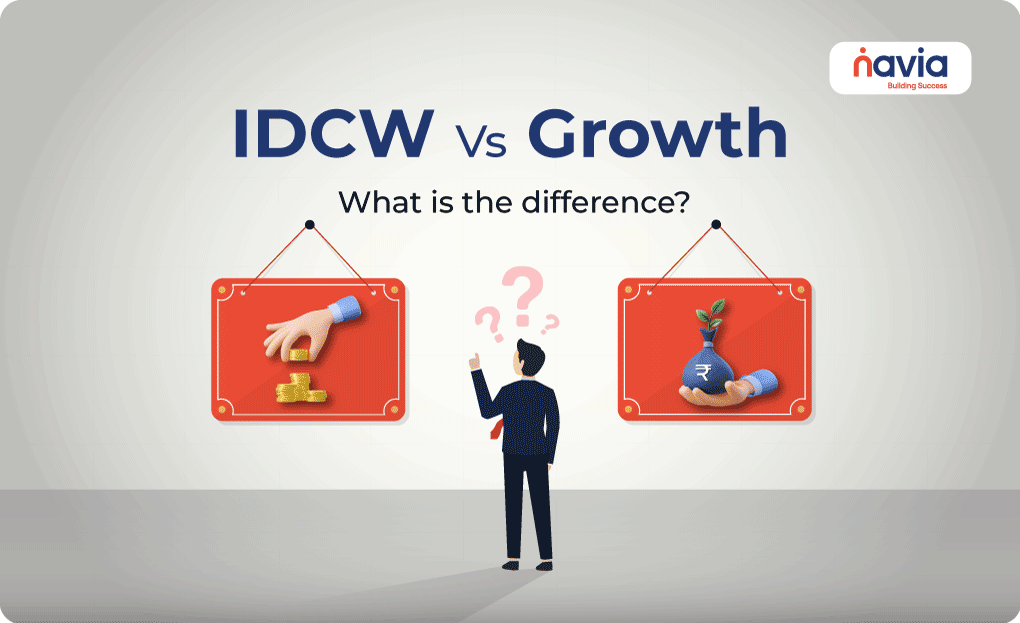
If you are planning to invest in mutual funds, it is necessary to understand the well-known types of funds available in the market. They are IDCW (Income Distribution cum Capital Withdrawal) and the other one is Growth. There are so many differences between these funds like duration, functionality and many more. This blog will guide you to understanding the difference between growth and IDCW in mutual funds that lead you to long-term financial goals.
💡 Quick Answer
IDCW (Income Distribution cum Capital Withdrawal) pays part of a fund’s profits out to you at intervals, so its NAV falls after each payout. Growth reinvests everything, so the NAV rises over time and you are taxed only on redemption. IDCW suits regular income, Growth suits long-term wealth.
What is IDCW in Mutual Funds?
IDCW is the abbreviation of Income Distribution cum Capital Withdrawal. It’s an option in mutual funds where investors receive payouts at intervals as decided by the fund house. The payouts can be in two forms, one is, profits/income that generated by the scheme another one is part of the investor’s own invested capital.
Key Features;
- Investors receive money at different intervals.
- After each distribution of money, the fund’s Net Asset Value (NAV) will decrease.
- There is no guarantee of payouts because it depends on the fund performance.
- Suitable for investors who are looking for regular income.
What is Growth in Mutual Funds?
Growth is the opposite of IDCW, because the fund doesn’t distribute any income to the investors. Instead, all earnings like dividends and capital gains are reinvested into the scheme.
Key Features;
- No payouts so return are reflected in the rise in Net Asset Value.
- It is ideal for achieving long-term goals.
- Tax-efficient fund because of the long run.
- Suitable for investors who don’t need regular income and aim for long-term wealth creation.
IDCW vs Growth in Mutual Funds
| Criteria | IDCW (Income Distribution cum Capital Withdrawal) | Growth |
| Distribution of income | Periodic payouts | No payouts |
| Net Asset Value | After each payouts NAV decreases | NAV increases over time |
| Taxation | Taxable in the year of distribution | Taxable only on redemption |
| Investment goals | Passive investors who seeking regular income | Long-term wealth builders |
| Example | You invest ₹1,00,000 in the IDCW scheme. The fund earns a 10% return in year, which means ₹10,000 profit. The fund decides to distribute ₹6,000 as income (dividend). The remaining ₹4,000 stays in the fund. Now your investment value is ₹1,04,000, and you receive ₹6,000 in your bank account. | You invest ₹1,00,000 in the Growth scheme. The fund earns a 10% return in year, which means ₹10,000 profit. The ₹10,000 profit is not paid out to you. It is reinvested back into the fund. Now your investment grows to ₹1,10,000. No cash in hand until you redeem your units. |

Growth Vs IDCW – Which is Better?
IDCW vs Growth mutual funds, which is better, is a tricky question. Because each one has unique features and advantages, but you can choose it according to your financial goals and income needs.
The major difference between IDCW and Growth is how the returns are distributed to the investors. If you are seeking a regular income, you must choose IDCW, and your goal is achieving long-term wealth creation, Growth is the best option. However, selecting the best one completely depends on the investor’s needs.
Conclusion
Before investing in mutual funds, you have to evaluate your financial goals, tax implications, time horizon and also the IDCW and growth difference. Because both IDCW and Growth offer a variety of benefits to the investors. For the investors who are looking for consistent income they can choose IDCW and for the investors who want to grow their wealth over time can choose Growth option.
If you are in doubt about finding the best one for you consult a financial advisor or use a trusted investment platform like Navia to make informed decisions.
Key Takeaways
- IDCW distributes income at intervals decided by the fund house; the payout can include part of your own invested capital.
- The Growth option makes no payouts at all, reinvesting dividends and capital gains back into the scheme.
- A fund’s Net Asset Value falls after every IDCW payout, while the Growth NAV rises over time.
- IDCW is taxable in the year of distribution; Growth is taxable only when you redeem your units.
- Choose IDCW if you need regular income and Growth if your goal is long-term wealth creation.
Do You Find This Interesting?
We’d Love to Hear from you-

Frequently Asked Questions
What is the main difference between IDCW and Growth options?
IDCW pays the investor the part of profits as a regular income, while Growth reinvests all profits to increase the fund value over time.
Is IDCW taxable?
Yes. Because it is added to your income and taxed as per your income slab.
Does Growth option have any tax?
Yes, if you redeem your unit’s capital gains tax will be applicable.
Which option gives better returns?
Growth usually gives better long-term returns due to compounding, provided no regular income NAV is needed.
Is NAV different for IDCW and Growth plans?
Yes, Growth is generally higher since returns are reinvested, while IDCW NAV may drop after each payout.
DISCLAIMER: Investments in the securities market are subject to market risks, read all the related documents carefully before investing. The securities quoted are exemplary and are not recommendatory. Brokerage will not exceed the SEBI prescribed limit. Full disclaimer: https://bit.ly/naviadisclaimer