

How to Show Stock Market Income in ITR: A Complete Beginner’s Guide (AY 2026-27)
If you bought or sold shares, mutual funds, or F&O contracts during FY 2025-26, many of these transactions may be reflected in your Annual Information Statement (AIS) and other tax records available on the Income Tax e-filing portal. It is therefore important to report your income correctly in your Income Tax Return (ITR).
In this blog let us break down, in plain language, about how stock market income is taxed in India, which ITR form applies to you, and how to report it step by step — whether you’re a long-term investor, a swing trader, or someone who dabbles in Futures & Options.
💡 Quick Answer
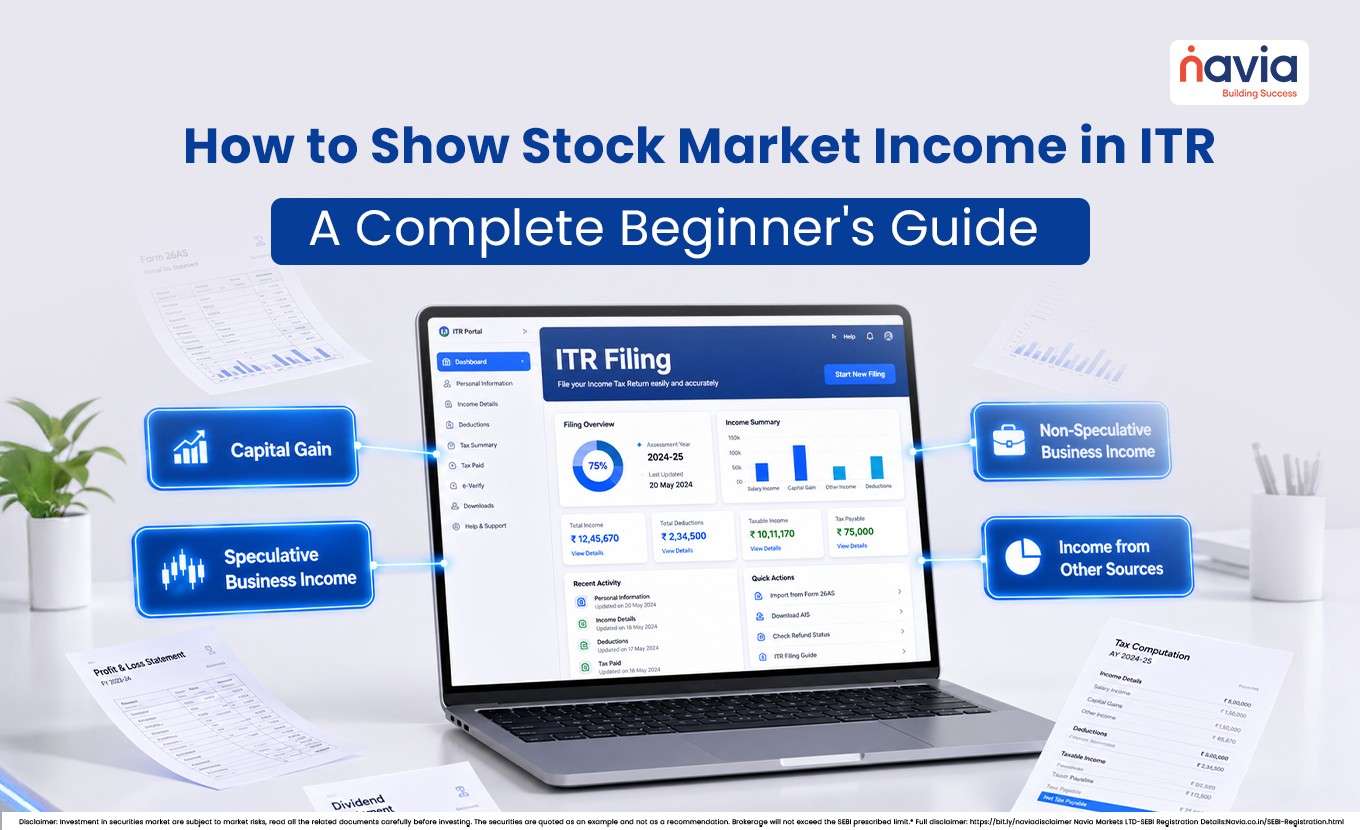
Stock market income falls into three tax buckets: capital gains (delivery-based investing), speculative business income (intraday), and non-speculative business income (F&O) — plus dividends under “Income from Other Sources.” Each maps to a specific ITR form and schedule, and paying STT does not settle your income tax. Reconcile your broker statements against your AIS before filing, and consult a Chartered Accountant when tax-audit rules may apply. Figures here are as stated in the article; verify current provisions on the Income Tax Department website.
Why You Must Report Stock Market Income?
Every time you buy or sell shares through a broker like the Navia All in One App, that transaction is reported to the Income Tax Department. Securities Transaction Tax (STT) is collected on eligible securities transactions through your broker and deposited as per applicable regulations. But here’s the part beginners often miss: STT is not the same as income tax. Paying STT does not mean your tax obligation is over — you still need to calculate and report the resulting gain or loss in your ITR and pay tax on it separately, if applicable.
If there’s a mismatch between what your broker reports in the AIS and what you declare in your ITR, it may result in a query or communication from the Income Tax Department seeking clarification. So the safest approach is to reconcile your trading statements before you file.
The Three Categories of Stock Market Income
One of the key concepts to understand is how different stock market activities are classified for tax purposes:
| Type of Activity | Tax Category | Reported Under |
|---|---|---|
| Buying and holding shares/mutual funds, then selling later | Capital Gains | Schedule Capital Gains |
| Buying and selling the same stock within the same day (no delivery) | Speculative Business Income | Schedule Business/Profession |
| Trading in Futures & Options (F&O) | Non-Speculative Business Income | Schedule Business/Profession |
A lot of tax notices trace back to exactly this confusion — someone reports their F&O profit or loss inside the capital gains section instead of the business income section, and the return gets kicked back as incomplete or inconsistent. Getting the classification right at the start avoids that headache entirely. Let’s look at each category in detail below.
1. Capital Gains — For Delivery-Based Investors
If you buy shares or equity mutual fund units and take delivery (i.e., they sit in your demat account before you sell), any profit or loss you make is a capital gain or loss. The tax you pay depends entirely on how long you held the investment.
Short-Term Capital Gains (STCG) — Section 111A If you sell listed shares or equity mutual funds within 12 months of buying them, the profit is short-term. STCG on which Securities Transaction Tax (STT) has been paid is taxed at a flat 20%, a rate that has applied since 23 July 2024 and continues for FY 2025-26 (AY 2026-27).
Long-Term Capital Gains (LTCG) — Section 112A If you hold listed shares or equity mutual funds for more than 12 months, the profit is long-term. LTCG is taxed at a flat 12.5%, but you get an exemption of up to ₹1.25 lakh in a financial year — only the amount above this threshold is taxed.
Example: Say you invested in a company called XYZ Ltd. through the Navia All in One App. You sold some shares after 8 months for a profit of ₹90,000 (short-term) and other shares held for 18 months for a profit of ₹1.6 lakh (long-term). Your STCG of ₹90,000 is taxed at 20%. Your LTCG of ₹1.6 lakh gets the ₹1.25 lakh exemption, so only ₹35,000 is taxed at 12.5%.
Important trap: The Section 87A rebate (which makes income up to ₹12 lakh tax-free under certain conditions) does not apply to STCG or LTCG taxed under Sections 111A and 112A. This means even a modest capital gain can create a tax bill, regardless of your total income level.
Set-off of losses: A short-term capital loss can be adjusted against both short-term and long-term capital gains. A long-term capital loss can only be adjusted against long-term capital gains. Unused capital losses can generally be carried forward for up to 8 assessment years, provided you file your ITR by the due date.
2. Speculative Business Income — For Intraday Traders
If you buy and sell the same stock on the same trading day without taking delivery, this is intraday trading, and under Section 43(5) of the Income Tax Act, it is classified as speculative business income — not a capital gain.
This means intraday profits are not taxed at a flat rate. Instead, they are added to your total income and taxed according to your regular income tax slab rate.
Important: Speculative losses (from intraday trading) can only be set off against speculative gains — they cannot be adjusted against your salary, capital gains, or other business income. They can be carried forward for up to 4 assessment years, but only against future speculative income.
3. Non-Speculative Business Income — For F&O Traders
Trading in Futures & Options (F&O) is treated differently from both capital gains and intraday equity trading. It is classified as non-speculative business income, reported in Schedule BP (Business/Profession) of your ITR, along with a profit and loss statement.
F&O profit or loss is added to your other income and taxed at your applicable slab rate — there’s no special flat rate.
Turnover calculation matters: A common misunderstanding is treating the full value of every F&O contract bought and sold as “turnover.” That’s not how it works. For tax purposes, you add up the profit or loss from each individual trade as a positive number — regardless of whether that trade was a gain or a loss — and then add any premium collected from options you sold. So a trader with ₹40,000 in gains on one trade and ₹25,000 in losses on another has a turnover of ₹65,000 for that pair, even though the net result is only ₹15,000. This turnover figure is one of the factors considered while determining whether the tax audit provisions may apply, so getting it right matters more than it might seem.
Set-off of losses: F&O losses (being non-speculative) can be set off against almost any other income — including capital gains and other business income — but generally not against salary income in the same year. Unabsorbed losses can typically be carried forward for up to 8 assessment years.
Dividend Income: Don’t Forget This One
If you hold shares or mutual fund units, any dividend you receive is fully taxable in your hands at your applicable income tax slab rate, and must be reported under “Income from Other Sources.” If your dividend income from a single company exceeds ₹10,000 in a year, the company typically deducts TDS at 10% before paying you — but this doesn’t mean the income is tax-free; you must still report the gross dividend and claim credit for the TDS already deducted.

Which ITR Form Should You File?
Picking the right ITR form is where most people go wrong. Here’s a simple way to match your situation to the correct form:
| Your Situation | ITR Form |
|---|---|
| Only LTCG under Section 112A, up to ₹1.25 lakh, no losses to carry forward [Eligibility for ITR-1 depends on the applicable Income Tax Rules for the relevant assessment year] | ITR-1 (Sahaj) |
| Any STCG, LTCG above the exemption limit, or capital losses — but no business income | ITR-2 |
| Intraday trading and/or F&O trading (business income), with or without capital gains | ITR-3 |
| F&O/intraday income only, opting for presumptive taxation under Section 44AD | ITR-4 |
Put simply: pure delivery-based investing through the Navia All in One App keeps you in ITR-2 territory, while any amount of intraday or F&O activity pushes you into ITR-3, since tax law treats that activity as running a business rather than making an investment.
Step-by-Step: How to Actually Report It?
- Download your statements. Get your consolidated capital gains statement and, if applicable, your F&O/intraday profit-and-loss statement from the Navia All in One App.
- Check your AIS and Form 26AS. Log in to the income tax e-filing portal and download your Annual Information Statement and Form 26AS. Reconcile these against your own records — any unexplained mismatch can trigger a query.
- Choose the correct ITR form based on the table above.
- Fill Schedule Capital Gains (for delivery-based investing): enter STCG and LTCG separately. For LTCG under Section 112A, you’ll need scrip-wise detail — each stock, quantity, cost, and sale value — in Schedule 112A.
- Apply grandfathering, where applicable under the Income Tax Act. If you bought shares before 1 February 2018, your cost of acquisition for LTCG purposes is calculated using a special grandfathering rule that protects gains earned before that date.
- Fill Schedule Business/Profession (for intraday and F&O income): report your turnover, expenses (like brokerage and STT, which are legitimate deductions), and net profit or loss.
- Report dividend income under “Income from Other Sources,” and check that any TDS deducted is reflected correctly.
- Set off and carry forward losses as applicable, following the rules described above for each category.
- Pay any self-assessment tax due, submit the return, and e-verify it (usually via Aadhaar OTP) within 30 days of filing — an unverified return is treated as if it was never filed.
Due Dates for AY 2026-27
Subject to notifications issued by the Income Tax Department, the due dates for AY 2026–27 are generally:
- Salaried investors filing ITR-2 (capital gains only, no business income): 31 July 2026
- Traders filing ITR-3 without a tax audit (F&O/intraday income): 31 August 2026
- Taxpayers requiring a tax audit under Section 44AB: 31 October 2026
- A belated return can still be filed up to 31 December 2026, but you lose the right to carry forward capital or business losses if you miss the original due date.
Missing the deadline also attracts a late fee under Section 234F — ₹5,000, or ₹1,000 if your total income is below ₹5 lakh — plus interest on any unpaid tax.
Investors should verify the latest due dates on the Income Tax Department website before filing.
Do You Need a Tax Audit?
This is a genuinely technical area, and the rules depend on your turnover, the proportion of digital transactions, whether you’ve reported a loss, and your history with presumptive taxation under Section 44AD. As a general guide:
- If your F&O/intraday business turnover is high Tax audit requirements under Section 44AB depend on several factors, including turnover, the nature of transactions, and applicable provisions of the Income Tax Act. As these requirements may change from time to time, investors should refer to the latest Income Tax guidelines or consult a Chartered Accountant to determine whether a tax audit applies.
- Even at lower turnover, an audit can still become necessary if you report a loss (or profit below the presumptive rate) and you had opted for presumptive taxation in a recent preceding year but are not opting for it this year.
- Failing to get a mandatory audit done attracts a penalty under Section 271B.
Because these thresholds and exceptions change with each Budget and depend heavily on your specific facts, it’s best to confirm your exact position with a Chartered Accountant rather than relying on a general rule of thumb.
Common Mistakes to Avoid
- Assuming a small profit isn’t worth mentioning. Every trade you make, however small, is already visible to the tax department through your AIS. Leaving it out of your return doesn’t make it disappear — it just creates a gap between what the department already knows and what you’ve declared, which is exactly the kind of gap that draws attention.
- Filing ITR-1 despite having a short-term gain. Taxpayers reporting short-term capital gains may generally be required to file ITR-2 or another applicable form, depending on their overall income and eligibility.
- Filing F&O profit or loss under Capital Gains instead of Business Income. These are two different tax regimes with different rates and rules. F&O belongs in Schedule Business/Profession under ITR-3, never in the capital gains schedule — mixing them up is one of the fastest ways to end up with a defective return.
- Paying tax on the entire LTCG amount. The first ₹1.25 lakh of long-term gains in a year is exempt — it’s easy to overlook this and calculate tax on the whole gain instead of just the amount above the threshold.
- Trying to adjust intraday losses against F&O profits, salary, or capital gains. Speculative losses live in their own bucket — they can only reduce speculative gains, nothing else.
- Leaving out brokerage and STT as expenses. If you’re reporting F&O or intraday income as business income, these trading costs are genuine, deductible expenses — skipping them only inflates your taxable profit unnecessarily.
- Treating the due date as a soft deadline. Beyond the late fee, filing after the due date can permanently cost you the ability to carry forward this year’s losses into future years — a consequence that’s often far more expensive than the fee itself.
Conclusion
Reporting stock market income correctly comes down to identifying which of the three categories your activity falls into — capital gains, speculative business income, or non-speculative business income — and using the matching ITR form and schedule. Delivery-based investing is generally simpler to report than business income from intraday or F&O trading, provided the applicable capital gains schedules are completed correctly.
When in doubt — especially around tax audit applicability or complex loss set-offs — it’s worth consulting a qualified Chartered Accountant before you file, since an incorrect ITR form or a missed schedule can lead to a defective return notice or a lost opportunity to carry forward losses.
Key Takeaways
- Stock market income splits into capital gains (delivery), speculative business income (intraday), and non-speculative business income (F&O) — each with its own rules and ITR schedule.
- Paying STT does not settle your income tax; reconcile your broker statements with your AIS and Form 26AS before filing.
- Pick the right form: delivery-based investing usually means ITR-2, while any intraday or F&O activity pushes you into ITR-3.
- Loss set-off rules differ by category, and filing by the due date is what preserves your right to carry losses forward.
- Related reading: how bonds are taxed in India, NRI equity taxation, and inheritance tax in India.
Did you find this article helpful?
Your feedback helps us write better content.

Frequently Asked Question
Do I have to pay tax on stock market profits even if TDS or STT was already deducted?
Yes. STT is a transaction-level tax and is separate from income tax. You still need to calculate the capital gain or business income and pay income tax on it, after adjusting for any TDS already deducted.
Which ITR form should a salaried person use if they only invest in shares and mutual funds?
In many cases, eligible salaried investors reporting capital gains without business income may file ITR-2. The appropriate form depends on the taxpayer’s overall income and eligibility criteria for the relevant assessment year.
Is intraday trading taxed the same way as delivery-based investing?
No. Delivery-based investing is taxed as capital gains at flat STCG/LTCG rates. Intraday trading is taxed as speculative business income at your regular income tax slab rate.
Can I set off my F&O trading loss against my salary income?
Generally, no. F&O losses (non-speculative business losses) can be set off against most other income heads, but not typically against salary income in the same year.
What happens if I don’t report small stock market gains in my ITR?
Even small transactions are reported by your broker to the Income Tax Department through the AIS. An unreported gain can create a mismatch and may result in a notice, regardless of how small the amount is.
Do I need a Chartered Accountant to file my ITR if I trade in F&O?
It’s not always mandatory, but if a tax audit applies to your situation, only a practising Chartered Accountant can conduct it. Given the complexity of turnover calculation and audit thresholds, professional guidance is generally advisable for active F&O traders.
DISCLAIMER: This article is intended for general educational purposes only and does not constitute tax, legal, or investment advice. Tax rates, exemption limits, ITR forms, and due dates are subject to change through Finance Bills and government notifications. Please verify the latest provisions on the official Income Tax Department website and consult a qualified Chartered Accountant or tax professional before filing your return or making any investment decision. Investments in securities markets are subject to market risks; please read all scheme-related documents carefully. Tax provisions referred to in this article are based on publicly available information applicable to AY 2026–27 and may be amended through future Finance Acts, CBDT notifications, or judicial interpretations.
Investment in securities market are subject to market risks, read all the related documents carefully before investing. The securities quoted are exemplary and are not recommendatory. Full disclaimer: https://bit.ly/naviadisclaimer.