

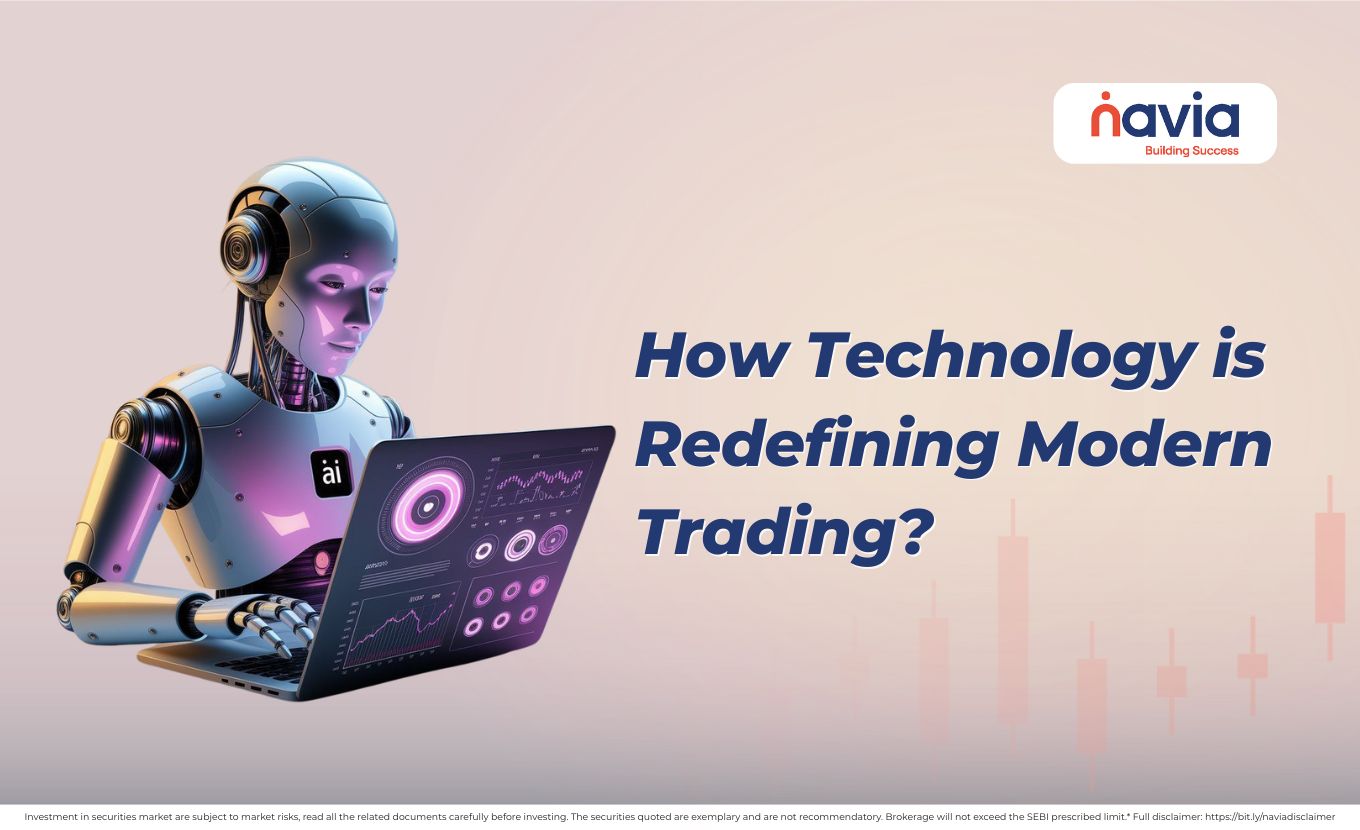
The Digital Revolution: How Technology is Redefining Modern Trading
- The Evolution: From Pit Trading to Pocket Trading
- Key Pillars of Modern Trading Technologies
- Enhancing Precision: Trading and Technical Analysis
- The Benefits: Why Tech Wins
- The Risks: The Double-Edged Sword of Trade and Tech
- The Future: What’s Next?
- Conclusion
- Frequently Asked Questions
The financial markets undergone a consequential shift over the last decade, which means the elimination of the days of chaotic trading floors, shouting brokers and hand-written ledger entries. In 2026, the meeting of trading and technology has created a landscape that is faster, more accessible, and more data-driven than ever before.
From the AI (Artificial Intelligence) to high-frequency execution, trading technologies are no longer just for wall street elite; they are the backbone of every retail investor smartphone app. Let’s explore how the marriage of trade and tech is empowering investors and what the future holds for this digital frontier.
The Evolution: From Pit Trading to Pocket Trading
The most visible impact of trading and technology is the democratization of market access. Historically, trading required a physical presence or a direct line to a floor broker. But today, the entire market is considered a mobile interface. This shift hasn’t just made trading more convenient; it has made it more transparent.
The real-time price updates, instant order execution, and live news feeds are ensuring a retail trader in a small town has access to the same basic information as a hedge fund manager in a skyscraper.
Key Pillars of Modern Trading Technologies
If we talk about trading technologies, we are referring to a sophisticated ecosystem designed to minimize latency and maximize efficiency. According to ICFM India, the role of technology extends across several critical areas, some of them are given below;
Algorithmic and High-Frequency Trading (HFT)
Algorithms are now executing most trades in global markets; these programs follow pre-defined sets of instructions (based on time, price or quantity) to place trades at speeds impossible for a human. It increases market liquidity and narrows “bid-ask” spreads, lowering costs for everyone.
Artificial Intelligence and Machine Learning
AI is the ultimate “co-pilot” for traders, because machine learning models can scan millions of data points like social media sentiment, weather patterns, and historical price action to predict the short-term movements. This deep integration of trade and tech allows you to predictive modeling that was science fiction just twenty years ago.
Blockchain and Tokenization
The backend of trading is also changing day by day; the blockchain technology is being used to speed up settlement times. While traditional trades once tool two days (T+2) to settle, distributed ledger technology is pushing the industry toward “instant settlement” that reduces counterparty risk.
Cloud Computing
The computing power required to process market data is now hosted in the cloud; this allows retail brokers to provide high-speed platforms to millions of users simultaneously without the system crashing during high-volatility events.
Enhancing Precision: Trading and Technical Analysis
The most significant impact for the individual trader is the synergy between trading and technical analysis. In the past, drawing a Fibonacci retracement or calculating a moving average required manual plotting on graph paper.
The arrival of technology has turned technical analysis into an automated science, so these modern charting platforms allows traders to:
| Backtest Strategies | Before risking real capital, a trader can run their strategy against ten years of historical data in seconds to see if it would have been profitable. |
| Automated Pattern Recognition | Software can now alert a trader at the moment a “Head and Shoulders” or “Three Inside Down” pattern forms across hundreds of different stocks. |
| Custom Indicators | Coding languages like Pine Script or Python allow traders to build their own bespoke indicators, tailoring their trading and technical analysis to their specific risk appetite. |
The Benefits: Why Tech Wins
The benefits of technology in trading can be summarized in three words: Speed, Accuracy, and Cost.
🔸 Speed: Orders are executed in microseconds, that ensures you get the price you see on your screen.
🔸 Reduced Human Error: Emotions like fear and greed are the enemies of a trader. So, the automation will remove the “finger-flinch” and ensure that stop-losses are triggered exactly when they should be.
🔸 Lower Costs: The rise of zero-brokerage models is a direct result of technology. Which means, brokers no longer need thousands of humans to process trades; they can pass those savings on to the consumer.
The Risks: The Double-Edged Sword of Trade and Tech
We just saw that technology provides incredible advantages, but remember it also introduces new risks. Over-reliance on technology can lead to “Flash Crashes”, where algorithms feed off each other’s selling pressure, causing a vertical drop in prices within seconds.
Furthermore, the “digital divide” remains a concern. Professional firms with “co-location” services (placing their servers in the same building as the stock exchange) still have a microsecond advantage over retail traders. In the world of trading technologies, even a millisecond can be worth millions.
The Future: What’s Next?
Actually, we look toward the end of the decade; the evolution of trading and technology shows no signs of slowing down. We are moving toward;
| Quantum Computing | It will be able to solve complex risk-management equations that current computers cannot handle. |
| Social Trading | Platforms where you can automatically “copy-paste” the trades of successful investors through a synchronized API. |
| Voice-Activated Trading | Executing complex multi-leg option strategies using simple voice commands to an AI assistant. |
Conclusion
The fusion of trade and tech has fundamentally changed the DNA of the financial markets. It has transformed trading from an exclusive club into a global utility. By mastering trading technologies and integrating automated trading and technical analysis into your routine, you are no longer just a participant in the market—you are a high-tech operator.
However, technology is a tool, not a crystal ball. The most successful traders in 2026 are those who combine the lightning speed of trading and technology with the timeless discipline of sound financial logic.
Do You Find This Interesting?
We’d Love to Hear from you-

Frequently Asked Questions
What technology is used in trading?
In 2026, the trading ecosystem is a high-tech powerhouse. The primary technologies include:
🔹 Artificial Intelligence (AI) & Machine Learning: Used for predictive analytics, sentiment analysis of news, and automated strategy refinement.
🔹 Algorithmic Trading Systems: Software that executes trades automatically based on pre-defined criteria (like price or time).
🔹 High-Frequency Trading (HFT) Servers: Specialized hardware located near stock exchanges to execute thousands of trades in milliseconds.
🔹 Cloud Computing: Platforms like Google Cloud provide the massive processing power needed for real-time data analysis.
What is the role of technology in trading?
Technology acts as the “accelerator” and “stabilizer” of the markets. Its roles include:
➨ Democratization: Mobile apps have made trading accessible to everyone, not just institutional giants.
➨ Precision: It removes human emotion (fear and greed) from the execution process through automation.
➨ Efficiency: Automated “Smart Order Routing” finds the best possible price across different exchanges in nanoseconds.
➨ Transparency: Real-time data streams ensure that all participants have access to the same market information simultaneously.
What is the 3 5 7 rule in trading?
The 3-5-7 rule is a disciplined risk management framework designed to protect your capital and ensure long-term survival in the markets.
◆ 3% (Max Risk Per Trade): Never risk more than 3% of your total trading capital on a single trade.
◆ 5% (Max Total Exposure): Do not have more than 5% of your total capital at risk across all open positions at any one time.
◆ 7% (Profit Target/Limit): Aim for at least a 7% profit on winning trades to maintain a healthy risk-to-reward ratio or stop trading for the day/week if your total portfolio value drops by 7% (a “Circuit Breaker”).
How to use AI technology in trading?
In 2026, retail traders use AI in three main ways:
1. Market Scanning: Use AI-powered “scanners” to filter thousands of stocks in seconds to find specific patterns (like a Bearish Mat Hold).
2. Sentiment Analysis: Use Natural Language Processing (NLP) tools to read thousands of news headlines and social media posts to gauge if the market mood is “Bullish” or “Bearish.”
3. Backtesting: AI can simulate your trading strategy against 20 years of historical data in minutes, telling you exactly how many times it would have won or lost.
What is technical analysis in trading?
Technical analysis is the study of historical price action and volume to predict future price movements. It is based on the philosophy that “the chart knows everything.”
➣ Core Principle: It ignores a company’s financial health (fundamentals) and focuses purely on supply and demand as shown on a chart.
➣ Tools: It uses candlestick patterns (like the Three Inside Down), support and resistance levels, and mathematical indicators like Moving Averages or the RSI (Relative Strength Index).
➣ Goal: To identify trends and “high-probability” entry and exit points.
DISCLAIMER: Investment in securities market are subject to market risks, read all the related documents carefully before investing. The securities quoted are exemplary and are not recommendatory. Full disclaimer: https://bit.ly/naviadisclaimer.